That corresponds to chapters 7 through 12 in the book.
There’s less hype this time except for the presence of part one in the October issue; Part two was not mentioned in Campbell’s Things to Come and wasn’t on the issue’s cover. Who is James H. Schmitz by the way? I don’t know!
But that doesn’t mean that nothing happened in this installment!
We see the aftermath of the assassination attempt of Hannis Gruer and learn what constitutes “sociology” on Solaria. We meet Gruer’s stand-in as Head of Security and watch as Baley gets to go walkabout across the planet. We also learn an uncomfortable amount about Solarian childrearing and witness a second, seemingly impossible assassination attempt on this world so filled with three-laws robots!
Here’s John W. Campbell’s blurb that precedes this installment!
Second of Three Parts. Lije Baley was investigating a murder. Usually, an alibi proves physical impossibility; on robot-dominated Solaria, a different question arose. Is a robot’s conditioning “physical” or “psychological” impossibility? And is there any such thing as “psychological impossibility”? And if it exists for robots, does it for humans…?
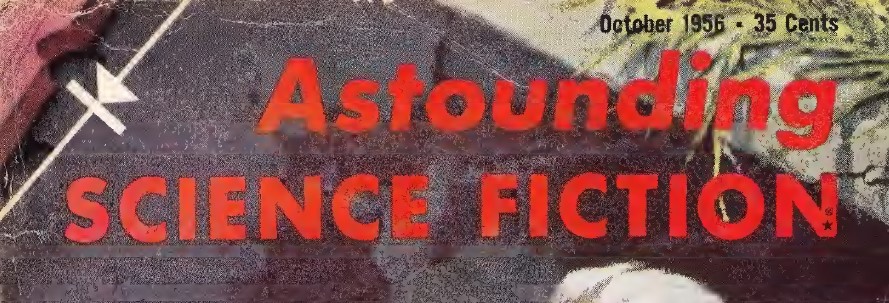
Astounding Science Fiction November 1956
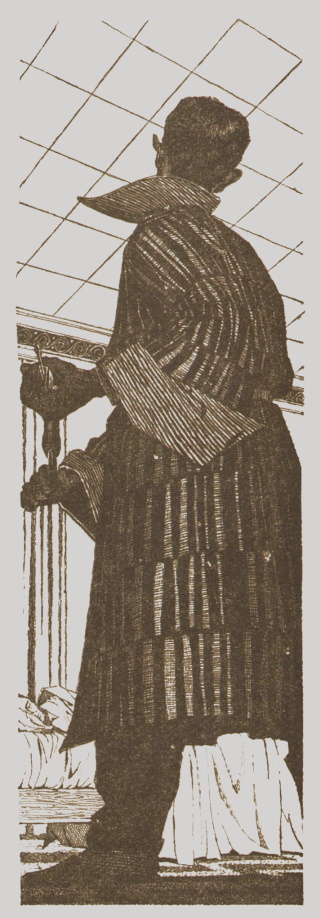
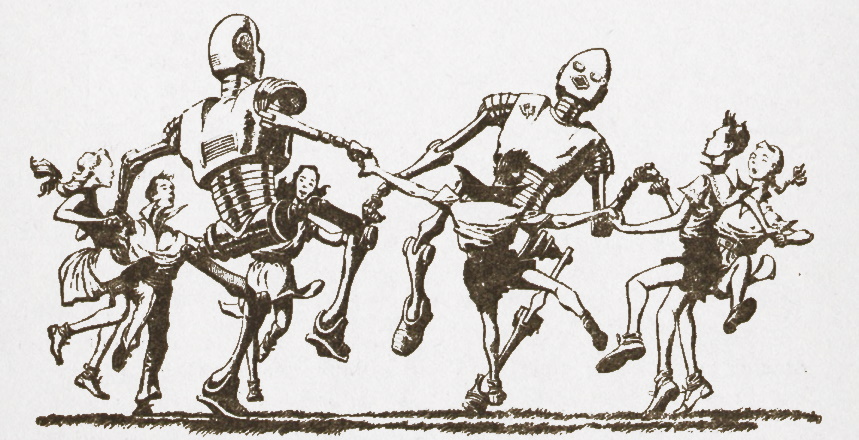
The illustrations this time are again by H. R. Van Dongen.
The available scans were not great, but I cleaned up the images as much as possible. If I keep this up, I may need to learn a lot more about that process.
Season 3, Episode 19: coming soon to anywhere the finest podcasts are sold!
Resources
Asimov, Isaac. “The Naked Sun, part 2” Astounding Science Fiction, November 1956, pp. 96-151.
In our last episode, we reached the end of The Caves of Steel. In our next episode, now in post-production, we continue our trip through the Robot Novels with The Naked Sun. We’re joined as our latest special guest by Joseph’s old friend Andy who has no discernable social media presence.
Asimov serialized The Caves of Steel in Galaxy Science Fiction because the editor, Horace Gold, suggested the idea of a human detective with a robot partner.
But three years later Asimov was increasingly interested in writing popular science and hadn’t published anything with John W. Campbell in a while. He decided to return to his roots and The Naked Sun was serialized in Astounding.
And Campbell did his best to capitalize on the famous author’s return. The month before its first segment ran The Naked Sun dominated Campbell’s “In Times to Come” column which highlighted coming attractions. Here’s what he had to say.
On the cover of next month’s issue, you’ll see Mr. Lije Baley, Earthman detective, coming out from underground into the light of The Naked Sun. Isaac Asimov’s new serial is bringing Elijah Baley and his robot partner, Daneel, on another detecting mission. But while the surface activity is that of determining who killed a man when it was self-evidently impossible, the real and important problem Baley has to solve is far more complex. Essentially, it is… “Which Way Is UP? Which way is forward?”
And this time, the problem lies on one of the Outer Planets; agoraphobic Elijah Baley has to solve a problem under the conditions least endurable to him — out under The Naked Sun
In this section, Baley is assigned to a murder case on Solaria, the newest of the Spacer worlds. He’s reunited with R. Daneel and we see him struggling with his agoraphobia in planes, spaceships, automobiles, and also in a big fancy house built just for him. We also learn about the murder and meet Gladia (pronounced gla-DEE-ah) Delmarre who is destined to become a major character and helps put the naked in The Naked Sun.
Here are the opening pages and the remaining illustrations by H. R. Van Dongen.
Season 3, Episode 17: coming soon to the aether near you!
Resources
Asimov, Isaac. “The Naked Sun, part 1” Astounding Science Fiction, October 1956, pp. 8-62.
Episode 15 of Season 3 dropped this morning and episode 16 is already in post-production. in it, we’ll be finishing up The Caves of Steel, reading and discussing the third and final installment that ran in Galaxy Science Fiction in December 1953.
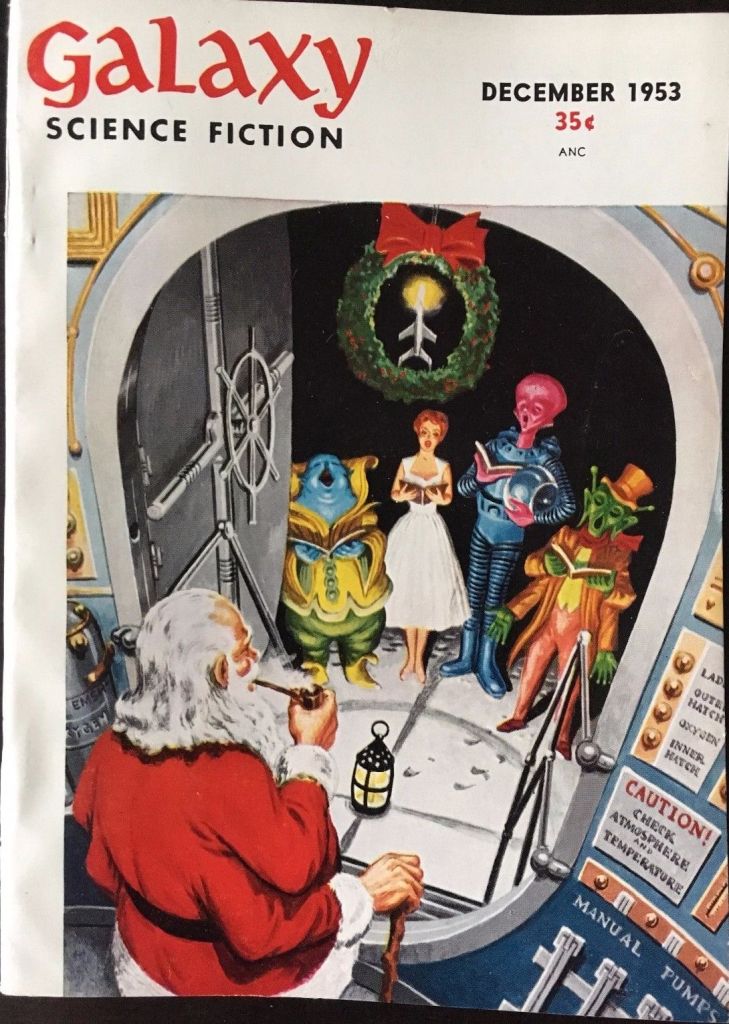
Our novel is not featured on the cover again, this time passed over for a nice holiday-themed illustration. Galaxy, evidently had a series of those.
In this concluding installment, Jessie confesses to conspiracy, Lije and Daneel play bad cop, uncomfortably robotic cop with a suspect and Baley cracks the case!
Here’s the promotion for this installment of The Caves of Steel from Galaxy’s November Issue.
Ed Emshwiller provides the artwork and we once again open with a two-page spread.
And here’s the rest of the synopsis if you want to refresh your memory about what’s already happened before you read the last installment or listen to our next episode.
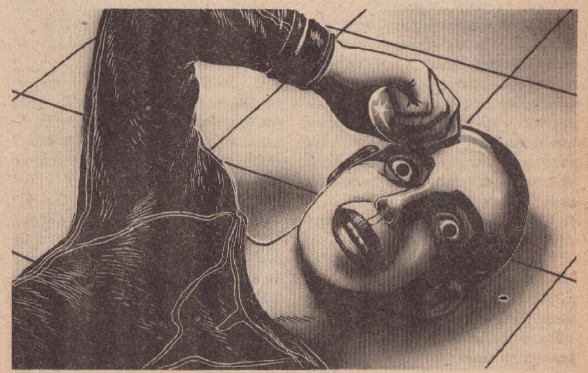
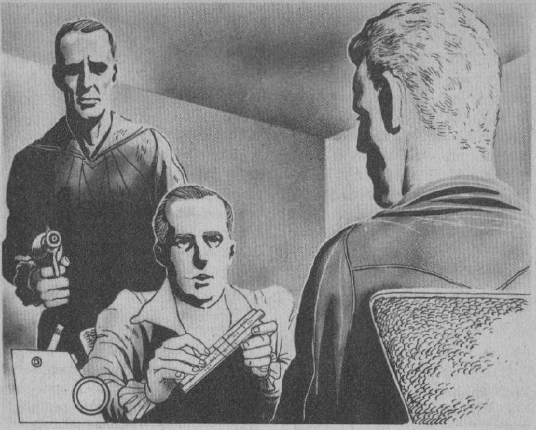
And here are the remaining illustrations from the story. Below we see Daneel closing on Clousarr during the interrogation (left), and R. Sammy as a murder vic… uh… property damage (right). We should keep our legal terms straight.
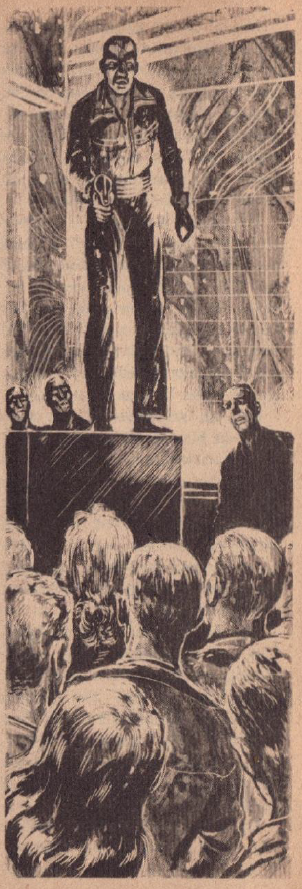
The final image shows Baley projecting the crime scene for Daneel and the commissioner.
We’re not recording our next episode until Saturday, but if you’re reading ahead, we’ll be discussing chapters 8-13 of The Caves of Steel, corresponding to the second installment that was published in Galaxy Science Fiction in November 1953.
Galaxy SF, 11/1953
It’s an interesting issue. Asimov didn’t score the cover this time. The cover references the non-fiction piece about the famous experiment that saw complex amino acids generating spontaneously when the conditions on primordial Earth were recreated in a laboratory.
Also of interest is “Galaxy’s 5-Star Shelf.” which reviews a compilation of Olaf Stapledon’s work, the non-fiction Man in Space by Heinz Haber, Second Stage Lensman by E. E. (Doc) Smith, Against the Fall of Night by Arthur C. Clarke and Second Foundation. In that last review, Groff Conklin calls the now-completed Foundation Trilogy “Our first great sociological space opera.” He compares it favorably with Smith’s Lensman series saying, “…Asimov’s work, based as it is on fairly sound social principles and the activities of fairly normal human beings, has a pressing sense of reality that Smith’s fairy tales lack…” He concludes “it is a thoroughly satisfying and adult play of the scientific imagination.”
But back to The Caves of Steel. Here’s the promotion for this installment in Galaxy’s October Issue.
And here are some pages from the story.
i
I’m particularly liking the opening two-page spread, with artwork once again by Ed Emshwiller. It depicts the encounter in Chapter 8. The synopsis is nicely done as well and continues for the entire next page. Here’s the remainder in case you want to remind yourself of the last installment before continuing to read this one.
Finally, here are the rest of the illustrations from the story. We have Lije and Daneel leaving Space Town (top right), traveling through a power plant (left), and Daneel being examined by Dr. Gerrigel, a roboticist.
We just recorded our latest episode last night and we’re back to reading the works of the Great and Glorious Az.
We’re thrilled to announce that, by popular demand, we’ll be reading the Robot Novels beginning at the beginning with The Caves of Steel. That’s my go-to novel if I want to introduce someone to Asimov’s work.
This novel was written at a time when Asimov was trying to get away from being a “one-editor-writer” and so he was working with, among others, Horace Gold of Galaxy Science Fiction. Gold had serialized The Stars, Like Dust in Galaxy under the title Tyrann and he was anxious to serialize another. He suggested a novel about robots, but Asimov declined. Robots, thought Asimov, were for short stories; the ideas wouldn’t carry an entire novel.
So Gold suggested that Asimov write a detective story where the detective had a robot partner and Elijah Baley and R. Daneel Olivaw were born. John W. Campbell had always claimed that a science fiction mystery story was a contradiction-in-terms and Asimov wanted to prove him wrong. The Caves of Steel became Asimov’s most successful book up to that point.
But first, it was serialized in Galaxy Science Fiction in October, November, and December of 1953. For this episode, we’re reading the first installment which corresponds to chapters 1-7 in the book. If you’re interested in reading The Caves of Steel as it first appeared, you can find that issue of Galaxy here courtesy of Archive.org but either way, you can enjoy the original artwork by Ed Emshwiller right here. Our episode will be out in a few days!
Getting caught up on these, still: Spoiler Alert! You know what to do!
That’s a crazy opening! C14 tries to commit suicide. I guess it didn’t take long for the mental health of the Cleon’s to become an issue. Maybe they should have let C11 live a bit longer and tried again.
Personal Shields Can Come in Handy.
He doesn’t die, but the young lady gardening runs away from him.
Funeral. For whom? “Faith is a sword forged in the fires of the infinite.” These ladies remind me of the Sisterhood of Karn from Doctor Who.
This is an odd sequence. It looks like some things are launched from the funeral which impact on a gas giant, making it all wibbley wobbly. The funeral must be taking place on one of the moons. Shift to Demerzel watching remotely.
Sexy time for C13. The Cs have a Kinetic field. Maybe Junior didn’t try to commit suicide after all. But he sure scared the crap out of that girl.
Demerzel interrupts sexy time. Brother Day is needed.
“Proxima Opal has passed.” That must be who the funeral was for. There is debate about her successor in the Conclave. It’s basically the political version of technobabble but the Cs aren’t happy about a possible candidate. Something about “Primary Octavo.” Unsurprisingly there’s a religious dimension to the Cs claim to rule.
“Luminism” must be a religion. Primary Octavo states that only individual beings have souls, excluding the Cs. No souls for you! Why not counter with the Cleons having a single soul? That makes the dynastic succession that much stronger. None the less it threatens their rule.
Back to Salvor and the Anacreonians.
The Anacreonians claim they want a navigation module. Salvor finally shows some indication of being smart. But “If you were going to kill me, you’d have done it already” reminds me of a bunch of things, not the least of which is Clara in “Deep Breath” (Doctor Who), which was a lot better.
Salvor and Phara go through the gate. “If she isn’t back within a watch, we’ll raze your city to the ground,” which wouldn’t take that much.
The Anacreonians are acting like terrorists.
Salvor sees the boy, but Phara does not.
Using the Vault to incapacitate Phara was smart.
“The stories about Salvor Hardin? They usually begin here. The warden and the ghost.”
We get a Direct refutation of old Hardin. Abbas says “Violence is the last refuge of the incompetent.” Salvor calls it “an old man’s doctrine.”
Questions about the plan.
Abbas: “If you were better at math, you’d know that repeated luck was more than just luck, Salvor.” Maybe. Except that random events can cluster in a way that seems non-random to our brains.
Back to Trantor. We meet Shadowmaster Olbrecht. C14 wants the name of the girl in the garden. Was he trying to manufacture a meet-cute with a faux suicide attempt?
Salvor is channeling Rosencrantz and Guildenstern are dead with the coins. Does she have some kind of mental powers?
Neutron bombs. 50% of the population on Anacreon died off within a week, 20-30% in the remaining year. But the use of neutron bombs changes a lot of assumptions; most of the infrastructure should be intact.
Salvor seems to intuit things about Phara. She wants to die. She wants everyone to die. Larken Keaen was the greatest hunter of Anacreon, so Phara must be the Grand Huntress of Anacreon.
Hologram Hari? Finally! But no, not that one.
The Outer Kingdoms are starting to fray away from the Empire. “Seldon all but gave you a to-do list and you ignored him!”
It’s even clearer that the “middle throne” is the actual emperor. I can’t believe these guys are a Kiwanis Club. President-Elect, President, and Immediate Past President.
Arguments about the plan. “I may be an outlier, Lewis, but I’m not the one screwing up the plan!” Lol, even though I’m feeling a bit sorry for Lewis.
Kubbra Sait is excellent. Real gravitas. “A weapon is only as good as the man who’s wielding it.” The music is briefly reminiscent of a motif in Doctor Who.
Trantor again. Gardener girl is Akuta Something? C14 is being a dick to her even as she’s being kind.
“If you’re not dead within the hour, have a kilogram of these sent to my quarters.”
Salvor has a vision of Seldon’s library. There’s THAT kid with THE knife. We’ve been seeing images of Raych.
Then they tell us what they’ve already shown in case we didn’t understand it.
Churchill from Doctor Who is a statistician. Thousands working. No results after 30 years? Claims the predictive models of Seldon are “counter factual.” Brother Day is having none of it. Lee Pace is fantastic here as he yells a statistician to death. Probably.
The philosophical divide seems to be couched as “Free will” vs. “predestination” rather than “Great Man” vs. “Bottom Up.” Although maybe that’s the same thing.
C13 gives 12 a rash of crap for his actions in episode 1. An almost complete repudiation. The discomfort Brother Dawn felt with the executions comes home to roost. “I will save our legacy.” Demerzel reinforces C13. “Certainly now the empire will no longer be rent by impulsive action.” He probably doesn’t get the sarcasm.
We see Dorwin. He’s sent to investigate the communications buoy and told to pay a visit to the Foundation. “The Empire will not be kept in the Dark.” Wowd Dowwin doesn’t sownd wight thow.
Meanwhile C14 is spying on Akuta using a drone that looks like a dragonfly. Creepy, but she doesn’t seem to mind.
Phara makes an argument that they really want the navigation module. To relocate from Anacreon. “You can’t negotiate with someone who’s willing to set the board on fire.”
Salvor thinks there’s a bigger picture that she’s missing. Reassessing is a sign of smart. She puts it together that the Vault is connected to Hari.
The Anacreonians are preparing to raze the city such as it is. Like a strong wind couldn’t do that.
“And the beginning of the end, as befitting its name, took place on Terminus.”
And in a Marvelesque precredits scene, a ship approaches Gaal Dornik’s escape pod.
You know how this works. Joseph’s Random thoughts about Episode 3, no post podcast revelations this time. Simultaneously published at ComicsTheUniverseAndEverything.net.
Cleon 1 with Demerzel 400 years previous. He’s dying and wistful, annoyed that although they’ve started the clone dynasty his ego will not persist. “Your continuity is assured,” Demerzel tells him. It looks like she gets to hold things together while Cleon 2 grows up.
19 years after the StarBridge bombing. The timing is interesting given that we’re just off the 20th anniversary of 9/11. Are we now looking at an analog of contemporary politics?
Sounds like it is Dusk’s final Day, foreshadowed by Cleon I’s flashback.
“The world is starting to see me at a distance” is a nice turn of phrase.
What is “ascension” exactly?
We parallel the passing of the torch metaphor with the tailor somewhat obviously.
Dusk is still questioning what happened with Anacreon and Thespis and pondering if he has anything left to say. “About anything. About whether any of this is truly within our power to control” juxtaposed against an image of Dusk casually swiping through holograms of planets.
They’re still thinking about Seldon though. Dusk is interested in preserving the “last remnants” of C1’s dream. Boy. This is maudlin.
Dusk is C11, called “the Painter” on the pedestal where his bust will go.
The final gift is a visit to the remnant of the StarBridge. The three wax nostalgic about C1 and Dawn claims “We will build something greater in his honor. For you.”
Demerzel looks stricken and weepy. They destroy the final remnant of the StarBridge as they leave. Dusk nods his assent but it’s thematically opposed to what he wants. All that debris entering the atmosphere is going to look spectacular though.
It’s not clear; is that glowing thing a permanent memorial?
Jump Ball?
Dusk visits the gestation chamber, “Even if Seldon wasn’t right there is something unnatural in that.” Then he paints a final piece of the mural. Is it Dawn and Day raising a newly ascendant Trantor?
Demerzel: “You are enough. It’s just that you always leave me.”
“You have grown into our greatness, Brother Dawn, now Day.” “Brother Darkness.” Holy crap. He senses something is wrong with the baby as Demerzel pushes him toward the light.
If it wasn’t obvious already, “ascension” is a euphemism for a ritualistic suicide.
This half of the episode is filled with imagery of Demerzel as a driving force, including carrying 11 to his final rest and transferring his ashes to the baby.
17 years later, Day has the Mural erased. Demerzel looks on but can’t stop it. There’s a real thread here about repudiating the past.
“We ignore the dead at our peril.”
Cut to the colonists arriving on Terminus. The Vault is already there. Young Salvor spends a lot of time staring at it. Evidently, they don’t have Apple TV+ on Terminus. They barely have walls. Lots of hints that Salvor is wise. “She’s aware.” I’m not convinced. Show, don’t tell.
There’s got to be a better way to test the field around the Vault than to torture a bird.
Warden again. Versus mayor? I don’t like it.
Something is up with the field. And we see Granite Hari foreshadowing Hologram Hari.
The Encyclopedists’ conversations are odd. There’s little point in writing about base 10 and not base 12 and there’s little point in writing about the sundial as opposed to the water clock. I assume that they’re planning for the fall of civilization rather than writing the encyclopedia at this point, but isn’t the point of the encyclopedia to WikiHow all this stuff so everybody after the fall has that information?
See? Smug.
And why does Louis Pirenne look so damn smug here?
Also, this whole thing is dumb. Where will the survivors be? Freaking everywhere! What if the survivors are on a planet with no water? What if the planet circles more than one sun? That way lies madness. If the survivors are thrown back into complete barbarism they’re not going to have libraries anyway! And probably they’ll just be thrown back to the point where they think digital watches are a pretty neat idea.
And you CAN preserve every innovation because you’re writing a damn book! You have hundreds of years!
The field is expanding. Now with nose bleeds!
But Salvor is special in case you missed episode 1.
Hugo is supposed to be pretty likable, and either gives beer to children or tricks them into unloading his ship.
A sky full of spilled coins is a lovely image. But they’re using a telescope to look into space during the day. Tell me how that works or I’m going to assume that you screwed up the lighting.
There’s a kid and he’s running with a knife. That can’t be good. Teach your children not to run with scissors before you worry about water clocks.
Also, that looks like the knife that Rayce used to “kill” Hari. Significant? Maybe?
Hologram Hari appears in the Vault, No, not that one.
Anacreonian ships are appearing. And that thing seems more or less like an ordinary telescope. How does it work?
“Grow up Lewis!” Lol. Like in the books, he has more faith in the Empire than is warranted.
Jon’s observation: Salvor wants to know how much violence the colony can muster. In the book, Salvor is famous for “Violence is the last refuge of the incompetent.”
Mari pulls out the prime radiant and shows it to Salvor. Like maybe she can understand it with absolutely no training. MATH ISN’T MAGIC! And having an individual as part of the plan undermines the idea of psychohistory or convinces me that this character they want to present as smart isn’t actually smart.
For a person who’s supposed to be famously quotable, “Different is not the same as special” is a bit of a sophomore slump.
“The Empire feared Hari because he could forecast the future. But in reality, all he was doing was examining the past.” No.
There’s that kid with the knife again. How is he connected to Maybel?
Also, “Vulcan” is better than “Vulcanian” but I prefer “Anacreonian” to “Anacreon.”
“The ghosts of the dead… surround us. And they are hungry for what’s ours.”
⭐⭐⭐⭐
Rating: 3.5 out of 5.
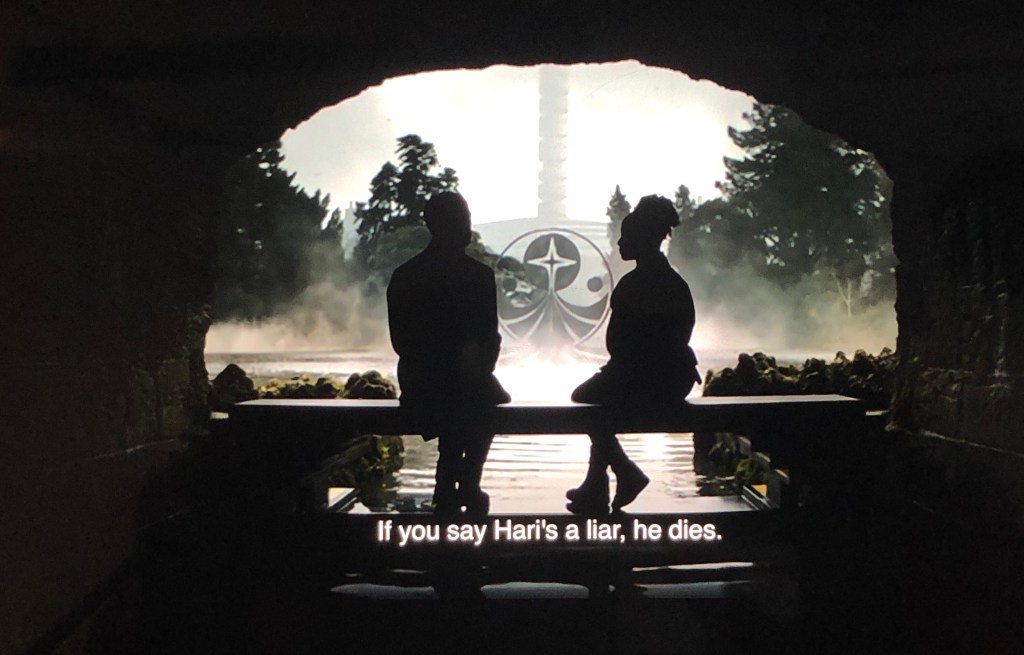
All Images from Foundation on Apple TV+ or Astounding Science Fiction.
If you followed my “Watching Loki” posts on Comics, The Universe and Everything, you know what this is. Comments, thoughts and predictions as I watch the episode or maybe as I watch it again. Stuff I think is interesting. Not a review or even an essay, although I’ll give my immediate impression at the end. I’m doing these this time as I’m preparing for the Stars End podcast but they won’t appear here until a couple of days after the newest episode is dropped. Maybe there’s even a bit of stuff I didn’t mention on the Podcast.
So, without further ado, here are my thoughts on the first two episodes.
S1E01 The Emperor’s Peace
Visually stunning. The opening reminded Joanne of the time travel scenes in ST4 but with much better graphics.
Partway through the figures, look as if they are made of sand and are eroding. That’s a nice visual indication of what is to come.
Wow, this looks good. But Star’s End isn’t at the edge of the Galaxy. Also, it doesn’t have an apostrophe.
Now, this looks like Star Wars with the land speeder.
There’s a creature called a Bishop’s Claw. As the kids approach “the Vault” I realize this is Terminus and we’re in for some non-linear storytelling.
Hmmm. “Kier.” “Gia.” “Poly.”
So, we meet Salvor Hardin before any other main character. Poly calls her “Warden.” I don’t know what that means. But the vibe here is strangely religious for Terminus and the Vault is altogether too mystical.
That is one impressive library.
“We have to remember the past and the ones who caused it all… A mathematician. A martyr. A murderer. And the most important player of all, Hari Seldon.”
There’s a sweet moment between Hari and Raych. Odd maybe, given what’s coming.
86,960,947 is prime.
86,960,957 is prime.
86,960,971 is prime.
86,960,987 is prime.
Gaal has to leave Synnax. “On Trantor, I’ll be safe.” More religion.
On the jump ship. Gaal meets Jerril who seems helpful. He mentions prayer stones.
There are odd scarred humans(?) attending to the passengers.
We see Gaal’s obvious genius when she talks about the gravity generators. “I won a math contest.”
Interesting visual for preparing for the jump and the jump itself. Gaal wakes up in the middle. That’s not supposed to happen according to Jerril. Only spacers can endure that without being driven insane.
The space elevator is impressive and nicely takes the place of Gaal’s trip to the tower and longing to see Trantor from Space. But here she seems more of a refugee than a tourist.
The projection of Brother Day has the same sand-like texture as the opening. That links the Empire to the erosion we saw earlier.
Caskets. From a “kerfuffle” between Anacreon and Thespis.
14 hours to descend and Gaal sees Trantor from space. Exposition 20:38.
We see the mural and Brother Day who is called Empire. That’s a nice device personifying the Empire so directly. Asimov did that especially well in the Mule story with both the Empire and Foundation.
And we’re shown the empire as evil assholes quite dramatically. They’re paranoid about “Raven” Seldon and are harsh censors. No ambiguity here. No shades of gray.
Brother Dawn learns a hunting song but it’s actually about “a boy’s first time with a woman.”
Day is again shown to execute people for tiny transgressions.
We see Demerzel. Nice visual Day, Dawn, and Dusk taking a bite in unison.
Gaal wants to see the Seer church on Trantor.
86,963,537 is prime.
86,963,549 is prime.
86,963,563 is prime.
86,963,567 is prime.
86,963,573 is prime.
It’s not praying. When Gaal’s nervous she “counts primes.”
Gaal meets Hari. The mathematics starts to bother me here. “Kalle’s Ninth Proof of Folding.” Gaal solved Abraxas. That’s evidently how she won her “math contest.” That has religious overtones (see below). And no one thought to use the ninth proof in five hundred years.
Kalle writes poetically so “serious scholars don’t read her.” But “reading between the lines” she’s talking about “rings of integers in non-Archimedean local fields.” I think that kind of hangs together based on a quick Google search but it’s far from something that normal folks could glean by “reading between the lines.”
There are shades here of Hardy and Ramanujan. The show has given us two unspeakably brilliant mathematicians and it’s important that one of them is a young lady of color. And they certainly sound like mathematicians here… “There’s a non-zero chance… but it’s not a number worth discussing.”
We get a quick definition of Psychohistory true to the books. Might be word for word. But we lose the sense that mathematics is hard work.
The prime radiant is cool, but it reinforces the “math is magic” theme.
“You know math is never just numbers. In the wrong hands, it’s a weapon in the right hands, deliverance.” “Stealing is a mercy.”
The Ancreonians give Day a weapon while the Thepians give a book of ablution honoring the peace. Exposition on the disagreement.
Subtle messages in the gifts. 36:47. Day and Dusk are training Brother Dawn.
Gaal goes to the Seer church. “The heretic and I will talk.” The religion on Synnax is extreme and all-consuming. The floor is covered with water.
Gaal in water. A dream or a memory of the removal of her prayer stones. Also, is it foreshadowing of the end of episode 2? The water is clearly a symbol of the Synnax religion. Gaal’s face turns out of the water as she has the prayer stones removed.
Those hoods they put on prisoners are brutal.
Courtroom scene. And Sig!
It “can only be proved to another mathematician conversant in ordinal analysis.”
Damn, Harris is great! And intense!
This loses a lot of the mathematics from the book. And Seldon “thanks the gods.”
Jerril tries to bribe Gaal and gives her the Prime Radiant. The Empire threatens to kill her. There’s water surrounding them as he tempts her to disavow the mathematics.
Spectacular shot.
She was awake on the jump ship; she is special.
The prime radiant again reinforces the idea that mathematics is magic.
Back to the trial. Encyclopedia Galactica. Saving our story.
It’s a nice moment when Gaal gets to speak truth to power.
It bothers me that one of the terrorists looks middle eastern. The other one doesn’t but still.
The orbital tower is falling snapped off the top. On Earth, the geosynchronous orbit is 22,300 miles. Stretched out that’s most of the way around the planet. (C = 24,900 miles).
Nice attention to detail; the fake sky is pixelated as the tower smashes through it.
I think they profoundly underestimated the devastation the fall of the star bridge would cause. Compare it to the size of the asteroid that killed the dinosaurs. This should be an extinction-level event.
“The tether wrapped around the planet like a Garrote.” Yup.
86,963,777 is prime.
86,963,791 is prime.
100 million deaths. Has Raych lost faith?
Lee Pace has a surprising amount of gravitas. More than he did playing Ronan which was overdone. It’s a lot subtler here. I would not have expected this watching Please Don’t Eat The Daisies.
Gaal bluffs Day. If you kill him the fall accelerates.
Seldon: “I see the value in difference, in the new.”
There’s something called a slow ship. A fundamental difference from the world in the stories.
“You lied.” “I hypothesized.” that’s pure Wrath of Khan stuff right there.
The seas on Synnax were rising. So Gaal Dorrnik here is a cross between Greta Thunberg and Srinivasa Ramanujan; a mathematical prodigy who wants to save her planet from destruction. The water doesn’t merely represent her home planet’s religion; there are a lot of levels here. On Synnax the rising water signals, one presumes, the growing threat of global warming AND the rampant anti-intellectualism that’s hastening the crisis.
Episode:
⭐⭐⭐⭐⭐
Rating: 4.5 out of 5.
S1E02: “Preparing to Live”
On a dwarf planet: a brutal takedown of a biohacking facility. And some torture to extract information.
Day (wanting to blame the Foundation): “Say they did it every hour on the hour until it becomes the air that we breathe.” These guys are the Bush administration.
800 odd days? Or 54 months?
Gail and Raych are like crazed weasels.
Then we have the Kobayashi Maru in a simulated cave. We get to see what a bishop’s claw looks like firsthand.
There were robot wars.
These assholes really are the Bush administration. More brutality. There is circumstantial evidence against the Anacreonian and Thepians. But that’s about it.
Brother Dusk is declining.
Gaal deposits an embryo and then talks to an engineer who refuses.
Dusk visits the Synnax priest. Wants to know if Gaal is a seer who can predict the future. Demerzel is injured on the way out. So not slow playing the Robot thing.
“The most advanced Math is like a sixth sense.” No, not necessarily.
Seldon seems to be using Tony Stark’s computer system.
Lots of aphorisms “Shame grows in darkness.”
But it’s notable here that Gaal is spending a lot of time swimming. She always swims in the dark. If the water is a metaphor for the religion on Synnax that says a lot. Not that this has been subtle. It isn’t.
Seldon never thought he’d be on the ship and he’s uncomfortable with the growing familiarity amongst the colonists.
Gaal says the mathematics is not complete. Rayce is upset.
Encyclopedia Meeting. Gaal is asking questions. This base 10 thing is a bunch of nonsense. It’s not the same thing as a different language. I get the point that they’re trying to make but damn it, that’s different. The writers must have scanned “The Crest of the Peacock” and didn’t understand it.
They’re shoehorning in as much math as they can. They either need to get a better consultant or listen to the good consultant they already have.
Demerzel repairs herself. We see she’s a robot.
Demerzel: “The rest of my kind didn’t die. They were destroyed by your kind.” Evidently, the “Robot Wars” weren’t very nice.
Dusk criticizes Cleon I (who has been stuffed) for arrogance. Not sure what the point of Taxidermy Cleon is, it’s odd.
“The Empire going to kill you,” says Dusk to the Anacreonian and Thepian ambassadors. But there’s plenty of reason to think Seldon is behind the Terrorist Attack
The Laundry. Yawn. Hari gets to make a speech.
“A theorem so abstract it might as well have been a prayer.” Damn it. Mathematics isn’t magic.
This handshaking thing is kind of trite.
Raych is out of sorts. Hari is trying to be gregarious and showing Raych to be a thief angers him.
Raych cries talking to Gaal in the holodeck.
Who’s really behind the star bridge? They don’t know. “The best face we can project outward now is one of strength.”
More brutality. Really over-the-top and disturbing and directed at people who aren’t responsible. These guys really are the Bush Administration.
Still, the little kid shows some humanity. Unfortunately, Demerzel tells him he’ll grow out of it.
A composite number means what? Raych “kills” Hari and takes something from behind Hari’s ear. Gaal is left in space counting primes (in the water yet again) and the episode ends? What the hell?
———-
Some thoughts from after we recorded the podcast. I think most people felt confused after this episode. In retrospect, I’m liking this episode more because it’s been so much fun to ponder what was going on in a Total Recall kind of way.
So, here’s a narrative that I think makes sense.
The key moment is when Gaal realizes that the math is incomplete. But here’s the thing: the math didn’t “have holes in it” because Hari didn’t finish. It was incomplete because he and Gaal are in the colony. We know from the books that predictions about the Foundation won’t work correctly if there are Psychohistorians on Terminus. They have to go.
So Hari realizes that he has to be murdered (or fake his death… something). He makes plans with Raych to do it. Then his personality shift, the wandering around the ship, reminiscing about his “son,” missing his favorite shirt, and awkwardly saying goodbye to people including the laundry workers all make sense as the actions of a condemned man or a man who’s planning suicide.
Raych’s behavior now makes sense too. Gaal gets the wet pneumatic tube treatment but she’ll still be gone. It explains his weepiness on the Holodeck during the sunset; he knows they’re not going to have those kids together. This also explains why Raych is suddenly so peevish with Hari.
The psychohistorians are now gone and the Foundation can develop as intended. This may not be right but it holds together, explains all the stuff that feels weird, and is consistent with the books. Where do we see Gaal again? I bet she’ll be central to founding the Second Foundation. Maybe Hari too. Eventually, we’ll learn that this was the ultimate plan all along.
⭐⭐⭐⭐
Rating: 3.5 out of 5.
Some Stuff From Wikipedia:
Abraxas (Biblical Greek: ἀβραξάς, romanized: abraxas, variant form ἀβρασάξ romanized: Abrasax) is a word of mystic meaning in the system of the GnosticBasilides, being there applied to the “Great Archon” (megas archōn), the princeps of the 365 spheres (ouranoi).[1] The word is found in Gnostic texts such as the Holy Book of the Great Invisible Spirit, and also appears in the Greek Magical Papyri. It was engraved on certain antique gemstones, called on that account Abraxas stones, which were used as amulets or charms.[2] As the initial spelling on stones was Abrasax (Αβρασαξ), the spelling of Abraxas seen today probably originates in the confusion made between the Greek letters sigma (Σ) and xi (Ξ) in the Latin transliteration.
Gnosticism (from Ancient Greek: γνωστικός, romanized: gnōstikós, Koine Greek: [ɣnostiˈkos], ‘having knowledge’) is a collection of religious ideas and systems which originated in the late 1st century AD among Jewish and early Christian sects.[1] These various groups emphasized personal spiritual knowledge (gnosis) above the orthodox teachings, traditions, and authority of traditional religious institutions. Viewing material existence as flawed or evil, Gnostic cosmogony generally presents a distinction between a supreme, hidden God and a malevolent lesser divinity (sometimes associated with the Yahweh of the Old Testament)[2] who is responsible for creating the material universe.[3] Gnostics considered the principal element of salvation to be direct knowledge of the supreme divinity in the form of mystical or esoteric insight. Many Gnostic texts deal not in concepts of sin and repentance, but with illusion and enlightenment.[3]
Anacreon (/əˈnækriən/; Greek: Ἀνακρέων ὁ Τήϊος; c. 582 – c. 485 BC)[1] was a Greeklyric poet, notable for his drinking songs and erotic poems. Later Greeks included him in the canonical list of Nine Lyric Poets. Anacreon wrote all of his poetry in the ancient Ionicdialect. Like all early lyric poetry, it was composed to be sung or recited to the accompaniment of music, usually the lyre. Anacreon’s poetry touched on universal themes of love, infatuation, disappointment, revelry, parties, festivals and the observations of everyday people and life.
As of today, 25 September 2021, Jon, Dan, and I have watched the first two episodes of Foundation and we’ve recorded Season 2 Episode 2 which starts our analysis!
There are some minor spoilers below, so beware!
One thing that seems to be a near-universal opinion is that the series looks great! I (Joseph) think it goes a bit farther than that. There’s some skillful use of imagery to tie the themes and moments together. This shot impressed me. When we see Gaal, there are frequent images of water. Water is tied closely to her home on Synnax and her religion, or rather, Synnax’s religion. In this scene, Jerril is trying to convince her to denounce psychohistory. Betray Hari, he’s telling her and you can go home. And here, with the two of them shrouded in darkness, with all of the water and all of the mist, is where he makes the case. Jerril is pushing the Empire’s interests and the spaceship and sun are central. Further in the background, those interests are tied to the star bridge. More on this soon!.
Here are each of our first impressions.
Jon: Very different from the book. They had a lot of exposition to do and they did it intelligently. I am left wanting to see what happens. I loved Sid in the courtroom scene! No twisting 😦
Joseph: Here’s my tweet from after the first episode.
Dan: We didn’t expect Hari to end up on the ship, either!
And what about episode 2? What do we think about everything else? You’ll have to listen to our next episode to find out! We look forward to seeing you!
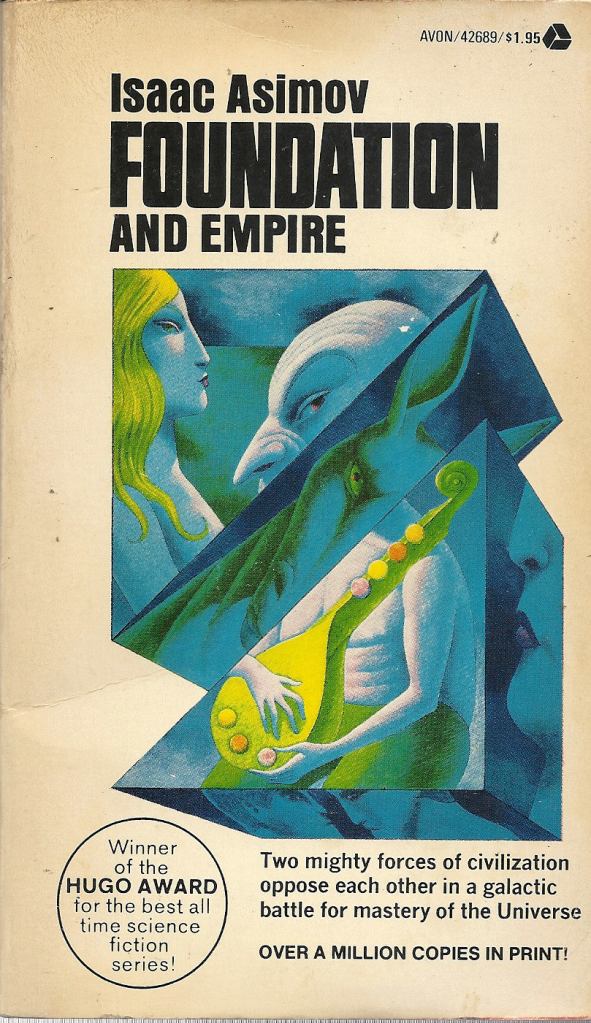
If you’re keeping up with the Stars End Podcast, Episode 8 has been out for about a week, and Episode 9’s release is imminent. In these two episodes, we discuss the entirety of “The Mule” as we know it from Foundation and Empire. If you’re reading along, of course, it’s pretty easy to find a copy of the book including on Archive.org.
If you want to read this story as it first appeared in Astounding Science Fiction, it appears in the November and December issues from 1945. Not-at-all coincidentally it’s broken up just as we did it on the podcast. The first installment covers the Foundation and Trader Worlds first learning about the Mule and then considering how to respond. It corresponds to Chapters 11 (Bride and Groom) through 18 (The Fall of the Foundation) and ends, as you might guess from the title, with quite a dramatic moment. The December installment covers the remainder of the story and completes the tale with a search for the Second Foundation. Asimov’s writing had gotten better here as evidenced by two nice touches; Mayor Indbur III on Terminus and Emperor Dagobert IX on Neotrantor are excellent personifications of their respective dominions.
As we’ve been seeing, Asimov changes very little from Astounding to the novels. As was the case with “The General” The obligatory Encyclopedia Galactica entry that serves as a prologue is absent, replaced in the first part, by this teaser, probably written by John W. Campbell.
First of two parts of Asimov’s first serial of the Foundation — and of the one factor that even Hari Sheldon could not predict — could not defend the Foundation against. The defenses were based on human psychology; The Mule was a mutant!
Unlike for “The General,” unfortunately, the layouts have largely reverted to rectangles and a lot of the images are tiny. We can hope they do a bit better in part two.
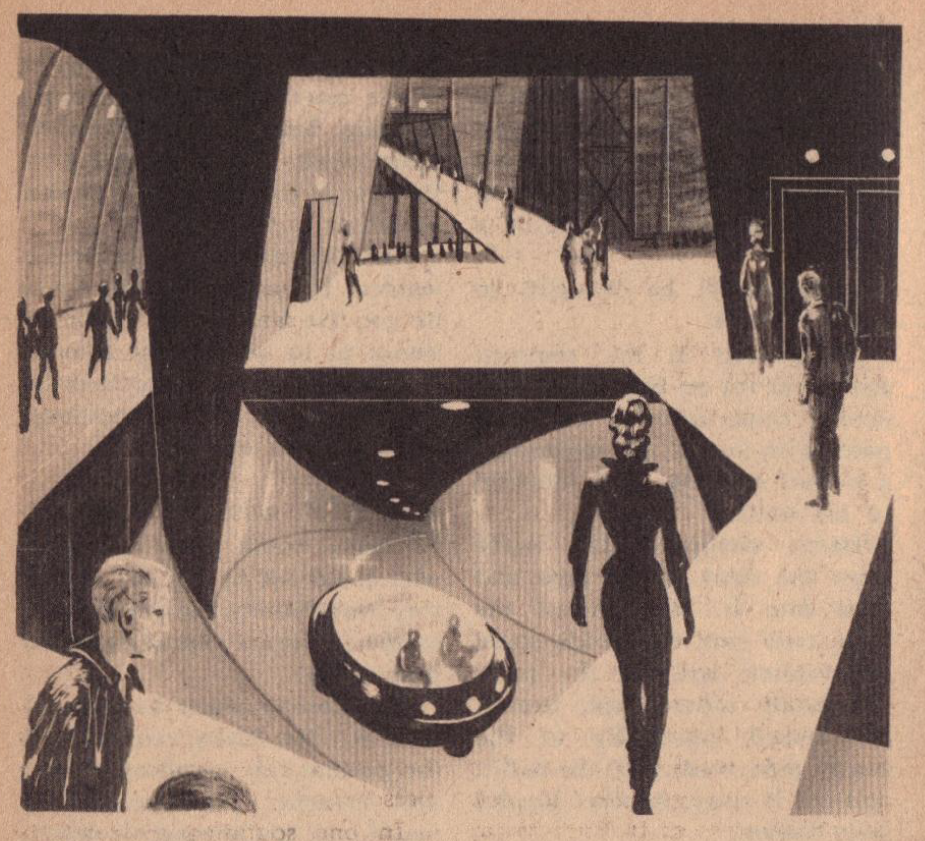
Once again there are some nice illustrations in both parts by Paul Orban. Unfortunately, the scans of these issues aren’t as clean as the previous installments have been so the image quality is uneven.
Second of two parts. Across the ruined, dying Galactic Empire , fleeing from a conquered Foundation, three frightened people and the hunted jester of the new conqueror, the Mule, sought the Second Foundation — the only hope, but it must be warned
That’s followed by a summary of part 1, which you can find here: Astounding Science Fiction, December 1945 if you’d like to read it. Paul Orban’s illustrations are below. They’re larger and more textured than the illustrations from Part 1.


























 Stars End: A Foundation Podcast