But first, it’s been a while; we’ve missed you, and we hope you feel the same. I’ve said it before: having a day job is no fun. And that’s the crux of it; we got bogged down with work, and the post-production got away from us.
That’s especially true in my case. Turns out that the parts of my brain that I podcast and/or blog with overlap with the bits of my brain that I use in teaching.
Plus Jon and I are trying our hand at a politics podcast.
The good news is that there’s lots of stuff on its way! Immediately, we’re gearing up for season 3 of the Foundation teevee series! We took a quick look at the trailer, and that will be out pretty soon after S5E21!
There’s a lot more in the can, and we’ll try to clear some of the backlog before we dive into Season Six of Stars End!
We’ve seen this before from a pulp SF fiction perspective, (or will again in the actual flow of time) with The Caves of Steel and The Naked Sun. The Good Doctor serializes a novel in Galaxy Science Fiction to convince himself that he can sell material to somebody other than John W. Campbell and then returns home to Astounding for the next novel in the trilogy.
And so we land in Book #007 in the Asimov canon. After wading through the quagmire of “Second Novel Syndrome” in The Stars Like Dust it seems like Isaac is back on solid ground.
The Currents of Space is indeed a return to form and we’ll be discussing chapters 1 through 6 in our next episode. That’s almost the first installment from Astounding Science Fiction, from October 1952; Campbell squeezed in an extra chapter on us.
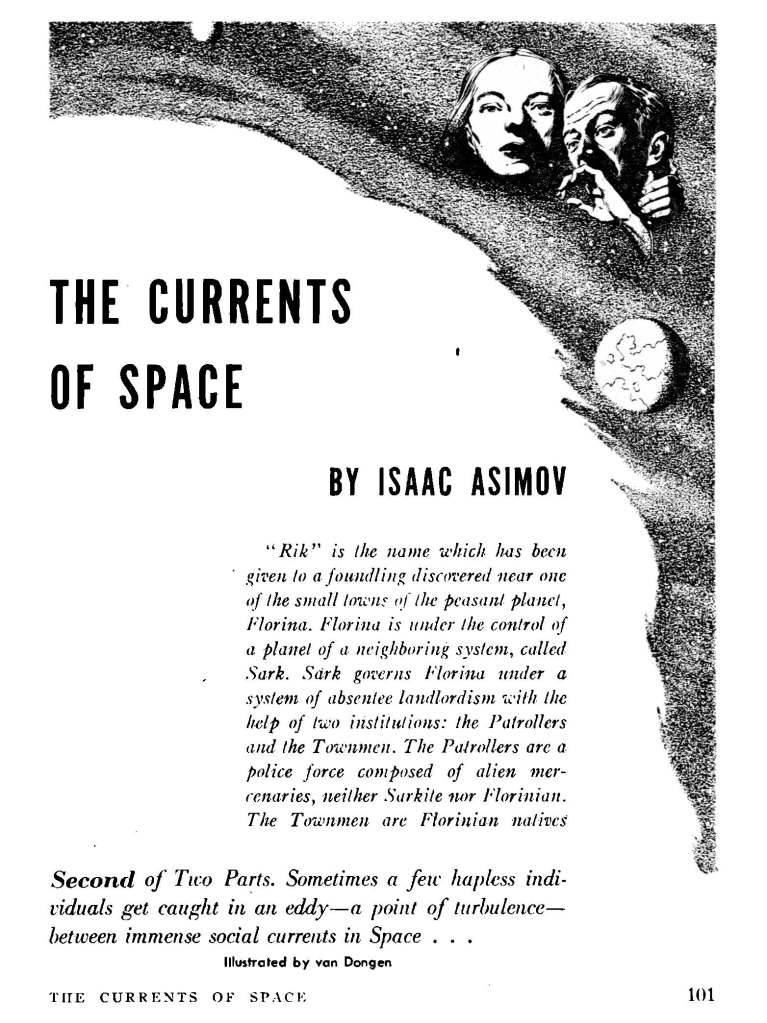
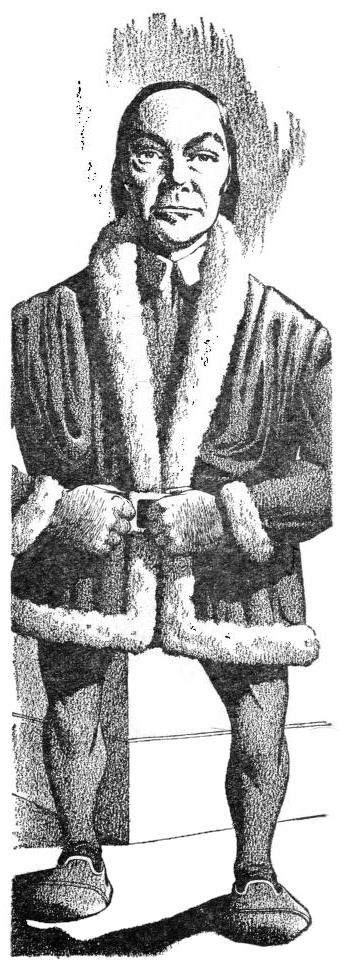
Both the cover and the interior illustrations for this installment in Astounding were created by H. R. van Dongen whose work we previously enjoyed with The Naked Sun. You can enjoy these while we wrap up post-production on the episode.
One of the fundamental properties of Horace Gold’s Galaxy Science Fiction, especially at the outset, was ambition. Gold was determined that Galaxy wouldn’t be just another SF magazine, but an excellent one. We’re only on Galaxy’s sixth issue as we reach the final installment of The Stars Like Dust ―, or Tyrann as it’s called in the magazine. Gold’s editorial for the issue concerns a readers’ poll about the magazine’s future and what will come as a result. The Five Star Shelf column will remain unchanged. An issue of self-contained stories will follow the conclusion of a serial. Stories with themes “too adult, too profound or revolutionary in concept” to be published elsewhere will continue. The editorial culminates with Gold’s plan for the magazine’s artwork which he describes thusly.
…we have been experimenting both in art and in technical processes, since we believe that a rebirth in science fiction should not be breeched by art of the forceps school. This month marks another experiment: halftone reproduction of photographs and wash drawings. This could not be done without trying out our technical processes. As we extend control, we will present other improvements that are now being worked on.
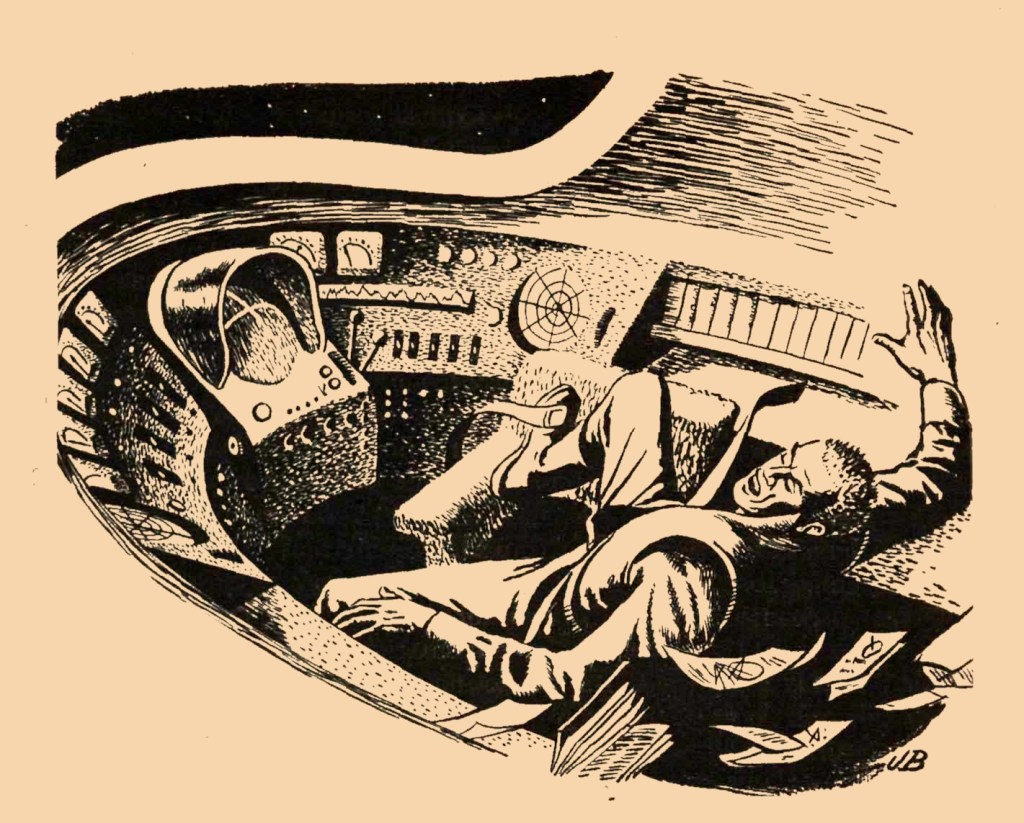
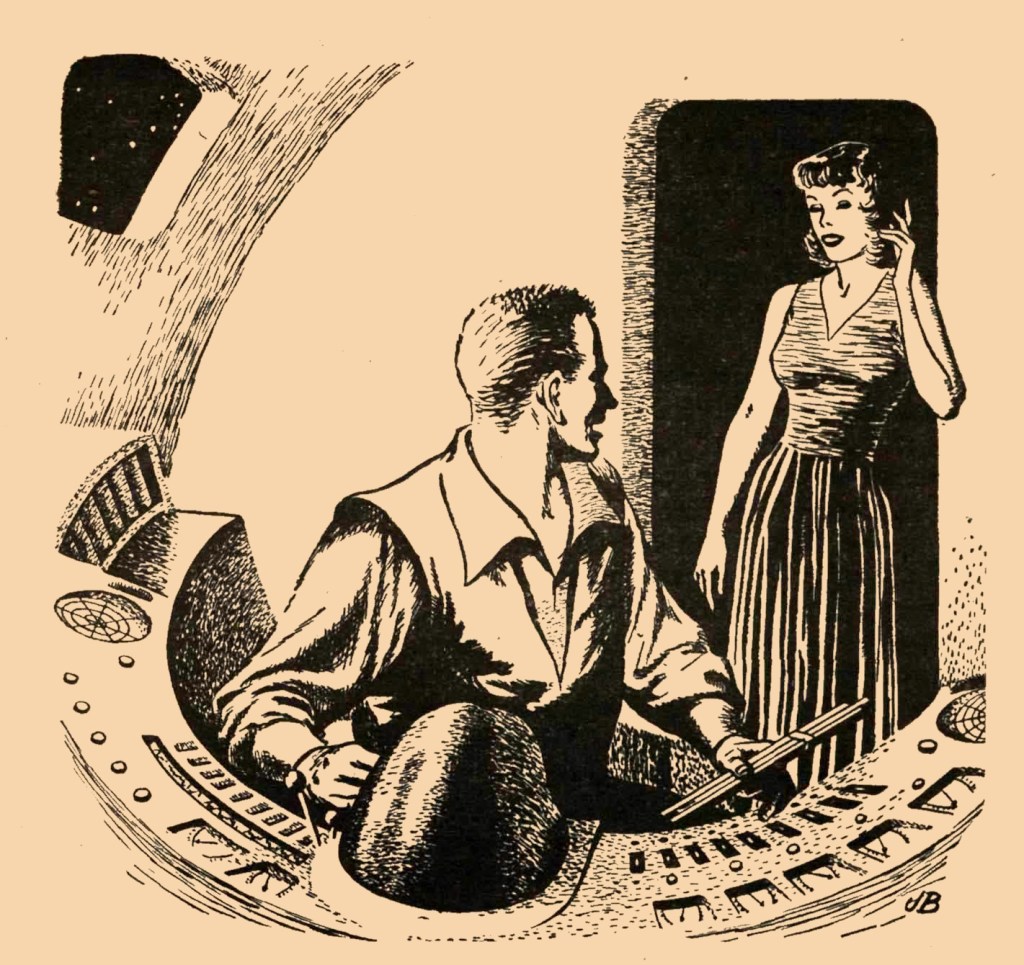
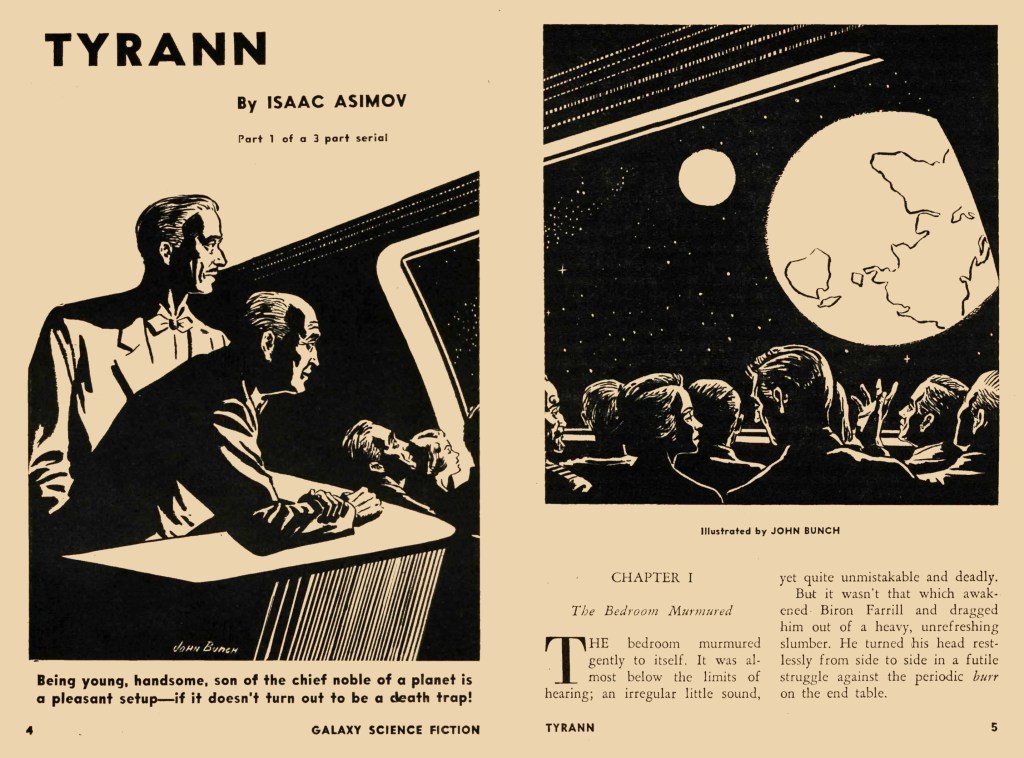
John Bunch once again illustrates the issue and it seems the decision to introduce wash drawings happened between his first and second illustration. These drawings give the artwork for this issue a distinctly different feel from the first two installments. Let’s take a look! Here’s the opening image.
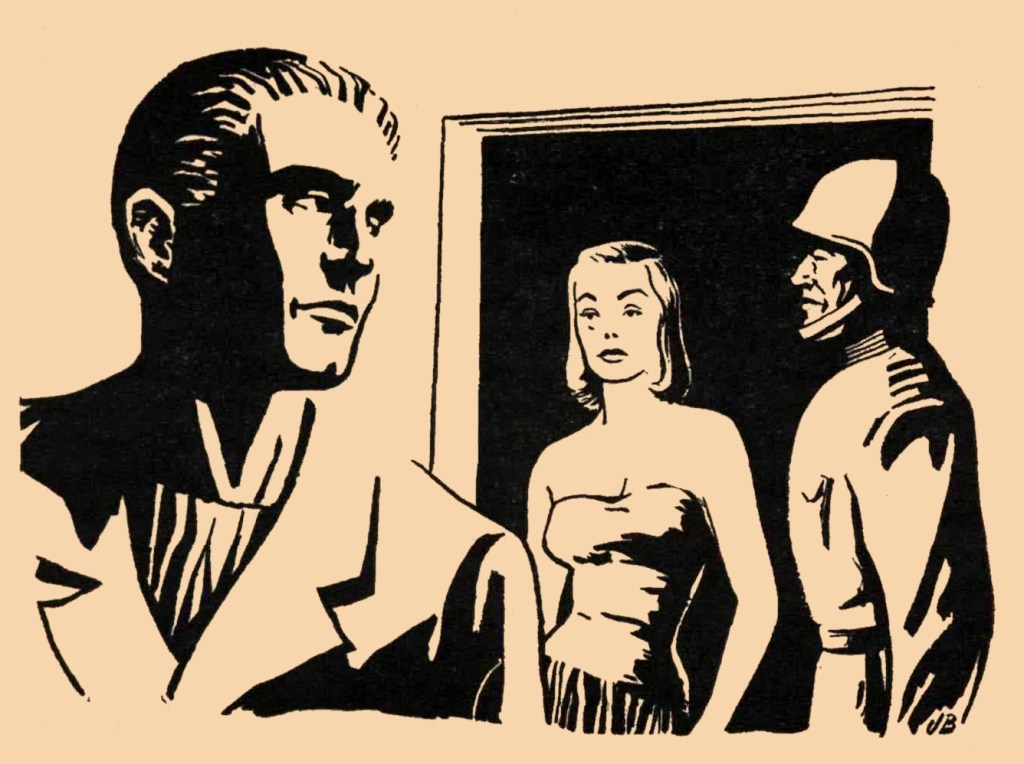
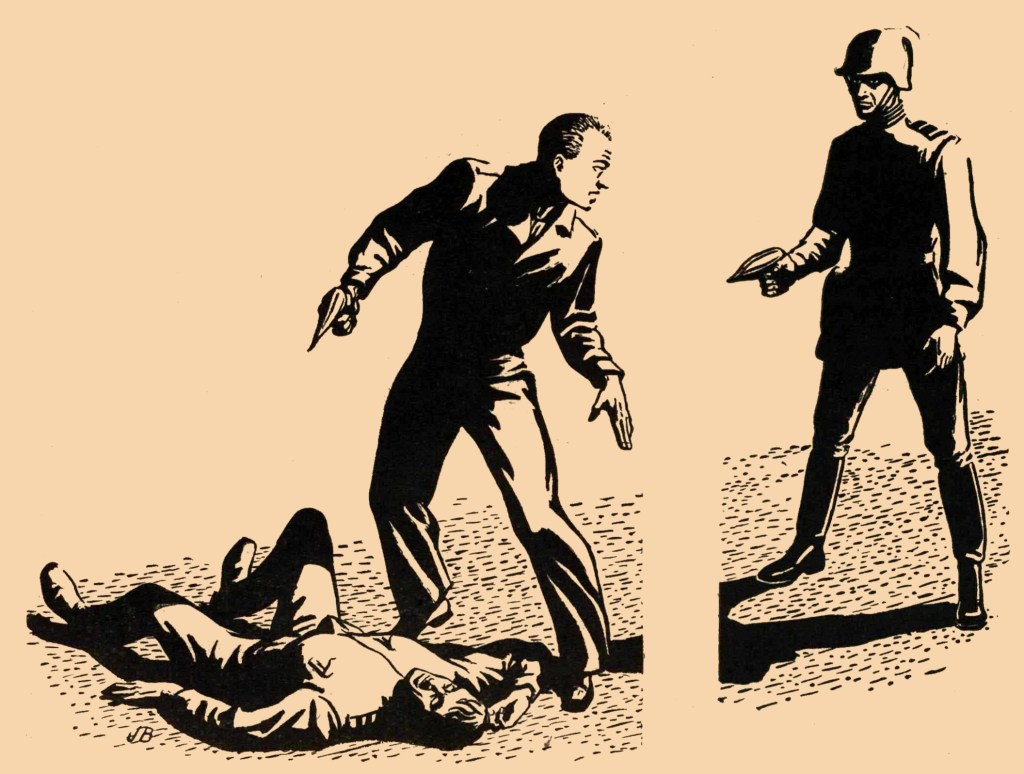
And here are the wash drawings. All but one of these span two pages.
If you’re interested in how the artwork in Galaxy developed, take a look at our coverage of The Caves of Steel which appeared in Galaxy two and a half years later.
And when you’re done reading The Stars Like Dust ― join us as we wrap up our conversation about the novel in our next episode!
There’s probably an argument to be made that the “Big Three” of Golden Age Science Fiction, rather than Clarke, Asimov, and Heinlein, are Astounding, Galaxy, and The Magazine of Fantasy and Science Fiction. A quick Duck-Duck-Go search confirms this and reminds me that I should really read more A. E. van Vogt.
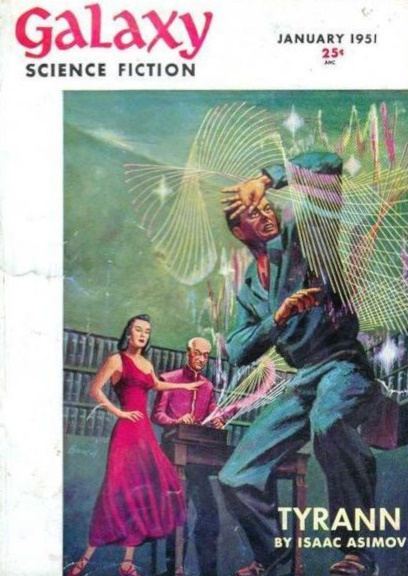
We’re not there yet, though; we’re at a place where Galaxy Science Fiction had blasted off a mere five months before. It was largely an auspicious beginning, with the inaugural issue containing Richard Matheson’s “Third from the Sun” which was adapted into an excellent episode of The Twilight Zone ten years later. That reminds me, I should really read more Richard Matheson. That first issue also included Asimov’s “The Darwinian Pool Room” which the Good Doctor said was “among the least satisfactory stories I have ever written” so maybe the lift-off wasn’t flawless.[1]
Our focus here though is the fifth issue cover dated February 1951. It contains the second installment of Isaac Asimov’s Tyrann, and that is the subject of our next episode. Galaxy’s editor, Horace Gold was notorious for retitling stories and we, of course, know Tyrann as The Stars Like Dust ―.
So, how is Isaac’s second novel progressing? Have we defeated “Second Novel Syndrome” yet? And are we observing the protoplasmic form of Asimov’s unlikeable protagonists like Golan Trevize? Plus, what’s up with that infamous subplot? All that and more is in the episode!
By the way, I was surprised to learn that this issue of Galaxy also contained “The Fireman” by Ray Bradbury. That novella eventually grew into Fahrenheit 451, undeniably one of the classics of Science Fiction. Even if the lift-off wasn’t flawless, the launch was impressive and accelerating.
While we wait for our next episode, hopefully coming on Sunday, let’s enjoy the illustrations from this installment once again featuring some interesting use of negative space by John Bunch.
Right now I’m listening to Magnets, the second album by the Vapors. Their initial outing, New Clear Days, most famous for the song “Turning Japanese,” remains one of my favorite albums. When I discovered New Clear Days, Magnets was already out of print. I literally spent years trying to track it down to no avail. Eventually, it reappeared with both albums packaged on one CD. At the time, it was a bit of a letdown. Today I’m finding it a much better listen than I remembered. The song “Linena” remains my favorite cut. Still, when I think about the “Second Album Curse,” I invariably think back to Magnets.
There’s a related notion in the publishing world, namely “Second Novel Syndrome.” The Stars, Like Dust — is the Good Doctor’s second novel. Did he escape the syndrome? Let’s save that for the podcast.
The Stars, Like Dust— was written while Horace Gold was trying to get Galaxy Science Fiction off the ground and he was anxious to include something by an author as popular as Asimov. Dust was serialized in Galaxy under the title Tyrann, starting in January of 1951, with art by John Bunch. That’s only the fourth issue. Let’s take a look at the illustrations; which I’ve cleaned up a bit.
Four of the six images are spread across two pages including this title page. I’ve kept the text in place so you can see it in context.
Without the text, I’m able to better align the two pieces.
One of the things that stands out in these illustrations is the extensive and effective use of solid black. Notice that Biron is entirely inside the negative space here.
This is one of the stand-alone images.
I’ve left the text here to highlight that this is an excellent use of layout. Biron feels both constrained and isolated, things highlighted by depicting him inside a cramped image, boxed in by the text.
Another example of effective use of negative space; our attention, like Biron’s, is drawn to Artemisia.
We end with one more three-column, two-page image.
Look for Stars End, Season 5, Episode 17 this weekend! We’ll talk about chapters 1 through 8 of The Stars, Like Dust— or, if you prefer, Part 1 of Tryann as published in the January 1951 issue of Galaxy Science Fiction.
Sometimes the world of science fiction publishing seems like the Wild, Wild West to me. I don’t mean the wacky 1960s teevee show. I probably don’t mean the real Wild, Wild West either because I suspect that was pretty brutal. What do I mean? The Wild West I mean is the one that I grew up with. It lived in shows like The Big Valley and the Star Trek episode “Specter of the Gun” with a little Firefly thrown in for good measure. It also lived in timeless classics like The Cheyenne Social Club. That’s the entire list, I wasn’t much of a Western guy. In fact, I only saw The Big Valley if I was home sick from school. Still, I mean chaotic and lawless in a mostly family-friendly sanitized PG kind of way.
Also, I realize that the inclusion of Firefly implies that I was still growing up when I was nearly forty. That tracks. On my last birthday, I entered my seventh childhood.
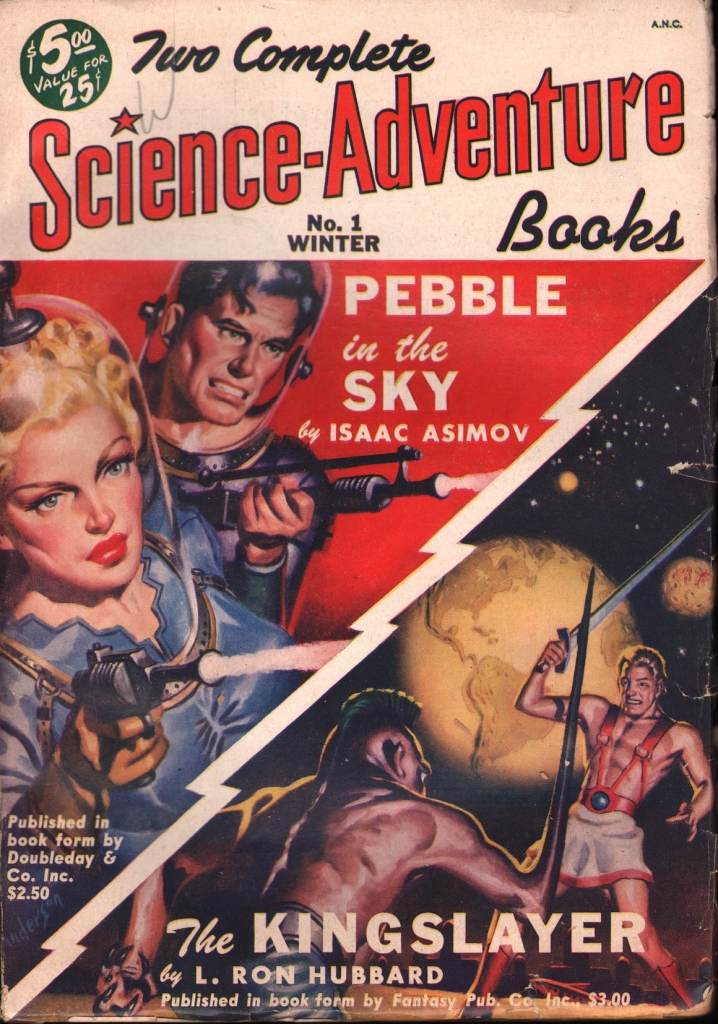
So my brain thinks that a novel comes out in hardcover and then some indeterminate time later the paperback edition follows. Mass market paperbacks were just getting started in the early 1950s and in SF publishing, although penny dreadfuls and dime novels were long gone, pulp magazines were still dominant. The other Galactic Empire novels were serialized in major pulp magazines as were the first two Robot Novels. But not Pebble in the Sky, its first paperback edition didn’t exist until 1957. What did we get instead? Two things.
Taking the second thing first, in 1953, Pebble in the Sky was published as the 14th Galaxy Science Fiction Novel. These were reprinted novels that were published monthly in the same digest format as Galaxy Science Fiction. We get a nice new cover illustration, but these have no interior artwork. The Galaxy novel isn’t the inspiration for this post.
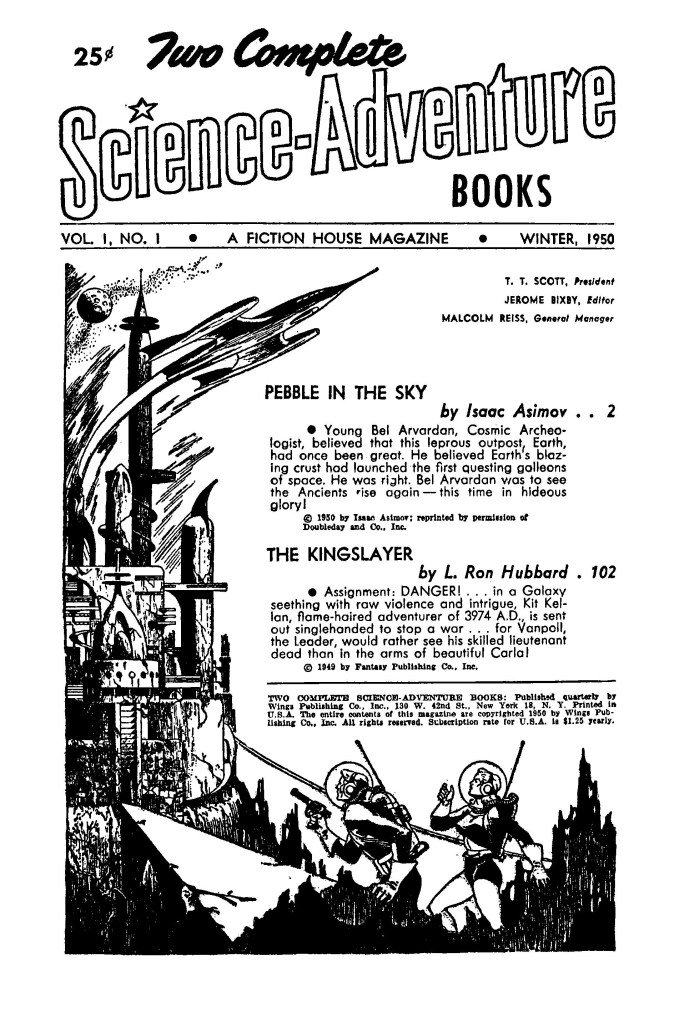
The first though arrived in late 1950. Pebble was also published in the first issue of Two Complete Science-Adventure Stories (2CS-AB). And this does have some interior artwork. It took me a while to track it down but I eventually found it at the Luminist Archives which, like Archive.org, is a treasure trove that includes a lot of Golden Age Science Fiction. Each of the two novels opens with an illustrated two-page spread. Here’s the one for Pebble.
The image from the contents page matches the cover image with the glass hats and the ray guns.
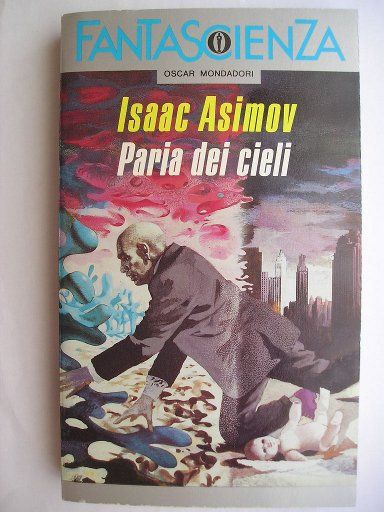
This is, so far as I know, the only Pulp Art for Pebble in the Sky. if you know of some more, please let us know in the comments! I’ll leave you with one final image, from an Italian language edition of Pebble. Unlike the 2CS-AB images above it has a clear and relevant relation to the events from the novel.
Resources
Pebble in the Sky at the Internet Speculative Fiction Database retrieved 25 August 2024
I like to try things I haven’t done before and, on Thursday I decided to make a serious attempt at learning some video editing skills. It’s still a work in progress because, as one of my professors in graduate school once said, “Everything takes longer than it does.” 9999 more videos and I’ll be an expert.
Meanwhile, Season 5, Episode 13 will be out tomorrow. In the meantime please enjoy this preview.
It’s been a while since we’ve done an installment of “Foundational Readings” or of “Next Time on Stars End.” I used those two columns to share the art that originally accompanied the stories we were reading. There’s a bit of unfinished business there, but today we have a bit of a surprise.
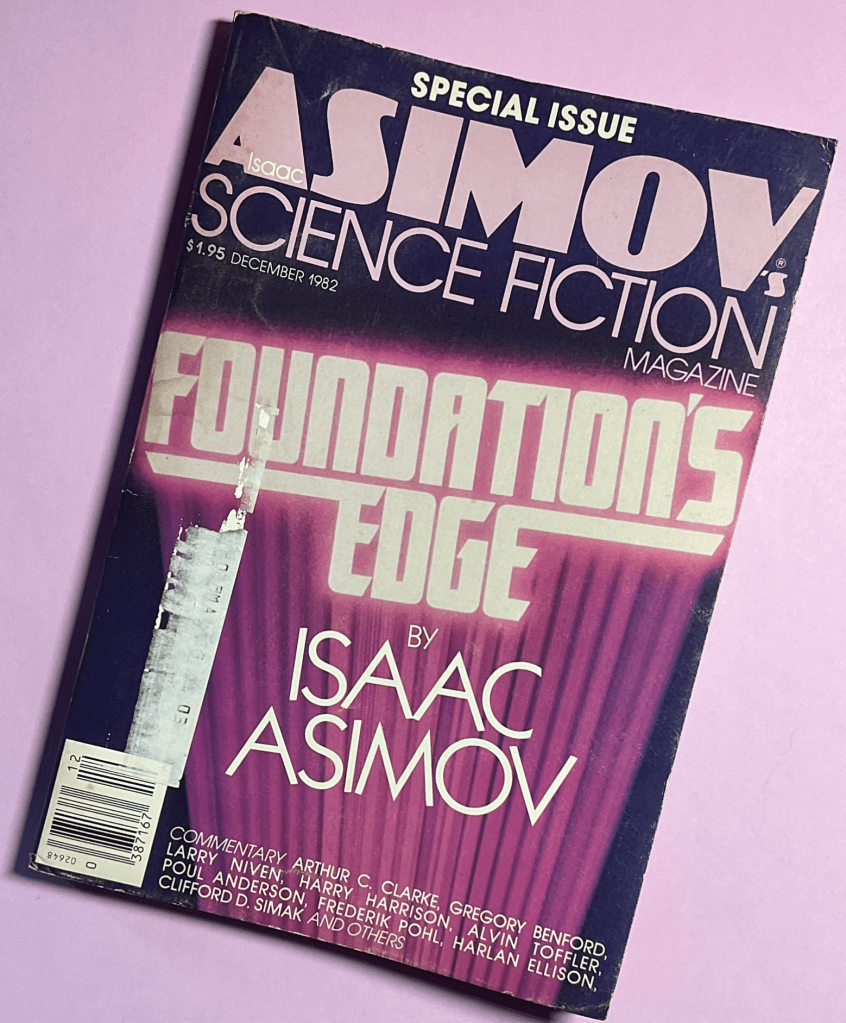
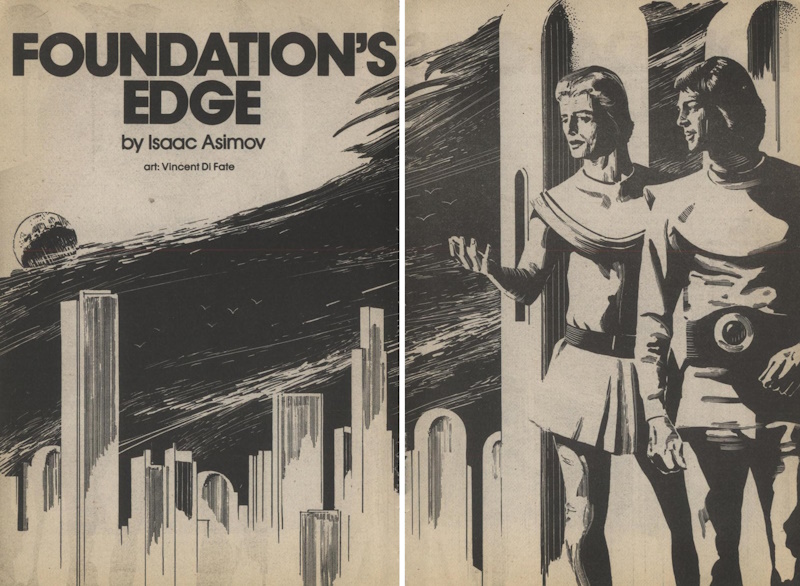
I remember what a big deal this was: the first Foundation novel in thirty-two years! But here’s something I didn’t remember or, more likely, wasn’t aware of at the time. Unsurprisingly, Asimov’s Science Fiction Magazine thought it was a pretty big deal too. So much so that the centerpiece of their December 1982 issue is the first two chapters excerpted from the book.
On Saturday, we’ll release Stars End, Season 5, Episode 5. It’s our last installment about Foundation’s Edge; we’ve reached Gaia and the book’s climax.
But there’s lots more! There are two additional pieces of writing by the Great and Glorious Az himself, an editorial entitled “Susan Calvin” and a short essay entitled “The Story Behind the Foundation” under the masthead “Viewpoint.” I’ve read the latter before, although maybe not all at once; it is repurposed in an abbreviated form as a foreword (with the same title) to Foundation and Earth. The editorial, though, was new to me; I’ve never seen it anywhere else.
There are also commentaries from some of the biggest names in Science Fiction lauding the advent of a new Foundation novel, including Arthur C. Clarke, Harlan Ellison, and Larry Niven. Those alone were worth tracking down a copy. Here’s a sample.
But of course, the main attraction here is the artwork: like the novel, these are the first Foundation illustrations in decades. Unlike the novel, these were not all that available in the subsequent forty-one years.
There are three nice images drawn by Vincent Di Fate. The first is the opening two-page spread of the excerpt.
The other two take up an entire page of the magazine each.
Two additional images reuse elements of images 2 and 3 above. This is lovely stuff, and as I’ve said on our companion site, JosephFranké.com, great art deserves to be seen.
You can find out about Asimov’s Science Fiction Magazine online at www.asimovs.com. I scored my copy on eBay for a reasonable price.
Do you know who liked milestones and writing? The Great and Glorious Az, that’s who! That should come as no surprise.
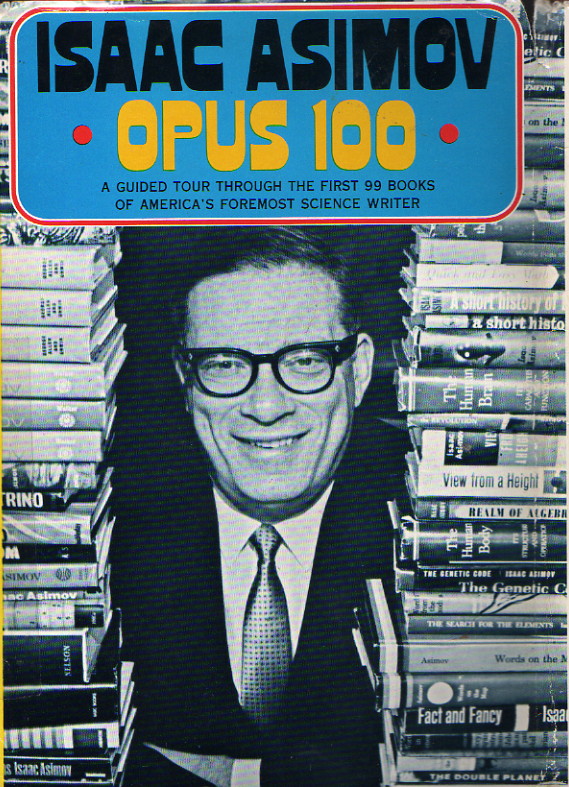
The Cover to Opus 100.
What does surprise me a bit is that his first book, Pebble in the Sky, wasn’t published until 1950. Isaac had been writing professionally for 11 years at that point. In 1969, after writing book #99, Asimov’s Guide to the Bible, Volume 2, he turned to a new subject, himself. His next book was entitled Opus 100. It presents an overview of his writing career from 1939 to 1969 organized by subject.
“Section Two: Robots,” for example, begins with an excerpt from a special issue of Science Journal entitled “Machines Like Men.” It proceeds into a history of Asimov’s robot stories beginning with “Strange Playfellow.” It’s highlighted with copious excerpts from not just the stories themselves but from his non-fiction as well. The section culminates in a full reprint of “The Last Question” because that story, in the words of Asimov, “represents my ultimate, thinking on the matters of computers/robots.“
I’ve only dipped into Opus 100, but it’s delightful! You might expect that from a beloved author, writing on what must be his favorite subject. You don’t have to take my word for that, here’s what Isaac said in the introduction.
The Back Cover
… I was about to have my ninety-second book published, and the question arose as to how many other books I had in press. As I began to tick them off, we all realized that My Hundredth Book was upon me.
Various suggestions were made, and finally, someone suggested that I make it a completely personal book in which I rattled on and on about myself and my writings, with selections from books, articles, and stories where those were appropriate.
I thought about it briefly and said “Any writer, who is a monster of vanity or egocentricity — like myself, for instance, — would love to write a book like that. But who would buy it?“
“You let us worry about that Isaac,” said Austin [Olney of Houghton Mifflin].
From Opus 100
The point here, of course, is that here we are at our 100th blog post, just a bit under two years and four months since we got started.
Sixty-Five of those posts introduced podcast episodes. Two of those episodes were about the Stars End Podcast itself, our very first episode and our 50th episode extravaganza.
Seventeen of our episodes were about episodes of the Apple TV+ series or the series as a whole. With three of the rest dedicated exclusively to interviews, and one dedicated to Asimov’s Foundation and Philosophy (which contains an essay by our own Dan Fried). The remaining firty-two were all about reading and then talking about Asimov’s work. Thus far we’ve talked about the entire Foundation Trilogy, both of the prequels, the four Robot Novels, and a handful of short stories and an essay.
Outside of introducing episodes, we’ve had 13 “Watching Foundation” posts with additional comments on the teevee episodes and nine posts with original pulp art from Astounding Science Fiction and Galaxy Science Fiction. Plus coming attractions, show news, and more!
Here are some highlights! We’ll start with posts about
Episodes of our Podcast.
in reverse chronological order.
It’s always a delight when a guest joins us on the podcast; the fresh perspective shakes things up and enhances the conversation. During our long journey through the Robot Novels, our in-depth discussions frequently brought us back to Star Trek: The Next Generation, Data, and frequently the episode “The Measure of a Man.” We were therefore particularly happy and honestly, a bit star-struck to have Melinda Snodgrass join us for an episode. Melinda wrote “Measure” and as a TNG Story Editor was the show’s Data-whisperer. It was an excellent coda to an extensive canticle.
And speaking of milestones, we had a lot of fun with the special 50th Episode of our podcast. Like this, it’s a retrospective, but it also contains our single most surprising segment! It must be heard to be believed!
Another fun episode was our second wrap-up of the first season of Foundation the teevee show. That was the First Annual Stars End Hari Awards! The best part of that was all the folks who helped by contributing to the discussion, promoting the project, and voting.
Our Website is like an excellent glass of orange juice, it comes with pulp. That is unless you don’t like orange juice with pulp. In that case, you’ll need to come up with your own metaphor. The “excellent” part is non negotiable though.
What does that mean though? Most of the Asimov stories we talk about appeared first in pulp magazines and we relish those connections. When available we can give the stories some context. We explore the differences between the original publications and their anthologized versions, use the coming attractions and the summaries to help our listeners and we enjoy the illustrations. I don’t know about you, but I find stories without illustrations to be too dreary. I may be biased. Have you heard about my side project?
Anyway, while we read The Caves of Steel and The Naked Sun, those posts looked like this.
Sometimes something will come up on the podcast that needs follow up, for example when we read “The Robot Chronicles” and discovered that Asimov said this about his short story, “Liar!”
This story was originally rather clumsily done, largely because it dealt with the relationship between the sexes… Fortunately, I’m a quick learner, and it is one story in which I made significant changes before allowing it to appear in I, Robot.
from “The Robot Chronicles”
Asimov’s ability to write female characters and his reticence to rewrite things had come up frequently and we were curious about what “significant changes” meant in this context. That led to this follow up.
One of the posts we’re proudest of here at StarsEndPodcast.com is our only (thus far) piece of fiction. Written by our own Jon Blumenfeld, It’s called “Dors” and it fills in some of the eponymous character’s back story. You should read it because it’s excellent. If that’s not reason enough, we’ve declared it canon here at Stars End and you never know when we’re going to rely on that to make some obscure point or other.
Those posts about pulp art started here with our “Foundational Readings” post and the first one covered all of Foundation, the first book of the Trilogy. Perhaps more importantly it contained a paene for Archive.org without which none of our Pulp Art posts could exist. While we read Second Foundation our attention was focused on the advent of the Apple TV Plus series, so there are more of these yet to come!
That corresponds to chapters 7 through 12 in the book.
There’s less hype this time except for the presence of part one in the October issue; Part two was not mentioned in Campbell’s Things to Come and wasn’t on the issue’s cover. Who is James H. Schmitz by the way? I don’t know!
But that doesn’t mean that nothing happened in this installment!
We see the aftermath of the assassination attempt of Hannis Gruer and learn what constitutes “sociology” on Solaria. We meet Gruer’s stand-in as Head of Security and watch as Baley gets to go walkabout across the planet. We also learn an uncomfortable amount about Solarian childrearing and witness a second, seemingly impossible assassination attempt on this world so filled with three-laws robots!
Here’s John W. Campbell’s blurb that precedes this installment!
Second of Three Parts. Lije Baley was investigating a murder. Usually, an alibi proves physical impossibility; on robot-dominated Solaria, a different question arose. Is a robot’s conditioning “physical” or “psychological” impossibility? And is there any such thing as “psychological impossibility”? And if it exists for robots, does it for humans…?
Astounding Science Fiction November 1956
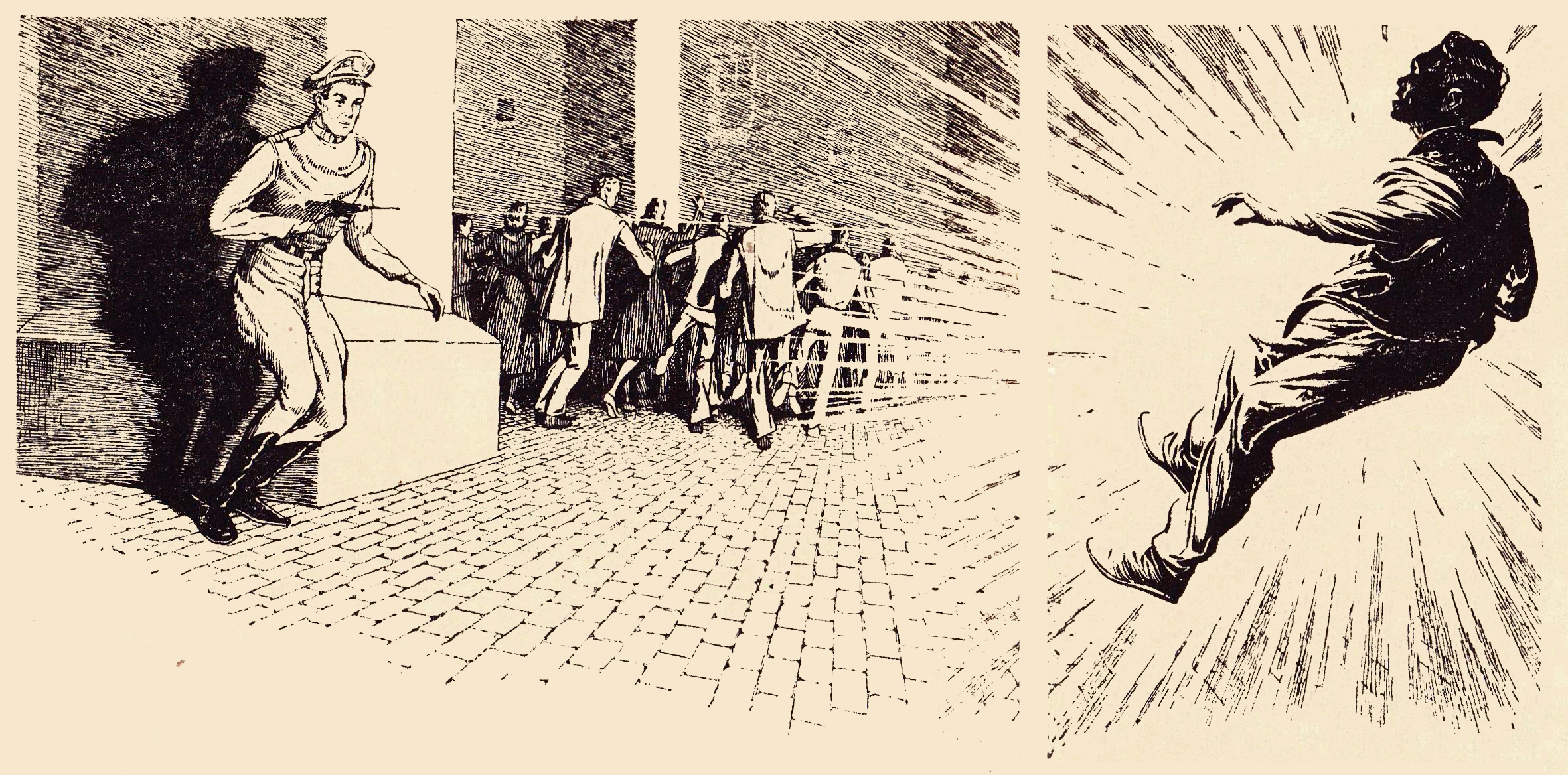
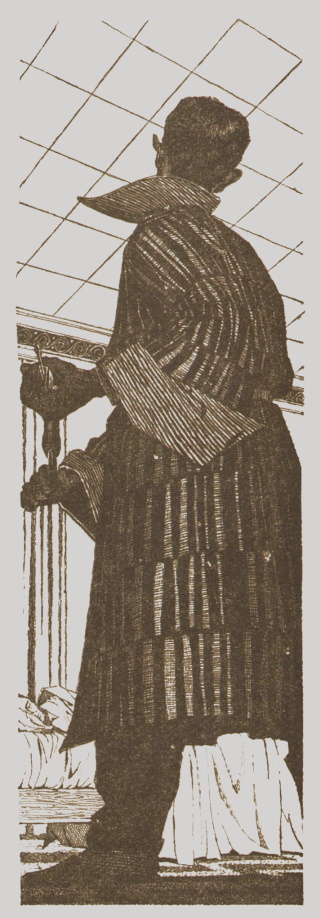
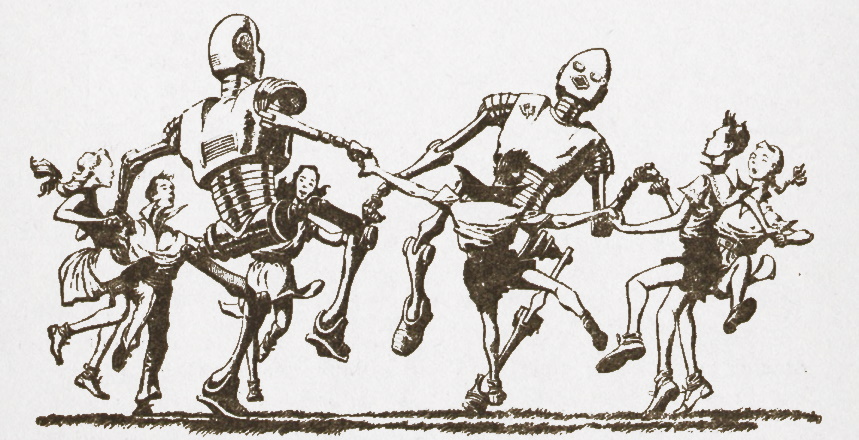
The illustrations this time are again by H. R. Van Dongen.
The available scans were not great, but I cleaned up the images as much as possible. If I keep this up, I may need to learn a lot more about that process.
Season 3, Episode 19: coming soon to anywhere the finest podcasts are sold!
Resources
Asimov, Isaac. “The Naked Sun, part 2” Astounding Science Fiction, November 1956, pp. 96-151.


























 Stars End: A Foundation Podcast