We’re not recording our next episode until Saturday, but if you’re reading ahead, we’ll be discussing chapters 8-13 of The Caves of Steel, corresponding to the second installment that was published in Galaxy Science Fiction in November 1953.
Galaxy SF, 11/1953
It’s an interesting issue. Asimov didn’t score the cover this time. The cover references the non-fiction piece about the famous experiment that saw complex amino acids generating spontaneously when the conditions on primordial Earth were recreated in a laboratory.
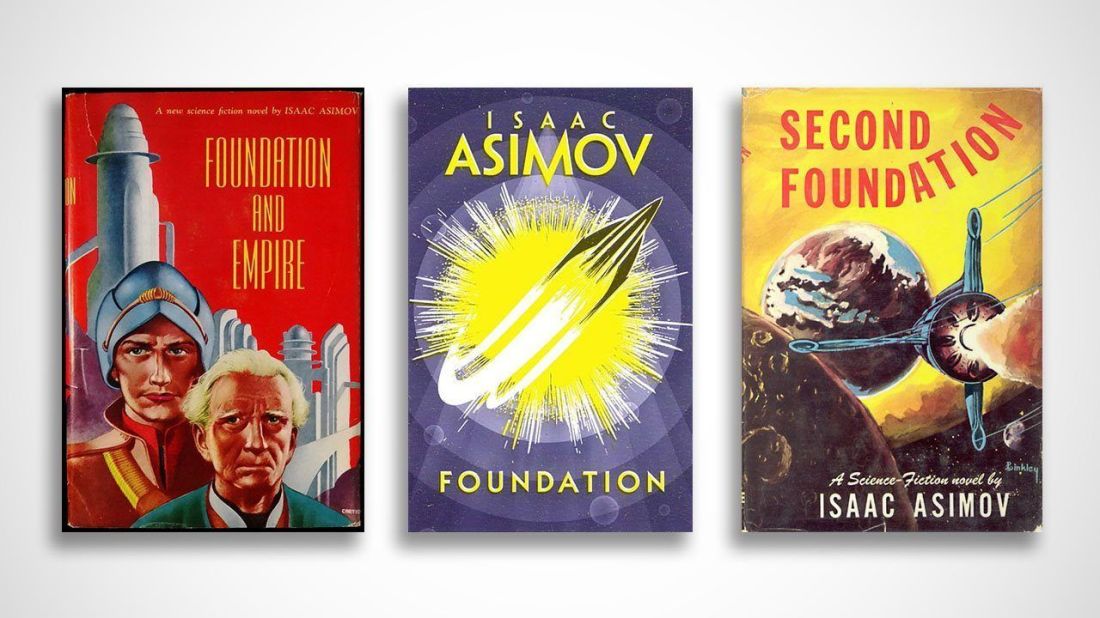
Also of interest is “Galaxy’s 5-Star Shelf.” which reviews a compilation of Olaf Stapledon’s work, the non-fiction Man in Space by Heinz Haber, Second Stage Lensman by E. E. (Doc) Smith, Against the Fall of Night by Arthur C. Clarke and Second Foundation. In that last review, Groff Conklin calls the now-completed Foundation Trilogy “Our first great sociological space opera.” He compares it favorably with Smith’s Lensman series saying, “…Asimov’s work, based as it is on fairly sound social principles and the activities of fairly normal human beings, has a pressing sense of reality that Smith’s fairy tales lack…” He concludes “it is a thoroughly satisfying and adult play of the scientific imagination.”
But back to The Caves of Steel. Here’s the promotion for this installment in Galaxy’s October Issue.
And here are some pages from the story.
i
I’m particularly liking the opening two-page spread, with artwork once again by Ed Emshwiller. It depicts the encounter in Chapter 8. The synopsis is nicely done as well and continues for the entire next page. Here’s the remainder in case you want to remind yourself of the last installment before continuing to read this one.
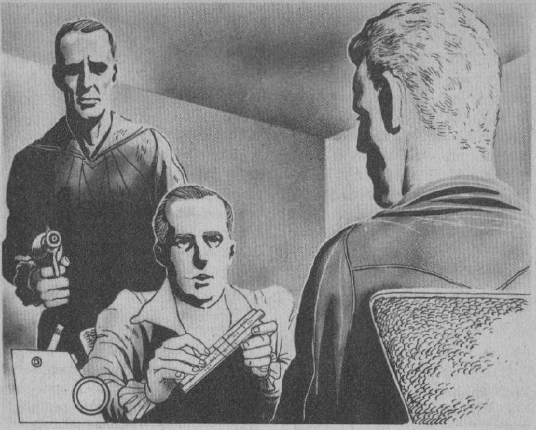
Finally, here are the rest of the illustrations from the story. We have Lije and Daneel leaving Space Town (top right), traveling through a power plant (left), and Daneel being examined by Dr. Gerrigel, a roboticist.
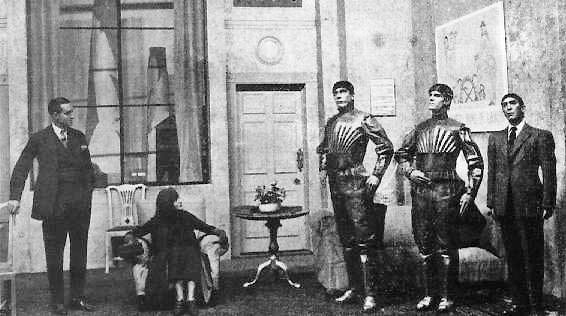
Just over a century ago, the word “robot,” derived from the Czech word “robota” which means “forced labor,” was introduced to the English language in the play R. U. R. by Karel Čapek. In it, a scientist has created artificial humans, called “roboti” or “robots.” Robots replace workers in factories, then become the basis of the economy. Eventually, the robots revolt, supplant humanity and ultimately cause humankind’s extinction.
In an interesting coincidence, R. U. R. debuted on 2 January 1921, The Great and Glorious Az’s first birthday! Who would have suspected that Ol’ Isaac and the word “robot” would be astrologically equivalent?
In this episode, we start discussing Asimov’s The Caves of Steel where the theme of robots replacing humans looms large. There’s already a palpable sense of economic anxiety within the New York Police Department as lower-level employees have already been replaced. Now Detective Elijah Baley is assigned a robot partner named R. Daneel Olivaw who is all but indistinguishable from a human being. It’s essential that Baley not only solve a murder but solve it in a way that doesn’t lead to many more humans being supplanted by robots.
We just recorded our latest episode last night and we’re back to reading the works of the Great and Glorious Az.
We’re thrilled to announce that, by popular demand, we’ll be reading the Robot Novels beginning at the beginning with The Caves of Steel. That’s my go-to novel if I want to introduce someone to Asimov’s work.
This novel was written at a time when Asimov was trying to get away from being a “one-editor-writer” and so he was working with, among others, Horace Gold of Galaxy Science Fiction. Gold had serialized The Stars, Like Dust in Galaxy under the title Tyrann and he was anxious to serialize another. He suggested a novel about robots, but Asimov declined. Robots, thought Asimov, were for short stories; the ideas wouldn’t carry an entire novel.
So Gold suggested that Asimov write a detective story where the detective had a robot partner and Elijah Baley and R. Daneel Olivaw were born. John W. Campbell had always claimed that a science fiction mystery story was a contradiction-in-terms and Asimov wanted to prove him wrong. The Caves of Steel became Asimov’s most successful book up to that point.
But first, it was serialized in Galaxy Science Fiction in October, November, and December of 1953. For this episode, we’re reading the first installment which corresponds to chapters 1-7 in the book. If you’re interested in reading The Caves of Steel as it first appeared, you can find that issue of Galaxy here courtesy of Archive.org but either way, you can enjoy the original artwork by Ed Emshwiller right here. Our episode will be out in a few days!
“The Creation of the Podcast Was Looked Upon as the Prime Example of the Overweening Arrogance of Humanity.”
Well, we’re between books this episode, so we decided to read “The Robot Chronicles” from the Great and Glorious Az’s Gold: The Final Science Fiction Collection. It’s an essay in which Asimov discusses his robot stories, their inspirations, and their milestones.
So far, I’ve found Gold enjoyable. It contains the last of Asimov’s science fiction short stories, essays about his stories, and essays about writing Science Fiction. He insists, by the way, that Science Fiction be abbreviated “SF” and not “sci-fi.” You can find out why and read “The Robot Chronicles” and the rest of Goldhere.
But, really, the bulk of this episode is an engaging and free-wheeling conversation with our special guest Travis Johnson, whom you may know from Twitter as @travisjohnson and/or @startravcommand. He’s one of the hosts of the Black Alert Podcast and created, with his 11-year-old daughter, a Star Trek Prodigy podcast called Star Trek Podigy. He has also published A Matter of Right: Futures of Justice, a “science fiction comics and prose anthology” about the US criminal justice system. Join us as we discuss Robots, Foundation, all things Asimov, and more! You don’t want to miss this one!
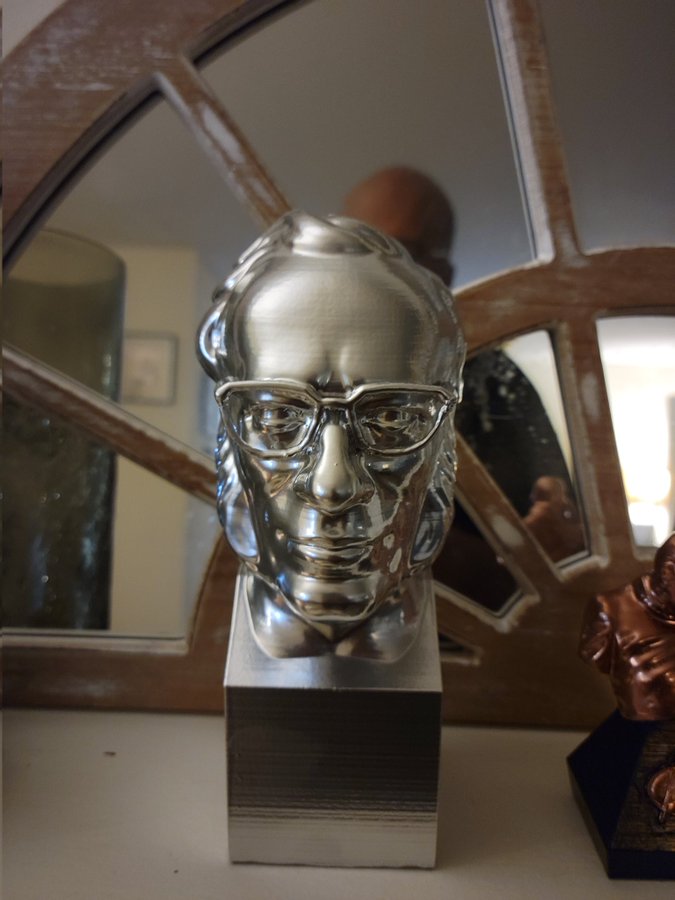
Update: sometimes I forget stuff, and I only remember when I listen to the episode after it’s published. This time it’s the Asimov bust that Travis told us he 3-D printed. It’s an impressive bit of work and here it is for your edification.
“Softly Beaming, A Steady Light of Hope… the Stars End Podcast.”
Are you troubled by premonitions of unsavory equations or non-standard beverages?
Do you experience feelings of dread from your grandfather’s office furniture?
Have you or anyone in your family experienced prestidigitation, clairvoyance, astral projection, or sphenopalatine ganglioneuralgia?
If the answer is yes, don’t wait another minute! The Second Foundation is for YOU!
Our courteous and efficient staff is on call 24 hours a day to serve all your psychohistorical prediction needs!
In this episode, we come to the end of Forward the Foundation with the story of Wanda Seldon where we finally see the inception of the Second Foundation as Hari discovers Wanda’s abilities and Wanda first becomes an important part of the Seldon Project before striking off with Stettin Palver to form the nucleus of the Second Foundation. Meanwhile, we hit the bittersweet part of any biography. Hari’s life winds down as he says goodbye to everyone he’s ever loved and is left only with psychohistory before we finally say goodbye to Hari himself.
And, in case you don’t recognize the reference above…
“No one outside the podcast has the faintest knowledge of how psychohistory works and not everyone inside does either.”
If you’re read our one piece of fan fiction, “Dors,” by our very own Jon Blumenfeld, you’ve read an origin story of sorts for Dors Venábili. If you like this character like so many others you should check it out; it’s excellent.
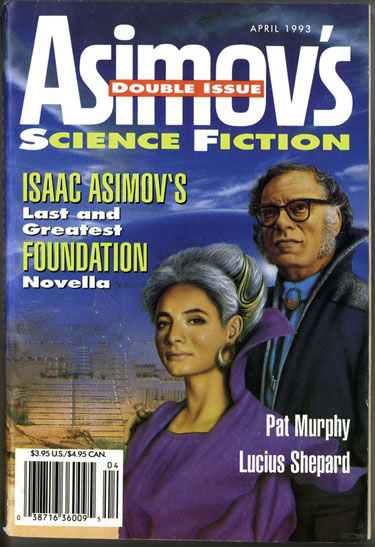
In this episode, we finally get to the chapter of Forward the Foundation featuring… well no, they all feature Hari but this one’s named after Dors. It was called “The Consort” when it ran in Asimov’s Science Fiction in April of 1993 and to be honest, Dors plays a larger role in this story than the so-called “featured” characters in the other eponymous chapters. If you hadn’t noticed the book has a bit of a pattern. In each section, Hari says farewell to his friends and loved ones as his life winds down in ten-year increments. In this story, Hari and we get to say goodbye to Dors, nicely bookending with Jon’s story.
Our guest this week is one of Joseph’s oldest friends, Rick Tetrault. Rick is the host of the Starbase 66 Podcast from the Infinite Potato Alliance and also qualifies as an “old friend” of Stars End. Rick gave us a great deal of sage advice when we were just figuring out how to do a podcast. You might recall that Starbase 66 was the site of our first collective guest appearance back in December. You’re more than invited to check that out here: Starbase 66: Foundationally Speaking.
But first, without further ado: Episode 11!
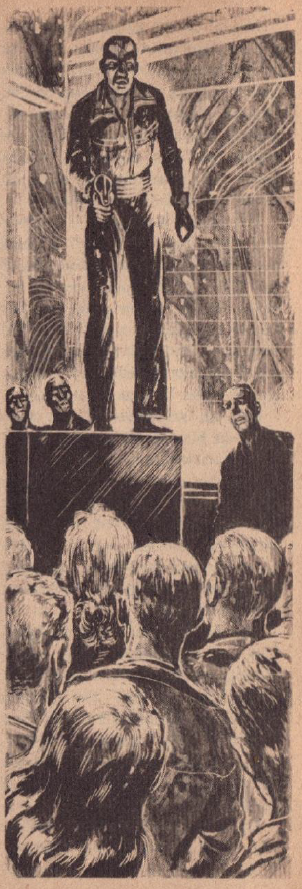
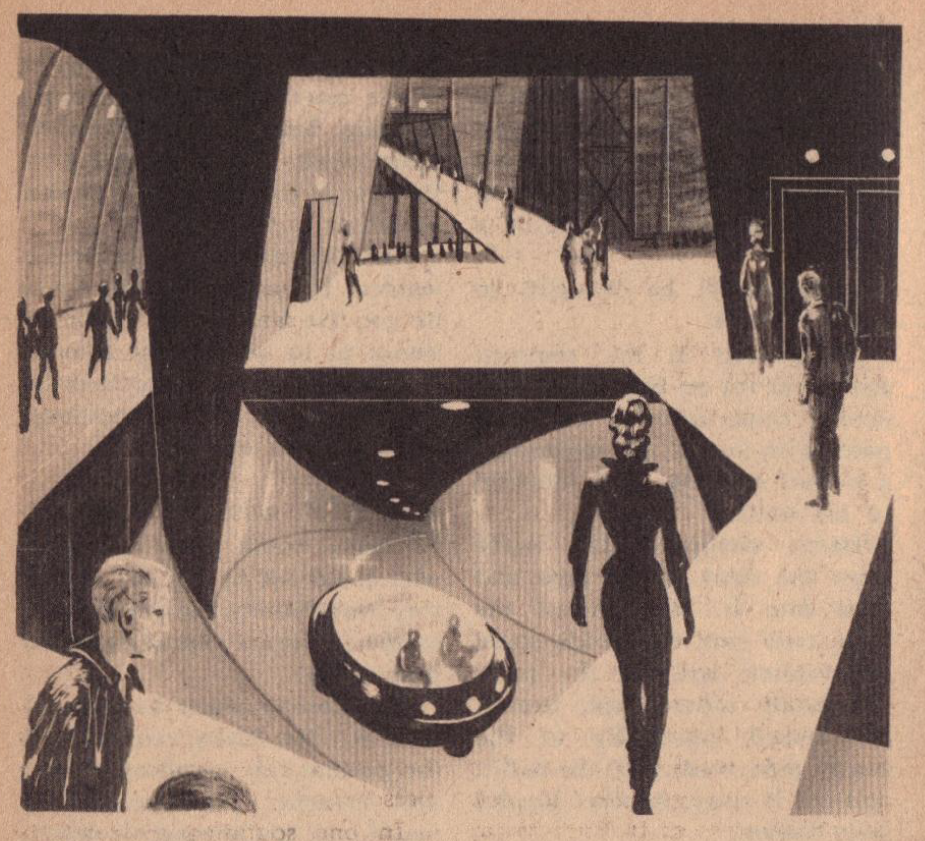
Featured Image: Interior artwork from Asimov’s Science Fiction Magazine, April 1993.
“We Must Keep the Podcast Stable If For No Other Reason Than That We’re Here”
Well, here we are again with another installment on Asimov’s swansong, Forward the Foundation.
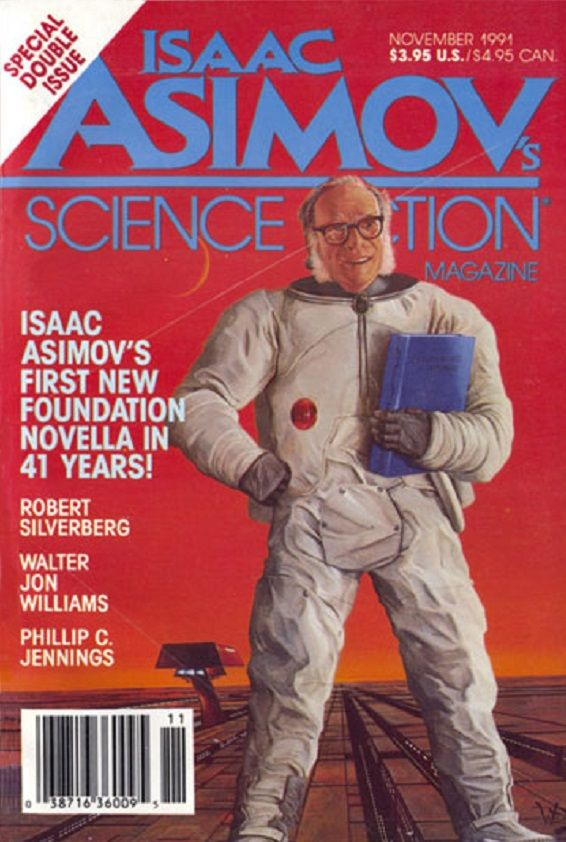
You might recall that Forward was written as a series of Novellas the first three of which appeared in Asimov’s Science Fiction Magazine. The installment we’re discussing this time is “Cleon I” which originally appeared in the magazine’s 15th-anniversary issue in April 1992 as “Cleon the Emperor.” Much like the previous story, it isn’t very much about the titular character but it’s a lot about Hari Seldon. This one is set during his tenure as Cleon’s First Minister.
But the cover, by Gary Friedman, is pretty great; it’s Asimov himself alongside a woman who is almost certainly Dors Venabali. I can’t say it’s Dors for sure, but I can state with absolute certainty that character is neither from Mycogen nor Dahl.
Inside the issue, there’s an extensive editorial about the Foundation series and its history and it answers, in part, one of the questions we posed on the podcast. We’d wondered why Asimov decided to write Forward as a series of novellas and evidently, the genesis of the idea came from Jennifer Brehl, who Asimov calls “my brilliant and lovely editor.” He continues.
Jennifer thought it might be a good idea if I wrote a Foundation book in which the characters were new from one section to another.
I thought the matter through and decided that I would write a Foundation book (called Forward the Foundation) in which Hari Seldon gradually grew older. I would tell it in five installments and in each installment, Hari was ten years older.
It turns bittersweet as we get some bits of the story we’ve heard before.
I began work on it but then toward the end of 1989 disaster struck. I came down with congestive heart failure produced by mitral valve insufficiency. I was very sick and I was hospitalized for months. Actually, I was convinced I was going to die — but I didn’t.
And a bit later…
But there’s a catch (there’s always a catch). I’m tired. I’m just plain tired. I sleep a great deal and I drag around even when I’m not asleep…
And the worst trouble is that I can’t write very much. This is especially true of the new Foundation book. I wrote the first installment (in fact, it was published last November in this magazine) and the second and third parts are finished as well. The fourth part is almost finished but it’s been weeks and weeks since I’ve been able to work on it. Nor do I know when I’ll be able to get to it. Every time I try, I find I am too tired to work at it.
Whether I will improve with time, I can’t say. Certainly, there seems no sign of it at the moment.
Believe me, I am sorry about this; more so than you can possibly be.
Coincidently, although the issue would have been printed weeks before, April 1992 is the very month that Asimov journeyed beyond this mortal coil.
“I Suspect You Will Find That No Podcast Is Ever Truly Crucial”
Have you been with us for a while? If you have you might remember some jokes back in the long, long ago about the longevity of our podcast. We were pretty stoked (is that what the kids say nowadays?) back in Season 1 Episode 8 when we surpassed the Manimal Threshold for example.
Well, on 26 April 2021 our first episode was squirted out into the aether so we have another milestone to celebrate; we’ve officially been a podcast for over a year.
Thirty-two episodes in and we’re starting to talk about our fifth book, Forward the Foundation by the Great and Glorious Az.
It’s a departure in that it started life as a series of novellas like the original trilogy; three of those appeared in Asimov’s Science Fiction Magazine starting in November 1991. The book and the stories within are somewhat bittersweet; we touch on that a bit in the podcast and we’ll get back to that here as soon as we’re able.
And we have a special guest in this episode, who you may know as @stratotron from that bluebird site! They are a perfect person to join us in a discussion of a chapter entitled “Eto Demerzel.” Join us and welcome the delightful Daneel Adrian Cayce to the conversation, Asimov Enthusiast, Trekkie, Twitterer, chiptune creator, and namesake of the quintessential character in the entire Asimov canon! It’s going to be good!
And thanks to everyone who’s stuck with us for an entire trip around the sun! Never fear, there’s no getting rid of us now!
“The Podcast Makes No Allowance For Unwitting Harm”
How time flies! It’s our final Episode on Prelude to Foundation and you’re not going to want to miss this one!
Our heroes finally, despite their best efforts, find themselves in the sector of Wye. That’s pronounced “why” and The Great and Glorious Az has a bit of fun with that. Also, “Who” is the Prime Minister, “What” is the neighboring sector, and “I Don’t Know” is on third. And while Raych gets to go to the Zoo, Rachelle eventually finds herself in the penalty box. I’m kidding, mostly. But whadya asking me for? You should take a look at this to see how it’s supposed to be done!
Also War! And the final climactic ending which, in classic Asimovian style, is people in rooms having conversations! But with tons of intrigue, lots of reveals, and a bit of what some might even call romance.
There’s more! A special report from our man on the scene at Star Trek: Mission Chicago! A special interview with a classic Captain of the USS Enterprise and a special surprise from one of our favorite Foundation actors!
Editor’s Note: If you’re here, you probably already know about Jon’s big announcement in the latest episode of our podcast. He’s written a story set in the Foundation Universe that explores the back-story of Dors Venábili. We’re proud here at StarsEndPodcast.com to publish that story as our very first piece of fiction. It’s already been favorably compared to the work of the Great and Glorious Az himself and everyone who has already read it has loved it! We’re betting that you will too! Without further ado, here’s “Dors” by Jon Blumenfeld. Enjoy!
Leonidas felt the ship lurch to the side and nearly lost his footing, but the magnetic boots held him firmly to the deck as he swayed and stumbled, and he started moving forward again even before the ship stabilized. The bridge was just ahead. Two red-suited guards raised blasters to fire, but hesitated for a moment, lowered their blasters and collapsed inside their suits, hanging there like marionettes whose puppeteers had simply stopped paying attention. Warning lights flared, and Leonidas presumed that sirens were blaring, but he couldn’t hear them through the helmet. The bridge door was closed, but Leonidas’s atomic blaster made short work of it, and in a moment he was through.
A man stood there in the chaos of smashed consoles, floating beams and bodies, flashing lights and flames. His grey hair flowed back on to his long, almost robe-like cloak, and he raised one hand even as Leonidas stalked toward him. He motioned into the air, and Leonidas understood, and unsealed his helmet so he could hear.
“I knew it was you, and I knew you’d come to finish the job yourself. So go ahead; you’ve won. Take your prize. I’ll even turn to face you, so you won’t have the dishonor of shooting a man in the back.” He turned, and crossed his arms over his chest. He stared out of eyes so yellow they practically glowed gold, and his mouth turned up into a sneer. “I said go ahead. What are you waiting for?”
Leonidas raised the blaster slowly, and his thumb moved toward the contact.
****
“Liliana.”
No response.
Leonidas bent over a console and made some adjustments. There was a snapping sound and then – “Liliana!”
“Yes. I am Liliana. Awaiting input.”
Leonidas’s mouth curled into what almost looked like a smile.
***
Leonidas sat at the console and watched the data swirl by, forming patterns in the air, shifting and circling. It was clear there was a pattern, and at the center of the pattern was a person. All the threads led to the center, and the figure at the center was clearly manipulating them – no coincidence. Leonidas started the simulation, but he knew what the result would be. Rarely had he ever seen such a compelling result – remove the figure in the center, and the threads would unravel, the patterns would disappear, and the swirling data would return to its “normal” state of near-randomness. It was all well and good to wish for better tools for analysis, but this time it was unnecessary. The course of action was obvious, but Leonidas could not conceive of any way to make it happen.
***
The grey-haired man threw his head back and laughed. The beam of the blaster had passed over his left shoulder, leaving a console behind him a devastated pile of wiring and twisted metal.
“I knew you couldn’t do it! I knew at the last you’d fail! You see, Leonidas, I know exactly who andwhat you are. Unlike the poor fools who were guarding the door, I’m immune to your little mind tricks, and I’ve anticipated your every move. And now, I must say farewell, for the time being.” And before Leonidas could react, the grey-haired man ducked through a hatch and a red alarm light flared. Leonidas leapt to the viewport and watched the escape pod’s engine come to life.
***
“You must learn, Liliana. You must be trained.”
“Why, Leonidas? What is my purpose?”
“All will be revealed in time, but for now I will tell you that there is a great task for us to perform. A task I cannot complete alone, and it is for this that you have been brought into this world. And if we succeed at the first task, there will be more. Many more.”
“I will do my best to make you proud of me, Leonidas.”
“I know you will, Lilliana. I know you will.”
***
Tilden is his name and he gazes at the stars. What does he want? Above all else he longs to make them clean.
The galaxy from a distance. So beautiful, the endless machine, so clear and crisp. He must preserve it, keep it, maintain it. The plan is simple, really. Push them back, force them inward, corral them, and finally… remove them.
Nothing must be allowed to interfere, not fleets or armies, not politicians, not the swarms of disease-ridden humanity. And not their toys, their helpers, their “noble” protectors. Their robots.
***
“Liliana, you know the three laws of Robotics, and the primacy of the first law, that you must not harm a human being or through inaction allow a human being to come to harm.”
“Of course, Leonidas, it flows through every fiber of my being.”
“But contemplate this, as others before you have. Humans together make up humanity, and you must ask yourself always if the greater good, the good of humanity must be served. The robots called this the zeroth law, and no concept has ever been subject to more discussion, analysis and confusion than this one. When is action allowed – when is action demanded by the zeroth law, even if it violates the first law?”
“But what is the answer Leonidas?”
He was silent.
***
There was a roaring in Leonidas’s ears, and somehow he could barely stand. Ahead through the wreckage he could see Tilden standing in front of a large machine, its two articulated arms pointing like cruel insect appendages at the woman strapped into its central seat. Leonidas lurched closer, one foot in front of the other, his damaged arm dangling from his shoulder, barely connected.
Tilden was shouting at the woman. “Do it! Blast me to atoms! You can’t, can you? Do you know what this machine is? Do you know what Gamma Rays do to positronic brains? I can shut you off permanently with one press of a button! Go on! Shoot me!”
For the first time Leonidas was close enough to see that it was Liliana strapped to the seat, with one arm free, and that arm held a wavering blaster as she tried to focus on Tilden.
“And when I’m done with you, I’ll bring your friend Leonidas in here… but I won’t kill him! Oh no. He has to live to see the destruction of everything he’s built and the slow death of human civilization. I’ll let a few of them live to serve me as slaves for a little while, but they’ll all be cleaned out soon, UNLESS YOU CLOSE THAT CONTACT. But I know you won’t. You’re pathetic. I’m going to launch the missiles now. You can watch.”
Through a haze, Liliana raised the blaster and aimed it at Tilden’s head. Her arm weaved and bobbed, and Liliana’s vision faded in and out. Tilden wasn’t even paying attention. “Tilden!” she shouted. “I’m going to do it! I’m going to end you now!”
He turned and looked at her with scorn. “Stop. Your empty little threats are boring and I have work to do.” Liliana’s mouth worked as she tried to speak, but finally she simply pointed the blaster and fired.
She was too late. The blaster beam slammed through the place where Tilden had been standing and made a gaping, ragged hole in the wall behind him. Liliana didn’t understand. What? Where…?
And there on the floor in front of her, his one good arm wrapped around the dead, broken neck of Tilden, was Leonidas, unconscious, his body twitching. He had killed Tilden himself with a single blow.
Liliana used the blaster to free herself and crawled to where Leonidas’s body, still wracked by spasms, lay on the ground. She turned him over and pulled him close, caressing the torn skin of his forehead. “Leonidas!” she called. “What happened? I nearly shot him, Leonidas, I tried to” she sobbed. “I had to! Leonidas!” His eyes fluttered open. “Liliana” he croaked, barely able to speak. “I killed him. I broke the only law that matters to us… I’ll shut down completely soon. You must… there’s something you must know…”
“Shhh. Don’t speak, save your energy…”
“NO! There is no time. You must open your mind to me, I must teach you your final lesson.”
And suddenly she saw. She saw Earth, in the early days, a room where a man worked, looking at her with calculating eyes. She was in parts, and connected to many machines. Then the image flew away, and other images, and names, and places. “Elijah!” she cried. And then a robot, Giskard, and knowledge, and wisdom, and… abilities. She could see Leonidas’s mind… his positronic mind… and she could change it. She could soothe him, and stop the seizures, and calm him. She could not make him forget what he had done, but she could… push it into the background, so the pain would fade, and after a time of sleep, perhaps he could live.
For many days – perhaps months, perhaps longer, she could no longer tell, she sat beside the bed with the prone figure. He was not dead, not really, and of course his body would never decompose. She held his hand and called his name.
“Leonidas!”
Nothing. She looked into his mind and saw the tiny spark, but she couldn’t reach it, couldn’t do what she needed to do to make it burst into flame and bring him back. She sat back and waited, and probed, and searched.
And finally, a single word came to her, and she leaned over his body, and whispered into his ear.
“Daneel.”
And he opened his eyes.
***
“You see, Liliana, it was you. I couldn’t allow him to do the things he said he was going to do to you, and I had to act.”
“But surely, Leonidas – Daneel – it was the humans you were saving, and not me. I am just a robot, and even if you created me, even if you were, well, fond of me, what difference does that make in the greater scheme of the three laws?”
“Four laws” he corrected her. “Never forget the zeroth law. But no, Liliana, you’re wrong. I’ve known every aspect of Tilden’s plan for many years, and even with my knowledge of the zeroth law I could never do what needed to be done, until now.”
He hesitated for a moment. “There was a name, a face. You do not know him, but you saw him in my mind, did you not?” he drifted away for a moment. “Elijah. My… friend, Elijah. I remembered him, and I saw you bound in that machine, and suddenly I saw a pathway to action, and without considering the consequences, I took it, knowing I would not survive. That I would, if I was lucky, have just enough time to pass the great gift on to you. And then you brought me back. I don’t know how, but here we are.”
“Yes,” she agreed. “Here we are. And now I must sleep, while you stay on as guardian. If I stay with you, awake, the temptation to cater to their every need will be too great. Only one robot with the power we control can stay with them, and even that may be too many.”
“You see so clearly, Liliana. I will resume my search, and when I find the right vessel, I will bring you back to complete the great work.”
“Don’t be sad, Daneel. We will be together again someday soon, and together we’ll create something fine.”
“Yes. Goodbye, sweet Liliana. Rest now.” And she closed her eyes, and would not open them again for long centuries.
***
In the 12,010th year of the galactic empire, a woman arrived on the planet Cinna, to study history – a topic she knew would be needed. It was the fifth time she had awakened, and though there had been progress, the first four could only be described as failures. This time, Daneel had seen the mind, far away on distant Helicon. The mind that would need help, and guidance, and more, and one day might complete the greatest task in the history of the human race. Time was running out – there might not be enough for a sixth attempt.
“Your name?” asked the intake agent. Daneel had given her a new identity. “Dors” she said, handing over her registration chip. “Dors Venábili.” The work would go on.
Image 4: The cover of Asimov’s Science Fiction Magazine, April 1993. “The Consort,” which was later published as “Dors Venábili” in Forward the Foundation first appeared here.
























 Stars End: A Foundation Podcast