It was right about this time last year; one of us got up in the middle of the night to share the latest Foundation trailer with you right here on this website.
This year there was a sneak peek of Foundation season 2 at San Diego Comic-Con. It’s more than a week later and we haven’t seen it anywhere. If that’s about generating interest, they’re missing the mark.
Also, in S3E13, we talked about how Asimov said he made “extensive changes” to “Liar!” when he revised it for I, Robot. Want to know why? Want to know how extensive? We plug our line-by-line comparison!
Also, also way back in S1E01, we talked about Joseph’s Grandfather’s artwork. There’s now a website where you can see and enjoy that artwork! Please visit JosephFranke.com and see why there’s such a fuss!
All this plus: we wrap up our conversation about The Caves of Steel! Jessie is revealed as a Medievalist! Another murder rocks the NYPD… wait… is it murder? And in the final denouement, we discover who did it in this who done it! You don’t want to miss all that! Let’s go!
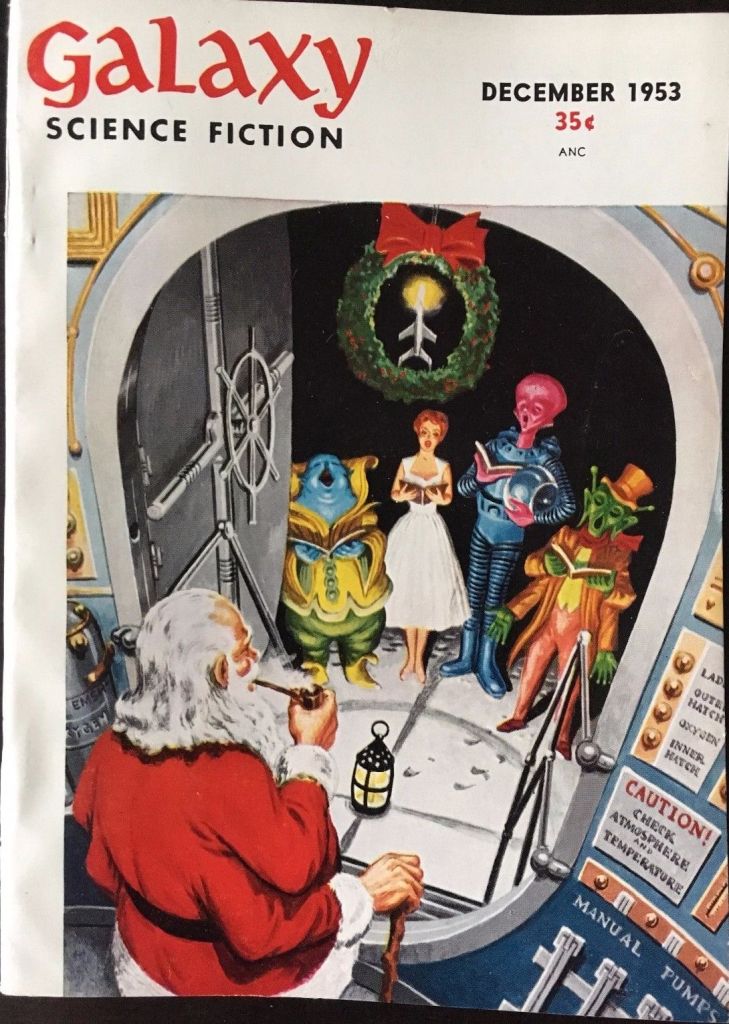
Episode 15 of Season 3 dropped this morning and episode 16 is already in post-production. in it, we’ll be finishing up The Caves of Steel, reading and discussing the third and final installment that ran in Galaxy Science Fiction in December 1953.
Our novel is not featured on the cover again, this time passed over for a nice holiday-themed illustration. Galaxy, evidently had a series of those.
In this concluding installment, Jessie confesses to conspiracy, Lije and Daneel play bad cop, uncomfortably robotic cop with a suspect and Baley cracks the case!
Here’s the promotion for this installment of The Caves of Steel from Galaxy’s November Issue.
Ed Emshwiller provides the artwork and we once again open with a two-page spread.
And here’s the rest of the synopsis if you want to refresh your memory about what’s already happened before you read the last installment or listen to our next episode.
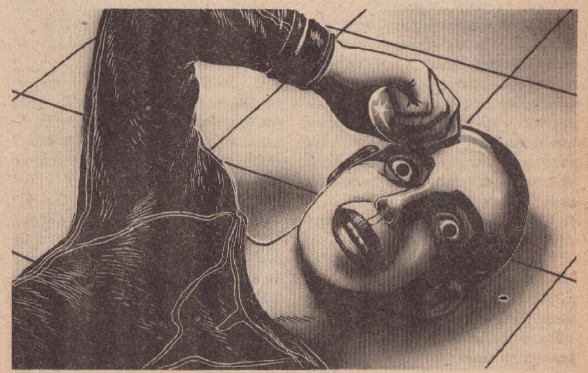
And here are the remaining illustrations from the story. Below we see Daneel closing on Clousarr during the interrogation (left), and R. Sammy as a murder vic… uh… property damage (right). We should keep our legal terms straight.
The final image shows Baley projecting the crime scene for Daneel and the commissioner.
If you follow our podcast you know that we’ve discussed Asimov’s reluctance to rewrite stuff many times. Even more frequently we’ve discussed… let’s call it the Great and Glorious Az’s ability to write female characters. We’ve speculated that, after attending Boys High School in Brooklyn, Seth Low Junior College, and Columbia University, neither of which were co-educational, it’s possible that Asimov simply hadn’t spent time with many women. Aside, of course, from his mother and sister.
The Robot Chronicles
We were therefore intrigued by the following quote from “The Robot Chronicles” as published in Asimov’s Gold: the Final Science Fiction Collection. At this point in the essay, Asimov writes about his individual Robot stories and what made them significant. Here’s what he had to say about “Liar!”
In the very next issue of Astounding, that of May 1941, my third robot story, “Liar!” appeared. The importance of this story was that it introduced Susan Calvin, who became the central character in my early robot stories. This story was originally rather clumsily done, largely because it dealt with the relationship between the sexes at a time when I had not yet had my first date with a young lady. Fortunately, I’m a quick learner, and it is one story in which I made significant changes before allowing it to appear in I, Robot.
You can find the story in any edition of I, Robot or The Complete Robot and you can see the original version in the May 1941 edition of Astoundinghere.
The original artwork for “Liar!” by Charles Schneeman
If you haven’t read it, “Liar!” tells the story of Herbie, a robot accidentally created with the ability to read minds. As the roboticists at U. S. Robots and Mechanical Men work to find out what caused this ability we get a first-hand look at how Herbie’s ability to read minds interacts with the three laws. We also get to see how Herbie’s subsequent behaviors affect the humans around him.
For those of us on the podcast, it was nice to get some confirmation for the theory we’d proposed on the show. For anyone who considers themself an Asimovologist, the changes to “Liar!” are intriguing for two reasons. The first is to see how Asimov’s treatment of women progressed to address the clumsiness that he perceived. The second asks how much of a rewrite he considers “significant.”
The Individual Edits
So let’s take a look at the changes. The first occurs in the fifteenth paragraph. Here’s the text from Astounding.
“Bogert is right,” said Dr. Calvin. “Ever since the Interplanetary Code was modified to allow robot models to be tested in the plants before being shipped out to space, antirobot propaganda has increased. If any word leaks out about a robot being able to read minds before we can announce complete control of the phenomenon, Tyrone and his demagogs (sic) could make pretty effective capital out of it.”
In the I, Robot version, the underlined part has been changed to, “pretty effective capital could be made out of it.” This change does not seem substantive. The mention of Tyrone was likely Asimov teasing a story that was ultimately never written. We would need evidence before we could say that for sure.
The next change occurs shortly after the first section break. Again and going forward, we start with the Astounding version.
“She paused to readjust the huge ‘No Entrance’ sign upon the door and then approached the robot with a friendly smile.”
Here, Susan Calvin is entering a room to bring books to Herbie. In the revised version the underlined text is omitted, which makes sense. Between this version and the publication of I, Robot, the character of Susan Calvin evolved into a no-nonsense professional thus the friendly smile seems to be a bit out of character. In a larger sense though, a disarming smile might ease interaction with another human but there is no reason to try that with a robot, much less a mind-reading one. The brilliant robopsychologist would have known this so the original neither fits the character nor the story.
Dr. Calvin and Herbie have a conversation about Milton Ashe. Eventually, we get this.
“The psychologist paused in thought and then looked up suddenly. ‘A girl visited him here at the plant half a year ago. She was pretty, I suppose—blond and slinky. And, of course, could scarcely add two and two.’”
In the book, “slinky” becomes “slim,” a more conservative and genteel description that seems more in keeping with Calvin’s personality. “Slinky” implies things about the way the woman holds herself and how she dresses. The combination of “slinky” with the remark about the young lady’s intelligence creates a different and less complimentary image of the character.
A bit later, we see this bit of conversation about Susan Calvin.
“He opened his eyes wide and frowned, “Say, Bogie, have you been noticing anything queer about the dame lately?”
The revised version replaces “dame” with “lady.” Another move toward more respectful language.
Next, we encounter one of the less substantive changes.
“Are you crazy? If you’ll reread Mitchell’s original paper in the Mathematical Journal—”
“Mathematical Journal—” becomes “Transactions of the Far—.” The latter sounds more like an actual journal, but it loses the emphasis that the paper appeared in a mathematics publication. That should have been clear from the context, however.
The most substantive change comes when Milton Ashe shows Calvin a sketch of a house he’s planning to buy. All of the underlined text is removed from the later version.
“Susan Calvin gazed across at him with melting eyes. There had been a preliminary self-consciousness when she had first forced her hair into curls and lacquered her fingernails a bright red — a silly everyone-is-snickering-at-me feeling — but it always vanished when she was with him. There was nothing then but the hard metallic voice of Herbie whispering in her ear —. ‘It’s really beautiful,’ she sighed…”
It’s an edit that improves the story. This sentence seems more suited to a cheesy romance comic or a movie like Beach Blanket Bingo than it does to an Asimovian robot story. This sentence seems especially out of character for Susan Calvin as the character had developed over many stories and many years.
Most of the remaining edits were made because the “Three Laws of Robotics” weren’t carefully codified until published in “Runaround,” which appeared ten months after “Liar!” It makes sense for the collection to use the language to which the readers had become accustomed. Thus, instead of this,
She faced them and spoke wearily. “You know the fundamental law impressed upon the positronic brain of all robots, of course.”
we get this.
“She faced them and spoke sarcastically, “Surely you know the fundamental First Law of Robotics.”
There’s the additional change from “wearily” to “sarcastically.” That’s more in keeping with Calvin’s character and because the two men she was talking to would unquestionably know the three laws; this isn’t a case of having to remind someone of the three laws; Calvin is making a rhetorical point.
But it’s also an opportunity to remind the reader of what the first law says, so while we initially got this,
“Certainly,” said Bogert. “On no conditions is a human being to be injured in any way, even when such injury is directly ordered by another human.”
After “Runaround,” we get the now-familiar wording.
“The other two nodded together. “Certainly,” said Bogert, irritably, “a robot may not injure a human being or, through inaction, allow him to come to harm.”
The insertion of “irritably” follows nicely from the inclusion of “sarcastically.” We get one more edit concerning the three laws. In Astounding, the exchange above is followed by this.
“How nicely put,” sneered Calvin. “But what kind of injury?”
And in I, Robot, “injury” becomes “harm,” which seems to fit better with the revised version of the First Law.
The first use of “robotics” in “Liar!”
An interesting aside: In “The Robot Chronicles” Asimov claims that the term “robotics” first appeared in print in the initial printing of “Runaround.” The Oxford English Dictionary, notes this and gives Asimov credit for inventing the word. The use of “robotics” predates that, however, as it’s used twice in “Liar!” in addition to the time noted above, which exists only in the revised version.
The final edit in “Liar!” aside from one that appears to fix a typo, comes in the following passage at the very end of the story.
“It was minutes after the two scientists left that Dr. Susan Calvin regained part of her mental equilibrium. Slowly, her eyes turned to the living-dead Herbie and the tight smile returned to her face.”
“Tight smile” is aptly changed to “tightness,” as the operant emotion at this point is anger. This again seems to fit Susan Calvin’s character better than the original.
A Holistic Look
It’s more apparent in retrospect than it would have been in 1950 when I, Robot was compiled but “Liar!” is an important story in the Asimov canon. It’s the first time the idea of a robot with mental powers is discussed, an idea that becomes a pillar of Asimov’s later work, and the Oxford English Dictionary recognizes it as the earliest known use of the word “robotics.” more importantly though, “Liar!” is the first appearance of Susan Calvin, one of Asimov’s most consequential and well-known characters. She’s so central to the early robot stories that the framing sequence of I, Robot is written as a conversation between Calvin and a biographer. Through this conversation, she introduces each chapter. I, Robot is Susan Calvin’s story and the introduction tells us that “In 2008, she obtained her Ph.D. and joined United States Robots as a ‘robopsychologist’ becoming the first great practitioner of a new science.”
So, let’s look at the changes holistically. There appear to be three categories.
There seems to be one change to smooth out the prose, where “Mathematical Journal—” becomes “Transactions of the Far—.” This reads better because the partial title seems more believable for an academic journal.
There are several bookkeeping changes, namely the one removing “Tyrone and his demagogues” and all those updating the Three Laws of Robotics. These are exactly the kinds of edits one should expect in a fix-up like I, Robot. In any series of stories, details will never be completely determined initially. The book will feel more cohesive if small changes are made for the sake of consistency.
The changes that remain must be what Asimov was referring to when he wrote, “This story was originally rather clumsily done, largely because it dealt with the relationship between the sexes at a time when I had not yet had my first date with a young lady.”
I’m not sure that these edits hit that mark and I’m certain that they fall short of being significant.
Let’s recap these changes. We have:
Calvin doesn’t approach Herbie “with a friendly smile.”
Calvin describes Ashe’s girlfriend as “slim” rather than “slinky.”
Ashe refers to Calvin as a “lady” rather than a “dame.”
The removal of the sentence where Calvin feels self-conscious about changing her hair and wearing make-up, but that feeling disappears when she’s with him.
So, are women written better as a result of these edits? When Asimov wrote about “significant” changes, it is reasonable to expect something like a fundamentally different subplot for Susan Calvin. Her subplot still resolves around a cringeworthy mistaken impression. It depends on some unfortunate tropes, like Calvin changing her hair and makeup to attract Ashe and destroying Herbie in a fit of pique. That subplot remains “clumsy,” and Asimov’s treatment of female characters isn’t significantly better. For example, although Ashe’s unnamed girlfriend is no longer “slinky,” she remains unable to add two to two.
But the changes are likely more about Susan Calvin than writing women in general or making the story less clumsy. It’s disappointing to ponder “Liar!” as Calvin’s initial appearance because it means that Asimov had the silly unrequited love subplot in mind and Calvin was created because the subplot required a female character. But over the following nine years Calvin and the characters surrounding her became the centerpiece of Asimov’s robot stories; they turned into the brilliant, serious professionals who drove the plots and resolved the problems. These edits are just enough to make this story fit with the rest of the book but is it a consistent portrayal? Let’s look at the framing sequence. In the run-up to “Liar!” Calvin tells the biographer “I was foolish once, young man. Would you believe that?” “No,” he replied.
Resources
Asimov, Isaac. “Liar!” Astounding Science Fiction, May 1941, pp. 43-55.
We’re not recording our next episode until Saturday, but if you’re reading ahead, we’ll be discussing chapters 8-13 of The Caves of Steel, corresponding to the second installment that was published in Galaxy Science Fiction in November 1953.
Galaxy SF, 11/1953
It’s an interesting issue. Asimov didn’t score the cover this time. The cover references the non-fiction piece about the famous experiment that saw complex amino acids generating spontaneously when the conditions on primordial Earth were recreated in a laboratory.
Also of interest is “Galaxy’s 5-Star Shelf.” which reviews a compilation of Olaf Stapledon’s work, the non-fiction Man in Space by Heinz Haber, Second Stage Lensman by E. E. (Doc) Smith, Against the Fall of Night by Arthur C. Clarke and Second Foundation. In that last review, Groff Conklin calls the now-completed Foundation Trilogy “Our first great sociological space opera.” He compares it favorably with Smith’s Lensman series saying, “…Asimov’s work, based as it is on fairly sound social principles and the activities of fairly normal human beings, has a pressing sense of reality that Smith’s fairy tales lack…” He concludes “it is a thoroughly satisfying and adult play of the scientific imagination.”
But back to The Caves of Steel. Here’s the promotion for this installment in Galaxy’s October Issue.
And here are some pages from the story.
i
I’m particularly liking the opening two-page spread, with artwork once again by Ed Emshwiller. It depicts the encounter in Chapter 8. The synopsis is nicely done as well and continues for the entire next page. Here’s the remainder in case you want to remind yourself of the last installment before continuing to read this one.
Finally, here are the rest of the illustrations from the story. We have Lije and Daneel leaving Space Town (top right), traveling through a power plant (left), and Daneel being examined by Dr. Gerrigel, a roboticist.
We just recorded our latest episode last night and we’re back to reading the works of the Great and Glorious Az.
We’re thrilled to announce that, by popular demand, we’ll be reading the Robot Novels beginning at the beginning with The Caves of Steel. That’s my go-to novel if I want to introduce someone to Asimov’s work.
This novel was written at a time when Asimov was trying to get away from being a “one-editor-writer” and so he was working with, among others, Horace Gold of Galaxy Science Fiction. Gold had serialized The Stars, Like Dust in Galaxy under the title Tyrann and he was anxious to serialize another. He suggested a novel about robots, but Asimov declined. Robots, thought Asimov, were for short stories; the ideas wouldn’t carry an entire novel.
So Gold suggested that Asimov write a detective story where the detective had a robot partner and Elijah Baley and R. Daneel Olivaw were born. John W. Campbell had always claimed that a science fiction mystery story was a contradiction-in-terms and Asimov wanted to prove him wrong. The Caves of Steel became Asimov’s most successful book up to that point.
But first, it was serialized in Galaxy Science Fiction in October, November, and December of 1953. For this episode, we’re reading the first installment which corresponds to chapters 1-7 in the book. If you’re interested in reading The Caves of Steel as it first appeared, you can find that issue of Galaxy here courtesy of Archive.org but either way, you can enjoy the original artwork by Ed Emshwiller right here. Our episode will be out in a few days!
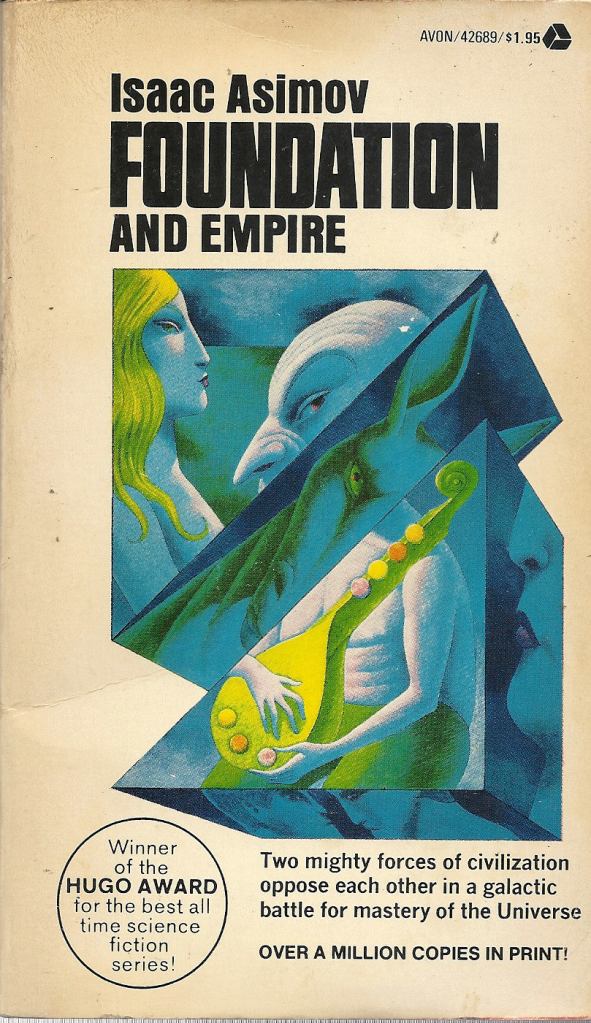
If you’re keeping up with the Stars End Podcast, Episode 8 has been out for about a week, and Episode 9’s release is imminent. In these two episodes, we discuss the entirety of “The Mule” as we know it from Foundation and Empire. If you’re reading along, of course, it’s pretty easy to find a copy of the book including on Archive.org.
If you want to read this story as it first appeared in Astounding Science Fiction, it appears in the November and December issues from 1945. Not-at-all coincidentally it’s broken up just as we did it on the podcast. The first installment covers the Foundation and Trader Worlds first learning about the Mule and then considering how to respond. It corresponds to Chapters 11 (Bride and Groom) through 18 (The Fall of the Foundation) and ends, as you might guess from the title, with quite a dramatic moment. The December installment covers the remainder of the story and completes the tale with a search for the Second Foundation. Asimov’s writing had gotten better here as evidenced by two nice touches; Mayor Indbur III on Terminus and Emperor Dagobert IX on Neotrantor are excellent personifications of their respective dominions.
As we’ve been seeing, Asimov changes very little from Astounding to the novels. As was the case with “The General” The obligatory Encyclopedia Galactica entry that serves as a prologue is absent, replaced in the first part, by this teaser, probably written by John W. Campbell.
First of two parts of Asimov’s first serial of the Foundation — and of the one factor that even Hari Sheldon could not predict — could not defend the Foundation against. The defenses were based on human psychology; The Mule was a mutant!
Unlike for “The General,” unfortunately, the layouts have largely reverted to rectangles and a lot of the images are tiny. We can hope they do a bit better in part two.
Once again there are some nice illustrations in both parts by Paul Orban. Unfortunately, the scans of these issues aren’t as clean as the previous installments have been so the image quality is uneven.
Second of two parts. Across the ruined, dying Galactic Empire , fleeing from a conquered Foundation, three frightened people and the hunted jester of the new conqueror, the Mule, sought the Second Foundation — the only hope, but it must be warned
That’s followed by a summary of part 1, which you can find here: Astounding Science Fiction, December 1945 if you’d like to read it. Paul Orban’s illustrations are below. They’re larger and more textured than the illustrations from Part 1.
If you’re following our podcast Episode 6 dropped on Wednesday and in it, we discuss “The General” from Foundation and Empire. If you’re reading along I’m sure that Apple and/or the publishing company have made sure that it’s available in all sorts of places and there is of course your public library or Archive.org.
The Empire was the theoretical obstacle to the growth of the Foundation in the first book. In “The General” we meet Bel Riose a general loyal to the Empire who will be the first to oppose the Foundation directly. What will this mean for Seldon’s Plan? You’ll have to read it and then listen to our podcast to find out.
And if you’re looking for a more nostalgic or, dare we say interestingly atavistic (to borrow Emperor Cleon’s description of Bel Riose) way to read “The General” we can again turn to Archive.org.
This story appeared for the first time under the title “Dead Hand” in the April 1945 issue of John W. Campbell’s Astounding Science Fiction. The cover proclaims “A Foundation Story by Isaac Asimov!” Evidently, the series has developed a following as well as the Author.
The story as it appears it’s very similar to the book’s version. Mostly the text is word-for-word the same, but there are some differences. The Encyclopedia Galactica entry, seemingly obligatory in the books is absent. In its place, we get this preview.
The Foundation had always been weak — but heretofore the sharp wits of it’s leaders had protected it. But this time — Foundation’s leaders were stupid men , and a clever general, under a strong Emperor was attacking.
As well as this abbreviated prologue.
Four centuries of internal wrenchings subsided into another faint interval of quiet and order, that was half-exhausting, and for twenty-five years under Cleon II the Galactic Empire experienced the milky feeble gleam of a last Indian Summer.
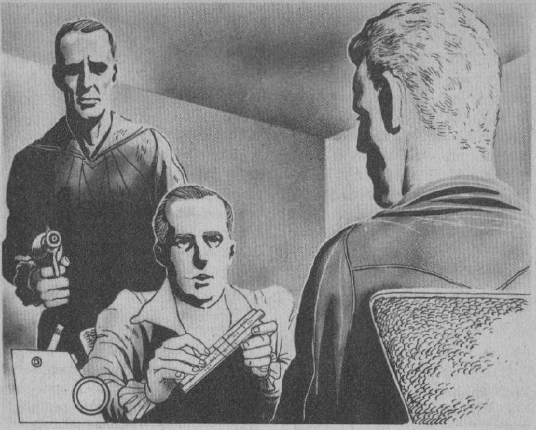
The other big difference is the internal artwork, four nice images by Paul Orban who seems to be settling in as the Foundation series illustrator.
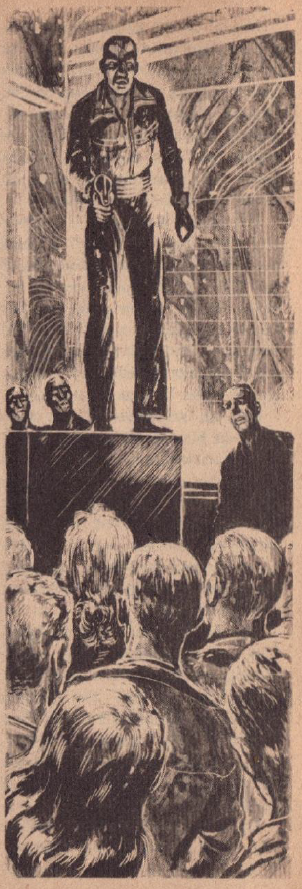
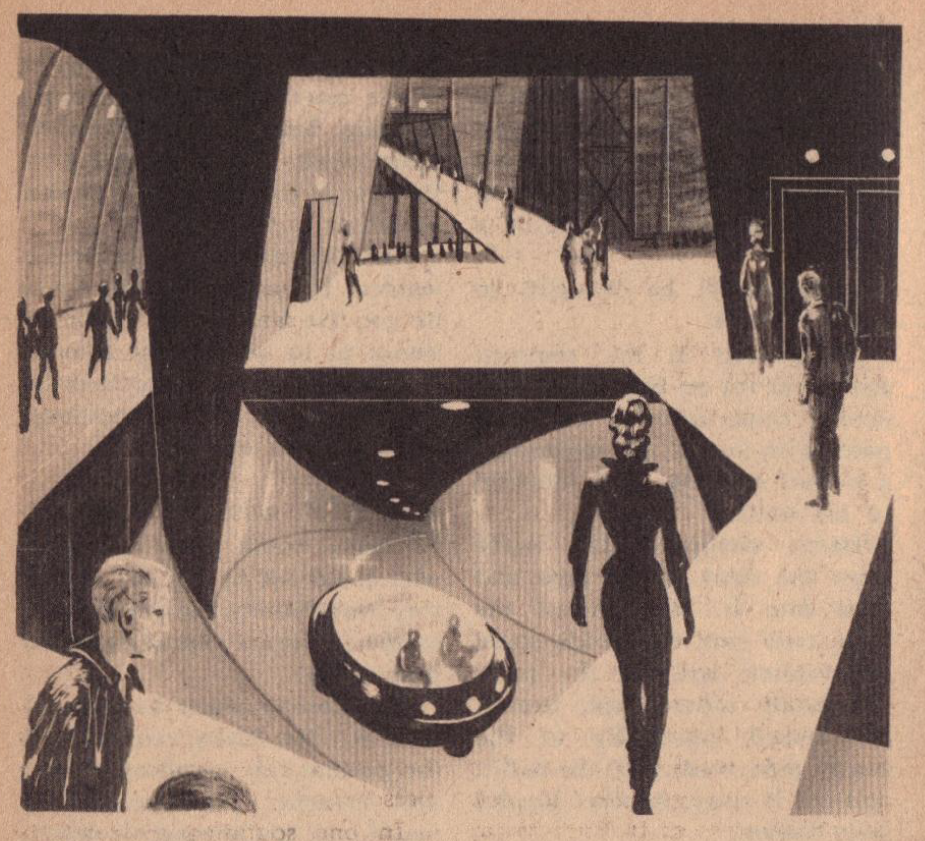
The presentations of the image have evolved here. The opening drawing depicts the most exciting moment in the story rather than something that happens toward the beginning. In previous installments, the illustrations are square or nearly so. Here the second and third images are “L” shaped; strategically placing some white space allows for larger images without sacrificing space for the story. The final image is tall and narrow, taking up an entire column on one page. It seems that Campbell is allowing Orban more freedom to change up his layouts to good effect.
The internet has since its inception been a remarkable tool for gathering and sharing information. Lately, it’s been both better and worse than it used to be and one of the reasons that it’s both is Archive.org.
It’s a literal treasure trove of information. Think of it as an internet library. If you’re looking for something, especially something out of print, there’s a good chance that it’s there, scanned and ready to be checked out. Archive.org was especially gracious during the lockdown. In May 2020, when I taught Science Fiction, all the novels we covered as well as most of the short stories were available there for my students to use free of charge. It was a huge help.
So, why better and worse? Well, having access to “a literal treasure trove of information” has a bit of a downside. When I’m researching something like, for example, Asimov Trivia there are things to find that I’ve never even heard of and didn’t know I needed. Sometimes this is helpful, like when I discovered Isaac Asimov Presents: SuperQuiz (See Episode 5). Other times it’s not; I take a long and winding road that doesn’t lead anywhere. Next thing I know I’m 6 books over and barely even aware of where I started or what I was doing. That’s fun, but it’s not productive unless serendipity lends a hand. No kidding. Paragraph two got put on hold while I looked up something random.
Suffice it to say that Archive.org is, well, astounding. But “What does this have to do with Foundation?” you might be wondering. If you’re following Stars End: A Foundation Podcast or even if you’re merely looking forward to the forthcoming Apple TV+ series you might be wanting to reread the books. They’re all there for sure.
But what I’m really excited about is that Archive.org has many issues of John W. Campbell’s Astounding Science Fiction. That’s the seminal SF pulp that defined the genre. There we find the original Foundation stories 8 years before they were collected into book form. This is the DNA of the Foundation series. As the story was developing, while Asimov was figuring out how psychohistory works, we can see this universe evolve in Astounding. And as an added bonus, we can read the stories with their original artwork, enjoying them as few have been able for almost eight decades. So here are the pieces of Foundation as they appeared in Astounding Science Fiction. Not too different. With his prodigious output, Asimov was known for writing rather than rewriting but I’ll note the changes that I noticed.
Foundation isn’t actually a novel, it’s what is known as a “fix-up,” a collection of short stories linked together with a framing sequence. “The Psychohistorians” is that framing sequence and is the only part of Foundation that was original to the book. It introduces Hari Seldon and sets up the universe replacing a much shorter introduction that ran as part of the next story.
“The Encyclopedists” originally ran in the May 1942 issue of Astounding under the title “Foundation.” Other than the short introduction that was supplanted by “The Psychohistorians” it’s largely the same as the version from the book.
There are two lovely illustrations by Manuel Islp and the issue also features “Asylum” by A. E. Van Vogt and “Beyond this Horizon” by Robert Heinlein writing as Anson MacDonald.
The story continues just a month later as “The Mayors” was published under the title “Bridle and Saddle.”
John W. Campbell showed a lot of enthusiasm for this story. Taking up half of the previous issue’s coming attractions, it was the lead story for the month, it was featured on the cover and was graced with 4 (Count ’em! 4!) lovely illustrations by Charles Schneeman. You can click on any image in the gallery for a better look.
For a science fiction adventure story the art work sure shows a lot of people sitting in chairs.
The issue also includes “My Name is Legion” by Lester Del Rey, “Proof” by Hal Clement and “The Slaver” by L. Ron Hubbard who actually wrote some Science Fiction before branching out into… let’s call it other areas.
“The Traders,” the shortest section of Foundation was published as “The Wedge” in Astounding’s October 1944 issue with little or no fanfare. This story has the most significant difference between the magazine and book versions. Here the main character is named Lathan Devers rather than Limmar Ponyets as it is in Foundation. The story has three illustrations by Frank Kramer.
“The Big and the Little” appeared in the August 1944 Issue of Astounding and once again it’s very similar to “The Merchant Princes.” There’s a difference that’s noticeable immediately though, rather than opening with a quote from the Encyclopedia Galactica, it begins with a different quote that prefigures the names of the sections of Foundation.
“Three Dynasties molded the Beginning: the Encyclopedists, the Mayors, and the Traders…”
Ligurn Vier, ‘Essays on History’
We never really see the traders as a formal dynasty leading the Foundation but perhaps we can infer one; in this story, we meet the third major figure in Foundation History after Hari Seldon and Salvor Hardin the first of the Merchant Princes, Hober Mallow.
Like “Bridal and Saddle,” “The Big and the Little” is both the lead and cover story for this issue. It is illustrated with six pictures rendered by Paul Orban.





















 Stars End: A Foundation Podcast