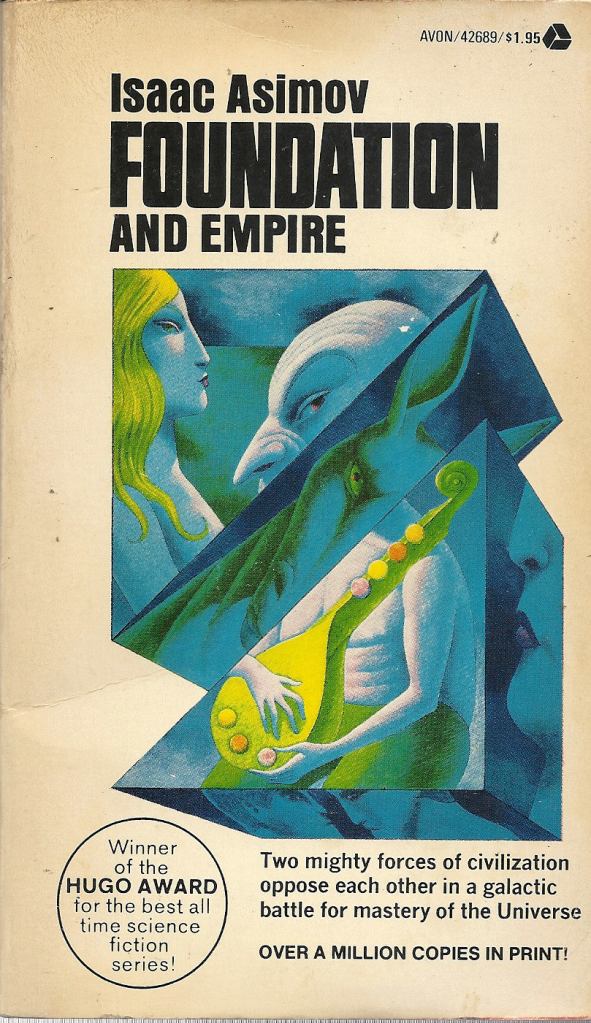
If you’re keeping up with the Stars End Podcast, Episode 8 has been out for about a week, and Episode 9’s release is imminent. In these two episodes, we discuss the entirety of “The Mule” as we know it from Foundation and Empire. If you’re reading along, of course, it’s pretty easy to find a copy of the book including on Archive.org.
If you want to read this story as it first appeared in Astounding Science Fiction, it appears in the November and December issues from 1945. Not-at-all coincidentally it’s broken up just as we did it on the podcast. The first installment covers the Foundation and Trader Worlds first learning about the Mule and then considering how to respond. It corresponds to Chapters 11 (Bride and Groom) through 18 (The Fall of the Foundation) and ends, as you might guess from the title, with quite a dramatic moment. The December installment covers the remainder of the story and completes the tale with a search for the Second Foundation. Asimov’s writing had gotten better here as evidenced by two nice touches; Mayor Indbur III on Terminus and Emperor Dagobert IX on Neotrantor are excellent personifications of their respective dominions.
As we’ve been seeing, Asimov changes very little from Astounding to the novels. As was the case with “The General” The obligatory Encyclopedia Galactica entry that serves as a prologue is absent, replaced in the first part, by this teaser, probably written by John W. Campbell.
First of two parts of Asimov’s first serial of the Foundation — and of the one factor that even Hari Sheldon could not predict — could not defend the Foundation against. The defenses were based on human psychology; The Mule was a mutant!
Unlike for “The General,” unfortunately, the layouts have largely reverted to rectangles and a lot of the images are tiny. We can hope they do a bit better in part two.
Once again there are some nice illustrations in both parts by Paul Orban. Unfortunately, the scans of these issues aren’t as clean as the previous installments have been so the image quality is uneven.
Second of two parts. Across the ruined, dying Galactic Empire , fleeing from a conquered Foundation, three frightened people and the hunted jester of the new conqueror, the Mule, sought the Second Foundation — the only hope, but it must be warned
That’s followed by a summary of part 1, which you can find here: Astounding Science Fiction, December 1945 if you’d like to read it. Paul Orban’s illustrations are below. They’re larger and more textured than the illustrations from Part 1.
Hello, again folks! It’s 8/8 (or if you write dates the European way 8/8) and here we are with Episode 8, “It’s a Dead Hand Against a Living Podcast.” We’re quite proud, we now officially have just as many episodes as Manimal! Imagine! For those of you tracking our milestones, eight is a very round number: It’s “10” in base eight, “20” in base four, and “1000” in base two. Soon, once we’re past the Manimal barrier, we’ll quickly approach an actual, genuine round number. In base ten even. Tom Lehrer tells us that “Base eight is just like base ten really, if you’re missing two fingers” but maybe it will be even better!
As for what’s in store we start off with our “Apple TV+” minute where we see what we can learn from an interview with David Goyer, Foundation‘s show-runner. We have another round of “Asimov Trivia” and discuss the first half of the second half of Foundation and Empire, “The Mule.” One of the highlights of the series.
Coincidently, this part of “The Mule” ran in the November 1945 issue of Astounding Science Fiction which was the first issue to go to press after the Atomic Bomb was dropped on Hiroshima. We’ll take a moment to reflect on John W. Campbell’s editorial from that issue.
The internet has since its inception been a remarkable tool for gathering and sharing information. Lately, it’s been both better and worse than it used to be and one of the reasons that it’s both is Archive.org.
It’s a literal treasure trove of information. Think of it as an internet library. If you’re looking for something, especially something out of print, there’s a good chance that it’s there, scanned and ready to be checked out. Archive.org was especially gracious during the lockdown. In May 2020, when I taught Science Fiction, all the novels we covered as well as most of the short stories were available there for my students to use free of charge. It was a huge help.
So, why better and worse? Well, having access to “a literal treasure trove of information” has a bit of a downside. When I’m researching something like, for example, Asimov Trivia there are things to find that I’ve never even heard of and didn’t know I needed. Sometimes this is helpful, like when I discovered Isaac Asimov Presents: SuperQuiz (See Episode 5). Other times it’s not; I take a long and winding road that doesn’t lead anywhere. Next thing I know I’m 6 books over and barely even aware of where I started or what I was doing. That’s fun, but it’s not productive unless serendipity lends a hand. No kidding. Paragraph two got put on hold while I looked up something random.
Suffice it to say that Archive.org is, well, astounding. But “What does this have to do with Foundation?” you might be wondering. If you’re following Stars End: A Foundation Podcast or even if you’re merely looking forward to the forthcoming Apple TV+ series you might be wanting to reread the books. They’re all there for sure.
But what I’m really excited about is that Archive.org has many issues of John W. Campbell’s Astounding Science Fiction. That’s the seminal SF pulp that defined the genre. There we find the original Foundation stories 8 years before they were collected into book form. This is the DNA of the Foundation series. As the story was developing, while Asimov was figuring out how psychohistory works, we can see this universe evolve in Astounding. And as an added bonus, we can read the stories with their original artwork, enjoying them as few have been able for almost eight decades. So here are the pieces of Foundation as they appeared in Astounding Science Fiction. Not too different. With his prodigious output, Asimov was known for writing rather than rewriting but I’ll note the changes that I noticed.
Foundation isn’t actually a novel, it’s what is known as a “fix-up,” a collection of short stories linked together with a framing sequence. “The Psychohistorians” is that framing sequence and is the only part of Foundation that was original to the book. It introduces Hari Seldon and sets up the universe replacing a much shorter introduction that ran as part of the next story.
“The Encyclopedists” originally ran in the May 1942 issue of Astounding under the title “Foundation.” Other than the short introduction that was supplanted by “The Psychohistorians” it’s largely the same as the version from the book.
There are two lovely illustrations by Manuel Islp and the issue also features “Asylum” by A. E. Van Vogt and “Beyond this Horizon” by Robert Heinlein writing as Anson MacDonald.
The story continues just a month later as “The Mayors” was published under the title “Bridle and Saddle.”
John W. Campbell showed a lot of enthusiasm for this story. Taking up half of the previous issue’s coming attractions, it was the lead story for the month, it was featured on the cover and was graced with 4 (Count ’em! 4!) lovely illustrations by Charles Schneeman. You can click on any image in the gallery for a better look.
For a science fiction adventure story the art work sure shows a lot of people sitting in chairs.
The issue also includes “My Name is Legion” by Lester Del Rey, “Proof” by Hal Clement and “The Slaver” by L. Ron Hubbard who actually wrote some Science Fiction before branching out into… let’s call it other areas.
“The Traders,” the shortest section of Foundation was published as “The Wedge” in Astounding’s October 1944 issue with little or no fanfare. This story has the most significant difference between the magazine and book versions. Here the main character is named Lathan Devers rather than Limmar Ponyets as it is in Foundation. The story has three illustrations by Frank Kramer.
“The Big and the Little” appeared in the August 1944 Issue of Astounding and once again it’s very similar to “The Merchant Princes.” There’s a difference that’s noticeable immediately though, rather than opening with a quote from the Encyclopedia Galactica, it begins with a different quote that prefigures the names of the sections of Foundation.
“Three Dynasties molded the Beginning: the Encyclopedists, the Mayors, and the Traders…”
Ligurn Vier, ‘Essays on History’
We never really see the traders as a formal dynasty leading the Foundation but perhaps we can infer one; in this story, we meet the third major figure in Foundation History after Hari Seldon and Salvor Hardin the first of the Merchant Princes, Hober Mallow.
Like “Bridal and Saddle,” “The Big and the Little” is both the lead and cover story for this issue. It is illustrated with six pictures rendered by Paul Orban.
As foretold! Mayors! Bridles! Saddles! Oddly, no actual horses! And the ultimate answer to the ultimate cliffhanger! It’s “A Podcast must protect its own existence as long as such protection does not conflict with the First or Second Episode!”
Also show news, we react to the trailer (this one, here)…
…and more Asimov trivia! Join us! Please rate and review.
Our second episode, entitled “Podcast must obey the orders given it by human beings except where such orders would conflict with the First Episode” is posted, and available wherever fine podcasts blossom or will be when Anchor gets around to uploading it for us. Of course, we are now begging the question… what will the fourth episode be called?
We start discussing the first novel, Foundation, in earnest and get all the way through the first two stories, “The Psychohistorians,” and “The Encyclopedists.” We also try our hand at a new segment, “Asimov Trivia.” You can join us at the link below.



 Stars End: A Foundation Podcast