“It’s a Bloodless Podcasting Coup” in which we’re joined by friend of the show, Travis Johnson, as we talk about Foundation, S2E07, “A Necessary Death.”
That title sure sounds dreary so it’s hard to believe that it’s attached to an episode that’s just so compulsively watchable! This episode is so compulsively watchable that no fewer than three characters IN the show are themselves watching the show. And that’s last week’s episode! It’s so compulsively watchable that next week’s episode is rumored to consist of nothing but characters watching this week’s episode! It’s so compulsively watchable that one of our hosts has watched the episode so many times that he’s lost count of just how many! Want to know who watched so many times? You’ll have to listen to our episode (and then make an educated guess) to find out!
And meanwhile the pile of bodies at Tellum Bonds’s feet just… keeps… getting… larger…
You want to hear about this episode! Travis and we want to tell you about this episode! You don’t want to miss that and neither do we!
Here we go again. Joseph’s reactions, thoughts, and theories from watching the episode. This one for some reason took a lot longer to sift through than the typical episode. Simultaneously published at StarsEndPodcast.com.
Watching Foundation S2E06
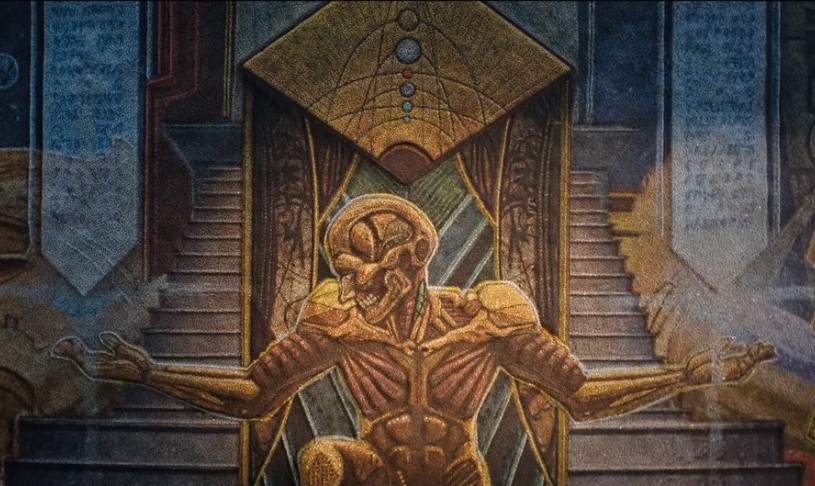
Watching the opening credits. I’ve noted before the feeling of decay it evokes. Today though I’m pondering the visual similarity between the opening and the Mural of Souls. That decay permeates the palace and surrounds the Genetic Dynasty. That must be intentional. And it works.
Ignus by the Sea.
Hari’s staring out into the ocean interspersed with chaotic images from under the water. What are those about? Still, he seems contemplative.
Salvor approaches. She can’t sleep. “Weird dreams. Arguments with strangers. I think it’s this place.” Nice foreshadowing, that’s the episode in a nutshell.
She starts a conversation with a kid, who opens with “Your Mother’s memories are full of water.” It’s already clear that water is an important image within the episode.
The kid tries to teach her how to communicate telepathically and then shows her disturbing memories from his past. I’m not sure it’s an execution technically but it’s certainly indicative of the kind of persecution the mentalics must have faced. Joanne is bothered by how casually characters in this series kill each other.
“People didn’t like that I knew what they were thinking.” There’s a ton of places they could go with this as a metaphor.
But I end up liking the kid.
He brings Salvor to the Mentalics’ village where she’s swarmed by them both physically and mentally. There’s a montage of images of harsh persecution that end with Tellum Bond as their savior.
Cut to Salvor conversing with Hari, Gaal, and Tellum. She’s talking about her experience. “I could see and feel everything they experienced. All that pain and suffering. And relief.“ Tellum replies, “Now you know why we are forced to hide. We know things. Know when the kings are full of shit or the husbands are cheating.” Rereading this later that totally sounds like a blackmailer’s point of view.
Tellum’s perspective certainly portrays the Mentalics in a sympathetic light, a stark contrast to the closing moments of the last episode.
Hari makes a strong plea for help while Tellum is disinterested. He invokes the Mule and claims that the alternative to helping is destruction.
Gaal’s precognition comes as a surprise to Tellum.
The language here bugs me. “Gaal’s future is real” ignores all sorts of things that will happen with some kind of probability distribution. It might be the most probable future right now, but it isn’t “the future.” There is no “the future” unless the universe is completely deterministic. It strikes me that this is the same thing that made me uneasy with Brother Dusk worrying about his fingerprints.
We know that clones are not identical to their progenitor, some characteristics will express themselves probabilistically. The fingerprints of a clone, like the markings on a cat will be different.
Now we’re discussing an “inescapable future.” Is that on the table? If it’s true then Psychohistory is pointless and there is no drama. It’s possible that we’re looking at the characters thinking it’s on the table even though it can’t be. Tellum makes some sense until she formulates the issue entirely in terms of Hari’s perceptions. That’s way too limited.
But we’re back onto free will. Jon will be happy.
Hmmm… even natural phenomena occur according to some probability distributions, therefore the universe cannot be deterministic. Thus we have free will. Sounds like something, but I think I’ve used a false dichotomy.
Trantor. Almost.
I like how the ship appears to be aflame as it exits jump space, it’s a nice effect. Is this Bel Riose’s ship? All the Empire’s ships look the same to me.
We zoom in. The people in cryosleep are visible from the outside of the ship. It looks cool, but is there a design scheme that justifies this? It seems wildly dangerous. And dumb.
It’s Poly and Constant’s ride. We see a spacer, named “She Shines Brightly.” Her torso is transparent and what we can see inside looks technological. Yet she asserts that she’s human. Is that in the sense of George 9 and George 10? It looks like a great deal more than genetic engineering.
But modifications to the Spacers have been happening for 600 years, “When our servitude was forged.“ “Forged” evokes chains.
The inside of Trantor station looks a lot like the inside of the Star Bridge. But this thing must be far less efficient than a space elevator.
We get another huge Cleon-Welcome-Hologram. I didn’t think about it back in Season 1 but the grainy texture of the figure also harkens back to the opening credits and their images of decay.
Poly comments “best to assume will be met with resistance.”
They get through customs, and the tone is light even though Constant calls the official “terrifying in a really friendly way.” Poly wants to party “on the prophet’s expense account.”
Ignus
Salvor and Hari have a long chat at the beach on a wide variety of topics including why someone gave Hari a body and who is at fault for what happened with Raych.
Tellum comes to Gaal on the Beggar under the pretense of apologizing for what she said about Hari. When Gaal points out that Hari’s trying to save humanity, Tellum replies, “Me too, the ones who deserve it.” That’s a very supervillain thing to say. By and large no one thinks that they themself is evil. Everybody thinks that they are the good guy.
Tellum is back to being sinister. She is full of praise and mind games as she offers Gaal leadership of the Mentalics. The price is turning away from Hari. “You can even call them the Second Foundation if you want” is disingenuous.
Space: The Spirit.
Hober drops out of jump space in the middle of nowhere. He’s trying to calm down Beki when a huge ship appears.
Ignus
Salvor and Hari are still at the seaside. The previous conversation continues. Hari asserts that the Second Foundation is not there to fight the First only to prod it. We learned that Pinocchio Harry, edited Hologram Harry’s knowledge so he does not have the complete plan, which makes sense. From the books, we know that The Foundation shouldn’t have psychohistorians because it should be developing naturally. Except the show pooped on that idea in season one. We also learn that Pinocchio Harry can use the Prime Radiant to spy on Hologram Hari because of quantum gobbledygook. They don’t point out that windows work both ways.
Hari and Salvor pull a fish from the water just as Gaal and Tellum arrive. Gaal is surprisingly amenable to Tellum’s offer now. She’s been hooked.
Hari is rightfully suspicious and Tellum confronts him with information she’s pulled from his mind. He storms off.
Trantor
Poly and Brother Constant finally get to their room and Constant tucks Poly into bed. He asks her to flush some of his drugs.
Then he goes on about belief and faith. Faith is pure. Poly believes in Hari Seldon because he saw Hari when he first left the Vault. But Constant has faith and her faith puts Poly’s belief to shame. This is probably the least Asimovian thing in this entire series. It brings me back to the following quote.
There are many aspects of the universe that still cannot be explained satisfactorily by science; but ignorance implies only ignorance that may someday be conquered. To surrender to ignorance and call it God has always been premature, and it remains premature today.
Isaac Asimov, “The Threat of Creationism,” The New York Times, 14 June 1981
But that’s not important right now. The Secret Police are here with some party favors.
Cut to Day in a Stadium.
This stadium would be a great place to see the Stones. Will Keith still be alive?
Huge crowd. Dignitaries on stage. Dawn and Dusk are well off to the side.
“Hey! Do you know how the Aztecs used to rip people’s hearts out? Well, guess what! I’m engaged!”
He reveals a comically large statue of Empress Winoset, mother of Cleon I.
Symbolically this signals a huge political shift away from the Genetic Dynasty
Bow before your new Empress, Sereth the First! Also, I am ending the Genetic Dynasty, we will be making Emperors the old-fashioned way! With test tubes and Petrie dishes! Wait, they do that now… With other test tubes and Petrie dishes! Plus a cocktail stirrer!
Day steps back and Sereth steps forward. This was not a planned part of today’s event.
She leads with some faux populism. “I am not wed to just one man, I am wed to all that people of imperium … I vow to you that your voices will be heard.” It’s the proper inverted pyramid of leadership. But I don’t think Sereth buys it. Day certainly doesn’t buy it and looks pissed.
This might lead to a January 6th metaphor, but who would be the home team, and would be the challengers?
The Spirit
Hober has evidentially been brought on board that huge ship. He discovers a vast empty space with little to no gravity and floaty spacers. If this thing were spinning it would make sense. But that hallway seemed to have normal gravity, and it would’ve been on the axis. Those two things are contradictory. A spacer approaches, “Why have you defiled the Home-Swarm?
This must be about the Foundation giving the spacers something to free them from the yoke of the Empire. Spacers gotta space!
Ignus
Salvor finds Hari and he’s kind of a mess. Tellum has been messing with his head. He tells Salvor to protect the Prime Radiant then runs off.
Salvor is approaching Gaal and now Gaal is being weird. “It can’t be all about the plan all of the time. I didn’t have time to shop, but I picked up this piece of fruit off of the ground. Happy birthday!“
All kidding aside, it’s kind of sweet.
Then they see Hari take off in the Beggar. Is it even space-worthy after that crash? Joanne Immediately points out the ship should only respond to Salvor. Something’s fishy.
Cut to a pool in the ocean. Hari’s tied to steaks in the water and the tide is coming in. This is a particularly cruel way to execute someone. The only purpose it might serve is to give the protagonists time to figure out what’s going on and stage a rescue. Well and a here’s-my-evil-plan-so-you-can-figure-out-how-to-stop-it speech.
Tellum et al. created an illusion and moved the ship. They can therefore search for the Prime Radiant at their leisure. That is probably a lie. I suspect that the ship is right where they left it.
The Mentalics here are the proverbial group who respond to persecution by persecuting others. Two wrongs don’t make a right your mom would say.
There’s the “who’s human and who isn’t” thing again. “This isn’t murder, I would never kill one of my own.” No nuance here. If the gig on Ignus doesn’t work out, Tellum could have a second career programming robots on Solaria.
Hari has faith in the plan. Tellem says she has faith in Gaal. Then she leaves Hari to die.
As Hari sinks under the water we see that same image from the very beginning of the episode. Perhaps this entire thing is a flashback.
But we get some backstory for Hari.
Little Kid Hari has figured out a pattern of some stampeding animals. Is he safe because he walked the path through them? It seems impossible that the Moon Shrike stampede even has a pattern. But we’re in a universe where Psychohistory works, so who am I to judge?
Scares his Mom. Pisses off his Dad, who smacks him in the mouth.
Mom calls him Hariton. Hariton!?!
Cut to a University. And that haircut. Hari looks like the son that 1964’s Ringo Starr and Moe Howard never had.
We see the highlights of Hari and Yanna’s relationship starting with Yanna inviting herself to share Hari’s Office. “Don’t worry, Dr. Seldon. I think your theory is brilliant. You just need help making it practical. We are going to do wonderful things together.”
We can only call her “Dors Light.”
We get the highlights of Hari and Yanna’s relationship in montage form: Hari and Yanna making a date, Hari showing Yanna a prototype of the Prime Radiant, and Yanna telling Hari that she’s pregnant.
Then the unpleasant sequence begins. Twer drops by to tell Yanna and Hari that they must move to Streeling University on Trantor or else have their work seized.
Hari won’t. Yanna tells Hari, “Streeling University is tucked up against the ribs of the Empire, and that’s the best place to slide in a knife.“ Then she drops the title, “The gods made wine to compensate those who can’t afford revenge.“
That ties most of the episode together and this sequence ends in a dark place. Hari bent or revenge is not as interesting as Hari wanting to save humanity. There are a lot of parallels between Tellum and Hari being pushed through intolerable abuse to act darkly in return. This might be foreshadowing Hari’s response to his attempted murder assuming he survives. It may, it just now occurs to me, might be the answer to the question Salvor won’t shut up about. “Why give Hari a body?” “Because I really want to kill that guy!” Ultimately though it’s the Phara thing all over again except Phara was interesting and nuanced.
And there’s a huge risk here. For me Hari’s close to Bojack Horseman or Walter White territory. This will be a worse series if the audience has to write him off as an irredeemable bastard.
This episode might be a low point for the series. It was disjointed and just seemed to wallow in darkness for the sole purpose of being grim. Bleh. Go back to the strangely out-of-place attempts at comedy, please.
“It Takes a While Yet for the Decay to Reach the Podcast” in which we discuss Foundation, S2E06 “Why The Gods Made Wine.”
We hope that we haven’t spoiled you with all the great guests lately, but this week it’s back to just the three of us muddling along.
And speaking of spoiling, as always, we’re working on the assumption that if you’re listening you’ve watched the episode. It’s up to you, but if you don’t want the latest episode of Foundation to be as spoiled as a swig of sour milk you know what to do!
If you were hoping for a Hari-centric episode you should be careful what you wish for. It isn’t all Hari all the time though. Two moments with Hober flash by. Queen Sereth expediently and efficiently drops an audacious power play in front of a stunned and scowling Brother Day. Constant and Poly have barely started trying to see Trantor on 30 Altarian dollars a day when the Secret Police all crowd into their room.
The big chunks of the episode are dealing with the Mentalics on Ignus and a flashback to Hari and Dor… uh… Yanna’s brief time together.
But there’s not much humor in this one. It’s dark. Want a theme for the episode? Let’s get the full quote from the title drop. “The gods, made wine to compensate those who can’t afford revenge.” And I’m pretty sure we’re all out of wine.
You’ve figured this out already, yes? Joseph goes on about the episode while watching it. Here be spoilers. Simultaneously published at ComicsTheUniverseAndEverything.net.
Watching Foundation S2E05
Space, a ship.
It must have been the Deliverance. We’re flashing back to just before Hari’s murder.
“I’m not angry, I love you.” “I know that too, Son.” Hari is awful. I’ve never understood why people love that line from Han Solo btw.
Scene shift. Pinocchio Hari is dreaming and talking to an image of Raych. Doubling down. “You got them all fooled. They think you care about them. But the truth is you don’t care about anyone.“
So we’re inside Hari’s head and this is about his insecurities. He still sucks though.
“I was your son and you let me die… we both know it wasn’t the first time.“ What the hell is that about?
The scene shift makes it unclear whether that was a dream or a hallucination. Now Hari is investigating his new body. Just pinch yourself, dude. No need to stick yourself with a knife. If there’s a tetanus booster on this ship at all it’s over a century old!
Space. Again. This time that’s clearly the Beggar.
Now Gaal and Salvor are mocking Hari for having legs. And speculating about Kalle. Maybe she wasn’t the manifestation of the Prime Radiant.
Hari says, “My body is as it was the moment before I died.” Great. So he’s terminally ill again? That seems to be a lot of wasted effort.
They jump to the conclusion that Hari’s been cloned. I have a hard time buying that there is a continuity of consciousness in that case. Teevee magic I guess, but it doesn’t work that way with the Cleons.
This loops us back around to “Measure of a Man” again. Specifically, why Data did not want to be disassembled. Except it’s even harder to believe with an organic human.
“Someone wanted you to be flesh and blood again. And after all that trouble you went to, turning yourself into an idea.” That’s funny.
Everyone’s being incongruously flippant in this scene.
The Empire had to physically send someone to Siwenna for an update. These three learn what’s up with the Foundation by listening to the radio. How does that work?
On the Foundation’s religious phase, Hari says, “It was bound to happen. People do love to kneel.” This might be my favorite line from this episode.
Ignus looks a lot nicer than Oona’s World. The Empire abandoned it a millennium ago.
“Negative ionic particles in the atmosphere have caused a system reboot.“
That’s funny, but it made me Google “Negative ionic particles.” They’re abundant and caused by things like sunlight and waterfalls. There might even be health benefits. They’re not going to bring down a starship. Make up some new substance for your technobabble. Star Trek learned that early on when they switched from lithium to dilithium.
“I’m flying dead stick!” “Is that bad?” Is funny.
“Pain is exhilarating.” “In small doses.” They’re really playing up the comedy.
Then the Beggar crashes into a bunch of trees like in Star Trek: Generations. Where’s Gordi LaForge when you need him?
Trees. Trees! TREES!!
It’s disappointing after Salvor’s arc last season that her first instinct is to grab a firearm.
Trantor
Markley is reporting to Sereth and Rue. They’ve only learned a little bit.
Base personality for Sareth: shy and sad. But that version died with the rest of her family, she says.
“She wants to copulate!” Is funny. But man, look at Day. That appears to be real anxiety! Demerzel reassures him. Are they just emphasizing that he’s insecure, or is he deteriorating in some way?
But the — flirting doesn’t describe it — is off putting. Is this all a consequence of Demerzel messing with him? Could this be a cumulative consequence of mental manipulation?
“Think of me…” then the clenched fist. Uh… okay… coach? Ugh. I’ve had about enough of this.
“Come in, Sereth, I’ve been anticipating you.” This is all so stilted that I’m uncomfortable even while I’m laughing.
The orbital rings were originally designed to be invisible from the ground but C-17 wanted them to be seen, “like a shackle around the world.” Two things:
1. This is another indication that C-17 is insecure. It’s an ostentatious display of his… “potency.” But:
2. Practically everyone is indoors. Why not just tweak the projections on the ceilings? Or have they profoundly changed the nature of Trantor over the last 150 years? Working theory: the writers forgot or are ignoring things that don’t suit their narratives. There’s a small possibility that the vernacular on Trantor is based on the fiction that there are no domes, but that seems unlikely.
Shouldn’t the technology exist to make the room damage invisible? This looks like a college student tried to hide the nail holes in the wall with blue toothpaste.
Now that Sereth has seen the damage around the room she seems anxious to get down to business.
The man needs to be on top! More insecurity? But then all the awkwardness. And things turn ugly. Sereth beautifully turns it around. “I was trying to figure out if it is safe to live here!” But it’s still ugly. Not at all like her chemistry with C-18.
A summary to Demerzel, followed by “we’re engaged,” *awkward smile.* And we learn that Day did have her family killed.
But more importantly, C-17 really seems off mentally, and to some degree that’s mirrored back by Demerzel.
“30 Years Earlier” kinda.
We flashback to C-16’s encounter with Rue. The perspective shifts, C-16 and Rue are watching the video in the present. I bet there’s also a mirror on the ceiling.
Rue wants to see when he selected her from Gossamer Court. We see that Rue is clever, but we already knew that. The important information here is that it’s not obvious when a memory has been removed, and Rue suggests to C-16 that perhaps his memories have been edited. That’s a thought that’s going to fester.
That said, while Rue claimed it’s very hard to tell whether your memory has been edited, she describes a clear discontinuity, the obvious sensation of lost time that is abundant in UFO narratives.
I still think the Cleons would never allow the concubines to have any awareness of the encounter.
Ignus
It’s like another Dungeons and Dragons moment when Salvor encounters a guy in a hoodie. I hope she noticed that his skin changed color.
Do you see it? I’m starting to doubt myself.
No such luck. She think’s that’s Hugo. He gives a long narrative that barely manages to be plausible. Don’t trust it.
Back on the Beggar, Gaal and Hari are discussing Salvor’s future. It’s softer than the conversation from the last episode, but it still misses the point. The future is mutable; if you change the big stuff, all the details will be different.
“… an embryo is a very different proposition to an actual person.”
Salvor brings “Hugo” to the ship. She should be smarter but I suppose wishful thinking can be pretty powerful.
Hari is suspicious and asks Hugo how tall he is. Hugo says he’s just under 2 m tall. That’s close to 6’7”. 181 cm is about 5’11”.
Hari moves on to weight and fixates on a difference of 3 kg. The difference of 3 kg between what Hugo and Salvor should weigh together. That’s about 7 pounds; a pretty trivial difference after 150 years, even if you ignore the fact that the two are carrying equipment. Shrinking 8 inches is a lot harder than gaining a few pounds.
On the other hand, I think the writers are bad at the metric system. You’re not going to sweat 7 pounds off in the jungle and it isn’t merely a few beers. It’s a bit much, even if you are being hyperbolic.
It all becomes moot as the sensors detect life forms approaching the ship.
Then they’re in a big kerfuffle which ends with “Hugo” saying “Unthink their Minds.” They should have led with that.
Trantor
Sareth and friends are back at the Banyan Tree. She seems to be learning things about the assassination attempt that the instigator would already know. But the memory audits come into play. They can’t get a Cleon’s but maybe one of the Doctors’.
Nice touch with the keeper’s eyes. But that shouldn’t have worked and Markley is going to wind up dead.
Dusk questions Demerzel about memory adjustments. Day took complete power over that after the attack. Dusk wants to know how he could figure out if his memory has been changed.
They like doing effects with people’s eyes this season.
Markley brings the memory audit to Sareth and Rue. They learn Demerzel is a robot. That will have huge consequences, I think. It’s clear these three never even pondered that possibility.
But this is interesting. Sereth says, “I’ve touched her hand. It was warm and alive.”
Compare this to what Gaal says about Kalle. In Episode 3 it’s “I’m telling you, she felt alive!” In this episode, it’s “I met her, she’s as solid as me, but she didn’t register as living on our scopes.”
Kalle is almost certainly a robot.
I thought Demerzel, having decentralized consciousness meant within her body but maybe I’m wrong. Maybe Kalle is an avatar of Demerzel.
But I don’t think that is likely. I think “Kalle” is actually Dors Venabili, who interfaced with the Prime Radiant to communicate with Hari (rather than it becoming sentient). I think that the image of Kalle is a second attempt by Dors, after Yanna, to put Hari at ease. We’ll be formally introduced soon.
Dawn and Dusk are going to drop a few quarters into the fortune-telling machine that is Cleon the First.
C-1 is no help. “If you become divided, you dishonor me, and what I devised.“
“I am here to give you what you need. Nothing more.”
I wonder how often Demerzel consults this simulacrum.
Now Dawn and Dusk want to see the size of the memory files for all the Cleons. That alone seems silly. I wonder if there will be dozens or hundreds more Cleons than they expected.
They’re pondering if they are no longer at the “top of the heap” or if they are in danger.
Dusk ponders his legacy and what Day is up to. “I should have seen this coming.”
To Dusk: “Perhaps Day did you a favor by giving away your chair.”
Dusk and Dawn’s memory files aren’t suspiciously small but C-1’s is startlingly large.
Incidentally, if they only alter Cleons’ memories so they don’t know that they died I’d like to see how C-14b turned out, having the memories of someone who was colorblind, betrayed, and hunted. I’ll bet that guy was an even bigger mess than usual.
Ignus
Salvor, Gaal, and Hari wake up in a hut.
Hey! There’s that staircase from the trailer.
They find the group of people we saw with telepathic powers earlier. Is this the nucleus of the Second Foundation?
Pa’a introduces herself as a goddess.
This is annoying. Pa’a introduced herself as “remote” yet Hari making’s a big deal of her not casting a shadow. Yet it works; in another Oz reference, Tellum Bond is revealed. So why the “remote” comment?
The real Tellum Bond called Hari “mentally incomplete.” She called Gaal and Salvor to Ignus because of their mental abilities. Mentalics = “sighted.”
“Do not worship children. It is not good for them.“ Does that explain Michael Jackson? My theory has been that he peaked when he was ten.
A refuge for Telepaths, many of whom had to flee their homes before they were killed, like Gaal.
They do recognize that using Hugo’s image was quite a violation.
All that stuff with Raych’s at the start of the episode was Tellum Bond trying to read Hari. “Hari’s very murky inside,” she says.
We end with Tellum Bond learning of the Prime Radiant. “I will find it and break it. There’s not going to be a Second Foundation.”
Still good, but sloppy. We’re certainly off the break-neck pace of the first two episodes. That’s fine as long as we don’t try to cram The Mule in here.
“The Whole Point of the Podcast is that the Future Isn’t Set in Stone” in which we discuss Foundation, S2E05 “The Sighted and the Seen” This week media analyst, Fordham professor, and Renaissance human Paul Levinson joins the conversation! That Beatles reference below, Paul? That’s for you.
Here’s the usual spoiler warning. If you haven’t, go watch the episode. We’ll be here.
Foundation, Season 2 seems to be leaning even harder on comic relief and sexy time than it had been. Still, the plot wanders forward.
After a fairly dark opening, we get the comic relief from Gaal, Salvor, and Hari. The beggar crashes into a forest on Ignus reminiscent of Star Trek: Generations. Where’s Jordi LaForge when you need him? Salvor yells “I’m flying dead stick!” Hari replies, “Is that bad?” That’s pretty funny but it’s not the best line. They encounter an old friend and then a crowd of mysterious mentalics. Could they be the nucleus of the Second Foundation?
Meanwhile, Sereth and Rue drive their arc forward with the sexy time while the theme of memory is writ large. We learn who was behind the murder of Sareth’s Family while Day is becoming more unstable and Demerzel just keeps getting creepier. Rue manages to send Dawn and Dusk on a journey to see the Wizard, which is to say the vending machine version of Cleon the First. Imagine two Junior High School Elvis impersonators meeting the One True Elvis and you have the idea. Later they’re impressed by the size of C-1’s… uh… data.
It’s a lot to digest and we talk about it. You should join us! We can’t promise it will help, but a splendid time is guaranteed for all!
Do you know who liked milestones and writing? The Great and Glorious Az, that’s who! That should come as no surprise.
The Cover to Opus 100.
What does surprise me a bit is that his first book, Pebble in the Sky, wasn’t published until 1950. Isaac had been writing professionally for 11 years at that point. In 1969, after writing book #99, Asimov’s Guide to the Bible, Volume 2, he turned to a new subject, himself. His next book was entitled Opus 100. It presents an overview of his writing career from 1939 to 1969 organized by subject.
“Section Two: Robots,” for example, begins with an excerpt from a special issue of Science Journal entitled “Machines Like Men.” It proceeds into a history of Asimov’s robot stories beginning with “Strange Playfellow.” It’s highlighted with copious excerpts from not just the stories themselves but from his non-fiction as well. The section culminates in a full reprint of “The Last Question” because that story, in the words of Asimov, “represents my ultimate, thinking on the matters of computers/robots.“
I’ve only dipped into Opus 100, but it’s delightful! You might expect that from a beloved author, writing on what must be his favorite subject. You don’t have to take my word for that, here’s what Isaac said in the introduction.
The Back Cover
… I was about to have my ninety-second book published, and the question arose as to how many other books I had in press. As I began to tick them off, we all realized that My Hundredth Book was upon me.
Various suggestions were made, and finally, someone suggested that I make it a completely personal book in which I rattled on and on about myself and my writings, with selections from books, articles, and stories where those were appropriate.
I thought about it briefly and said “Any writer, who is a monster of vanity or egocentricity — like myself, for instance, — would love to write a book like that. But who would buy it?“
“You let us worry about that Isaac,” said Austin [Olney of Houghton Mifflin].
From Opus 100
The point here, of course, is that here we are at our 100th blog post, just a bit under two years and four months since we got started.
Sixty-Five of those posts introduced podcast episodes. Two of those episodes were about the Stars End Podcast itself, our very first episode and our 50th episode extravaganza.
Seventeen of our episodes were about episodes of the Apple TV+ series or the series as a whole. With three of the rest dedicated exclusively to interviews, and one dedicated to Asimov’s Foundation and Philosophy (which contains an essay by our own Dan Fried). The remaining firty-two were all about reading and then talking about Asimov’s work. Thus far we’ve talked about the entire Foundation Trilogy, both of the prequels, the four Robot Novels, and a handful of short stories and an essay.
Outside of introducing episodes, we’ve had 13 “Watching Foundation” posts with additional comments on the teevee episodes and nine posts with original pulp art from Astounding Science Fiction and Galaxy Science Fiction. Plus coming attractions, show news, and more!
Here are some highlights! We’ll start with posts about
Episodes of our Podcast.
in reverse chronological order.
It’s always a delight when a guest joins us on the podcast; the fresh perspective shakes things up and enhances the conversation. During our long journey through the Robot Novels, our in-depth discussions frequently brought us back to Star Trek: The Next Generation, Data, and frequently the episode “The Measure of a Man.” We were therefore particularly happy and honestly, a bit star-struck to have Melinda Snodgrass join us for an episode. Melinda wrote “Measure” and as a TNG Story Editor was the show’s Data-whisperer. It was an excellent coda to an extensive canticle.
And speaking of milestones, we had a lot of fun with the special 50th Episode of our podcast. Like this, it’s a retrospective, but it also contains our single most surprising segment! It must be heard to be believed!
Another fun episode was our second wrap-up of the first season of Foundation the teevee show. That was the First Annual Stars End Hari Awards! The best part of that was all the folks who helped by contributing to the discussion, promoting the project, and voting.
Our Website is like an excellent glass of orange juice, it comes with pulp. That is unless you don’t like orange juice with pulp. In that case, you’ll need to come up with your own metaphor. The “excellent” part is non negotiable though.
What does that mean though? Most of the Asimov stories we talk about appeared first in pulp magazines and we relish those connections. When available we can give the stories some context. We explore the differences between the original publications and their anthologized versions, use the coming attractions and the summaries to help our listeners and we enjoy the illustrations. I don’t know about you, but I find stories without illustrations to be too dreary. I may be biased. Have you heard about my side project?
Anyway, while we read The Caves of Steel and The Naked Sun, those posts looked like this.
Sometimes something will come up on the podcast that needs follow up, for example when we read “The Robot Chronicles” and discovered that Asimov said this about his short story, “Liar!”
This story was originally rather clumsily done, largely because it dealt with the relationship between the sexes… Fortunately, I’m a quick learner, and it is one story in which I made significant changes before allowing it to appear in I, Robot.
from “The Robot Chronicles”
Asimov’s ability to write female characters and his reticence to rewrite things had come up frequently and we were curious about what “significant changes” meant in this context. That led to this follow up.
One of the posts we’re proudest of here at StarsEndPodcast.com is our only (thus far) piece of fiction. Written by our own Jon Blumenfeld, It’s called “Dors” and it fills in some of the eponymous character’s back story. You should read it because it’s excellent. If that’s not reason enough, we’ve declared it canon here at Stars End and you never know when we’re going to rely on that to make some obscure point or other.
Those posts about pulp art started here with our “Foundational Readings” post and the first one covered all of Foundation, the first book of the Trilogy. Perhaps more importantly it contained a paene for Archive.org without which none of our Pulp Art posts could exist. While we read Second Foundation our attention was focused on the advent of the Apple TV Plus series, so there are more of these yet to come!
A quick programming note: This is the one-hundredth post on StarsEndPodcast.com. I have plans for a post or two to mark the occasion, but in the meantime, we’re deep into the second season of the teevee show and that’s why most of you are interested in this blog in the first place.
So, for now, let’s return to “Watching Foundation.” As always, Joseph’s initial reactions, wild theories, and a few digressions from watching the episode. One digression is more extensive than usual. You have been warned. Simultaneously published at ComicsTheUniverseAndEverything.net. Let’s go!
Watching Foundation S2E04
In the narration, “If your parents never met, you wouldn’t exist… everyone in the universe is the result of a unique set of pairings. And psychohistory doesn’t care about them at all.”
Kudos to saying the right thing about Psychohistory but on the larger point about whether or not you would exist this seems optimistic. I think if anything had even a minor effect on the circumstances of your conception you wouldn’t exist. I’m not going to research the probabilities involved here but my best guess is that if you’re lucky the resulting individual is as close to you as an identical twin. But it might be someone who’s as unlike you as any of your siblings. Or someone who doesn’t exist at all.
Constant and Poly are waking up on the Spirit. When we see Hober he’s still being played for comic relief.
According to a (very) quick internet search, constant sunlight wouldn’t be good for wine. This from Calwineries: “At the same time, too much direct sun exposure can burn the fruit and will lead to excessive sugar development. The result is unbalanced wines with a lack of acidity and too much alcohol.”
Now I’m pondering if a planet that’s tidally locked could support life.
Asimov wrote about a tidally locked planet in Foundation and Empire.
Radole was a small world – and, in military potential, perhaps the weakest of the twenty-seven. That, by the way, was another factor in the logic of the choice. It was a ribbon world – of which the Galaxy boasts sufficient, but among which, the inhabited variety is a rarity for the physical requirements are difficult to meet. It was a world, in other words, where the two halves face the monotonous extremes of heat and cold, while the region of possible life is the girdling ribbon of the twilight zone.
Such a world invariably sounds uninviting to those who have not tried it, but there exist spots, strategically placed – and Radole City was located in such a one. It spread along the soft slopes of the foothills before the hacked-out mountains that backed it along the rim of the cold hemisphere and held off the frightful ice.
The warm, dry air of the sun-half spilled over, and from the mountains was piped the water-and between the two, Radole City became a continuous garden, swimming in the eternal morning of an eternal June.
Isaac Asimov, in Foundation and Empire
What I really want is a science essay by Asimov that specifically discusses whether “ribbon worlds” could be habitable. I read “Time and Tide” from Asimov on Astronomy, which was pretty good, but it wasn’t what I was looking for. It might be more of a Clarke topic.
This website speculates that the exoplanet Gliese 581g could be habitable despite being tidally locked. It’s out of date though: the latest information is that Gliese_581g doesn’t even exist.
But I digress.
Constant and Hober have chemistry. These two are cute together.
They arrive on Terminus and head towards the Vault.
Trantor
We learn more about Queen Sereth’s motives: she wants the truth about what happened to her family; C-17’s denials clearly weren’t enough. “I know how to employ courtesan tricks.”
Surprisingly, it’s C-18 with whom she’s spending time. These two also have chemistry, a more casual and comfortable flavor than between Sereth and Brother Day.
That’s a great tree! Is it a Banyan?
Blunt as usual, Sereth brings up the assassination attempt. I know we’re supposed to be suspicious here, but was the timing really that suspicious? And she asks Dawn about whether Day had her family killed. This is less “courtesan tricks” and more “bull in a China shop.”
“I was a million steps from the throne” and “then one mysterious crash later, and suddenly there I am“ don’t mesh for me.
This Dawn claims he wouldn’t be capable of the assassination of Sereth’s family but “I am well prepared to think I could become capable of it.” That is an interesting admission.
It’s asymmetric but both of them are trying to play the other; the politics here is dense. Sereth ends with the notion that she and Dawn could have been paired. These two are certainly more age-appropriate for each other. The point of that seems obvious. Could there be something more subtle there? And is the kid always going to have problems stemming from romance?
Now a scene with Dusk and Rue. C-16 implies that dominion pigments are better than what the Empire usually has. Not sure if that changes anything from the gifting scene in the first episode.
They walk by a picture of the mural that has to be Demerzel. It must be her because the solar system motif from the jewelry box is behind the figure. It looks to me as though it depicts the positronic conflict from the last episode of season one. I’m sure we’ll be coming back to this.
They talk about their history together. “I thought I had lost count of my Cleons.“
“You might be the last Dusk, and the first grandfather Cleon” is pretty damn aggressive.
Then talk about how Rue doesn’t remember their time together because as we know, courtesans have their memories wiped. Allowing a courtesan to even know that there had been a liaison with one of the Cleons seems completely inconsistent with how those assholes conduct their business. It also seems like a dumb decision on their part that never would have happened except the writers wanted to go with this plot.
But memories and memory suppression are clearly recurring themes in this season.
Siwenna
“Love itself is inconsequential when measured against the scale of the Galaxy.” Gaal is quite the Ray of sunshine here. Is this her being an unreliable narrator?
Riose and his ship have arrived.
Boy, the transporters in this universe are really inefficient, and filled with unnecessary spectacle!
The first time through, I spent this sequence being sure that Glawin was going to die.
What’s with all these things that look like gigantic antlion sand pits?
This sequence doesn’t add much to the episode except Bel and Glawin are arguing at the end of it. Is that what Gaal was alluding to in her narration?
“By the time you recognize an atrocity, you may have already been complicit in one” is wise, but ominous.
Terminus. At the Vault.
Hober’s “It doesn’t work like this” is a hot take and a correct one.
“Governance depends on me continuing to govern.” Coward.
The vault, first of all, seems to use time lord technology. It’s bigger on the inside of course, but also time passed differently for Hober in the vault, two days rather than two minutes. Constant and Poly didn’t notice even though there was a similar gap between when those too entered. Are we supposed to take from this that time passes inconsistently inside the vault? Are the writers just being sloppy?
“We’re inside the mathematics of Hari Seldon.“ No, you’re literally inside Hari Seldon himself.
This does seem a lot like the inside of the prime radiant though.
Those blue contacts really make Isabella Laughland look intense.
“I see by your robes that the foundation has entered the religious phase.“ That’s a decent callback to the books. Then Hari pats Brother Constant on the head. Who’s a good girl? Who’s a good girl? Is it you? Who’s a good girl?
So Hari knows Director Sermak and he knows Hober Mallow but he doesn’t recognize Poly and he didn’t know that the Foundation had entered its religious phase. Sigh.
Poly gets that the Vault is a tesseract. This makes me want to go back and reread Heinlein’s “And he built a crooked house.”
Hari says he wants to prevent the coming war.
Siwenna
Bel and Glawin approach a dwelling.
“Fleet Supremus?”
We’ve swapped Onum Barr and Ducem Barr. Whoever he is, he’s been sending reports to the empire for 40 years.
Is an oval bookshelf one of those things that are supposed to look science fictional but aren’t?
“Books are for old men.”
Glawin, “Here’s to those who fight and ask why.” Ducem is beside himself with approval!
This is twice now. What are the writers implying?
Ducem shows Bel and Glawin some reruns. They quickly learned important stuff about the Foundation and its technology: jump ships, and personal shields. Bel is dubious.
The “Local Constabulary” arrives and Ducem asks to be shot in the head. Not sure that isn’t stupid. If nothing else it’s a waste of a good character… unless he has the imperial nanobots, maybe?
And again, with the laughably efficient transporters. A futuristic pneumatic tube seems like the worst possible way to attain orbit. Especially without a ship of some sort.
Terminus.
Hari offering Sermak wine that was literally made from his body is way too “on point.”
We learn that the prime radiant is “a quantum computer that exists in a state of superposition.” Quantum computers seem like magic, but maybe not that magic.
Hari is assigning people homework.
Sermak is dismissed out of hand. Constant and Poly get to be envoys to the Empire. Poly: “An agent of peace. Yes. That’s something worth being.”
“The honor is mine, my loyal child” is much better than a pat on the head. I was afraid he was going to scratch her behind her ears.
Fine suit. Now piss off. Lol.
And we learn hologram, Hari, like any AI, needs the three laws. He “had to” kill the warden. “For a god to be effective you have to be intermittently wrathful.”
Then, this, “I heard the warden on my doorstep. How long before he declared himself the only holy vessel worthy of my spirit?”
On the one hand, that’s an apt critique of organized religion. But it seems at odds with a policy of using an ersatz religion to expand the Foundation.
“Let no being presume upon my mercy.” *WINK*
I enjoyed Hober calling out Hari on his BS.
Hari in turn, calls religion “A developmental stage, that all successful civilizations go through.” But can you go through that stage legitimately if it’s all a con? Did the United States have a religious stage? Is it right, freaking now? Is the Church of the Galactic Spirit akin to the US’s current religious status quo with megachurches and pastors using the trappings of Christianity to their own ends?
Hober gets his own homework and it’s not being an agent of peace.
Trantor
Sarath, Rue, and the Handman are beneath the banyan tree. They are joined by someone who is wearing an utterly ridiculous outfit.
The new guy, Markley, is worried. We learn that Cloud Dominion can block or reverse a memory wipe and fool a memory audit. Clear implications here about Rue.
Sarath wants information both about her parents’ assassination, and the assassination attempt on Day. She’s cold and matter-of-fact. Everything we have seen of her personality thus far could have been a front.
Terminus.
The sun has gone down, so a decent chunk of time must’ve passed. Hober is leaving the Vault.
I don’t believe that Hari said Hober could take the Spirit. By the way, the bishop’s claw in the Spirit, is named Beki.
It’s actually Constant who calls out the sexual tension between her and Mallow. This could be foreshadowing that’s either good or bad. “I can’t help feeling that this is it” is ominous. [But the discussion on our podcast makes me think that Hober and Constant getting together could be equally ominous].
“Wenus” is funny. I did not expect to hear that name in the teevee show.
We end on a long wistful look between Constant and Hober and a bit more of Gaal’s narration. That narration always seems to be in counterpoint to what we’re seeing on the screen. “With few exceptions, attraction is entirely irrelevant to human history. It only matters on the small scale of the human heart.” I think this is the show trying too hard to misdirect us.
“The Podcast Itself is Inconsequential When Measured Against the Scale of the Galaxy” in which we discuss Foundation, S2E04 “Where the Stars are Scattered Thinly” We’re joined this week by Joel McKinnon, host of Seldon Crisis, another excellent Foundation Podcast!
As the season slows down a bit to focus on some of the significant plotlines we get the closest thing to a special Valentine’s Day episode that this show could possibly do.
from cryptogram.com/
Meanwhile, Gaal, as the narrator, tells us repeatedly that “Psychohistory does not give a damn about how you monkeys hook up.” I’m paraphrasing.
The narration notwithstanding the situation on Terminus is framed by Hober and Constant’s sexual tension. Will they or won’t they? Watch the episode!
We learn a lot about the situation with Queen Sereth. Sereth flirts with Brother Dawn! Rue flirts with Brother Dusk! It’s all about what Brother Day may or may not have done. Will anybody flirt with Markley? Only time will tell!
And we see Bel Riose’s story unfolding through the lens of his relationship with Glawin. “By the time you recognize an atrocity,” says Glawin “you may have already been complicit in one!” What does that mean? I don’t know, but it seems ominous!
At least we don’t see Day and Demerzel in this context; I don’t need to hear my skin crawl this week.
It all seems important! I’m pretty sure Gaal is an unreliable narrator here.
Also, enough is going on about wine to make for a reasonable freshman comp essay or at least a session or two with a good therapist.
We’ve got a lot to talk about! Don’t miss this one!
You know how this works. Joseph’s comments, critiques, and conjectures from watching the episode. Simultaneously published at ComicsTheUniverseAndEverything.net. Let’s go!
Watching Foundation S2E03
Space
It’s a slow pretty build as we see the Beggar approaching a planet, presumably Ignus.
It’s tense between Gaal and Salvor. The planet appears to be a dump and Gaal comments that it’s a weird place to build the Second Foundation.
Salvor’s “You would say that” is annoyingly passive-aggressive. Will they follow up?
The time jump bothers me here. First of all, they’ve had some travel time since this conversation started between Salvor and Gail. It should’ve happened already. Or if it seems almost instantaneous to them that they reached the planet they must’ve been traveling very close to the speed of light. I think this is a contradiction that’s going to be increasingly annoying as the show goes on.
The elephant in the room is that Salvor died in Gaal’s vision. There is a heated discussion about whether they can avoid or change those events. Nobody’s pondering how Gaal encountered someone with mental powers. Could that be an implanted image?
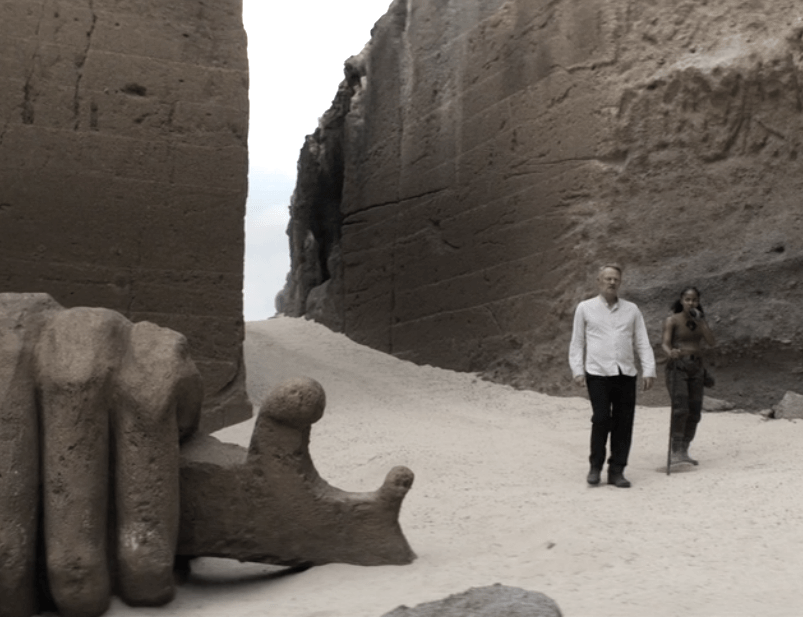
There’s that hand that we see crashing to the ground in the previews.
And Hari’s being an ass again. He’s taking them to Oona’s World without even bothering to discuss it with them.
Gaal’s anger about the math not making sense would be better in a show where they were carefully trying to make things make sense.
But Hari needs to go to an abandoned mine, and the Wi-Fi won’t reach that far. Boy, these three are being pissy with each other.
“Uninhabited doesn’t mean we’re alone.” That sounds good but actually yes it does.
Terminus
We see the Vault with Hober Mallow scrawled across it in large friendly letters. I think “don’t panic“ might have been a better choice given that the vault just exploded a guy.
It seems to me that stoic armed guards surrounding the vault is a very unfoundational visual.
Cut to a tense discussion involving Poly and Director Sermak.
“The vault is literally a man.” “Was this divine justice?” “How could Seldon’s math predict an individual?” It seems we’ve got a lot of characters pointing out the flaws in the show. I’m not sure that helps enough.
But “we don’t have time to cry and clasp our icons“ is at least funny.
Now it’s nice that Poly is the one making some sense about psychohistory, despite profoundly non-psychohistorical things going on.
So Poly and Brother Constant are going in search of Hober Mallow even though he is a “fuc%ing @sshole.“
Oona’s World
There are “autonomous mining machines“ abandoned in the desert. That means robot.
These robots “…sucked the palladium from the pores of the planet; and then, when there was nothing left of value, they were turned loose upon the population. The emperors are hollow men who hollow out their worlds.”
The political commentary here is apt but simplistic.
Then there’s a pretty much content-free argument between Hari and Gaal. Hari is an ass and Gaal is petulant. We knew that already.
It gets a bit better when the conversation turns to Salvor’s destiny. But not much. Hari starts by saying that Salvor’s future, might well be immutable. Then he talks about making small changes in the present to adjust large events in the future. Salvor’s death is a small detail in one of those large events. If the large event changes, of course, that will change! Ultimately the two are arguing over nothing simply because they are both profoundly unpleasant people.
Eventually, Hari says “At enough scale, I am insignificant.” I’m not sure a mathematician would phrase it that way. More importantly, it’s like the writers aren’t even watching their own show. In the last episode, we get that preventing Hari from starting the Second Foundation put the galaxy on a disastrous path. The show has already argued that Hari is NOT insignificant.
Lepsis Penal Colony
I assume that’s Bel Riose but I can’t see the guy from Law and Order UK under there. Joanne says he looks like a character from Planet of the Apes.
The quick scene introducing the Bel Riose at the penal colony is outstanding. We very quickly learn that Riose is compassionate, able to speak truth to power, and steadfast in both his beliefs and in defending others.
This tells you everything you need to know about him for the rest of the scene and the rest of the episode, possibly the rest of the season. Notice how many of the same beats hit in his conversation with Demerzel.
Oona’s World.
There’s a real dungeons and dragons vibe and Gaal gets to meet the image of Kalle, who Gaal tells us has been dead for hundreds of years. This surprises Gaal even though Hari’s standing right next to her. [Note: The handshake here is significant. I missed that.]
Hari sends Gaal away. “if you don’t hear from me within six hours, leave.” Yeah, right!
Korell
This looks very short-hand fascistic, except the leader is in fancy dress.
We hear the name “Master Trader Ponyets,” the main character of “The Traders” from Foundation the book.
That’s Commdor Argo in the fancy dress. And Ponyets turns out to be Hober Mallow, who in fairness, does seem to be an asshole.
He wants to sell a “castling device.” I’ve always heard “castling“ pronounced as three syllables in the chess context, “cas-el-ing.” “Cast-ling” sounds like a tiny member of a cast.
Hijinks ensue. This bit ends in a Kafkaesque fashion.
Trantor:
Demerzel is back with Riose. “I want to see Day like this” is admirable, and I see Law and Order guy under there now. Well, second time through.
C-17 is being a Dick. But the guy in the straw hat on Siwenna is an informant for the Empire. Why would they bother to do that?
Dawn and dusk are merely window-dressing here, emphasizing that C-17 wants to separate from the dynasty.
Riose really gets the better of the exchange with C-17 who comes off as cruel and insecure. Ultimately Riose is reunited with his husband. Now he’s reminding Joanne of Monty Python’s Life of Brian and me of the “it’s” guy at the start of an episode of Flying Circus. [Note: really Jon was right: “It’s the old man from scene 24” is the optimal reference.]
Then, haircut… and BAM! Law and Order Guy!
Demerzel and C-17 are being creepy again. And she has to reassure him he’s doing okay. More insecurity.
Oona’s World.
Gaal and Salvor debrief and prepare to leave. Salvor points out how dysfunctional Gaal and Hari are together.
“Never let your sense of morals prevent you from doing what is right” is another Salvor Hardin quote ascribed to Abbas. It might be less irritating if they called that character “Salvor” and Leah Harvey’s something else.
Korell
The two red robes standing out within the deluge of people is very effective.
Yet another execution in a revolting festival atmosphere. The name of the method of execution is funny and disturbing at the same time.
“I’m rather busy right now” is hilarious. Mallow’s funny. At least that’s something. The escape brings us back to comic-bookish. I don’t mind though.
This whole sequence is great fun!
Trantor
Riose: “A weak emperor needs a strong general.” Loyal to the empire to protect its people.
On his ship: absolute confidence. The casualness with which Riose comports himself is impressive and something I’ve never quite seen before.
We get our first good look at a Spacer who is named “She-Bends-Light.” Are they going for a Native American vibe there? That would be a weird juxtaposition.
Is the Foundation more technologically advanced than the Empire now?
Oona’s World.
I think a planet stripped of all its resources is different from a collection of sinkholes. Strip mining would make a lot more sense. Literally no one is going to go to the extra trouble to mine in a way that leaves easily-collapsable caverns. Looked cool though.
If the mining robots were programmed to go after living things, which seems to be the case, why are they just waking up now? Is the fourth law “A robot may not act until it is necessary to the plot?”
This is too Star-Warsesque for me.
They detect a life-form and it’s Hari. Off to the rescue because the plot robots are after him!
“You have a body, how is this possible?” “I don’t know!”
Because of math? I feel like we’re back to the Mathematicians being wizards. Not only don’t I like that but it can do real damage. Gaal and Salvor’s superpowers were bad enough. If they don’t explain this well it will diminish the entire series.











 Stars End: A Foundation Podcast