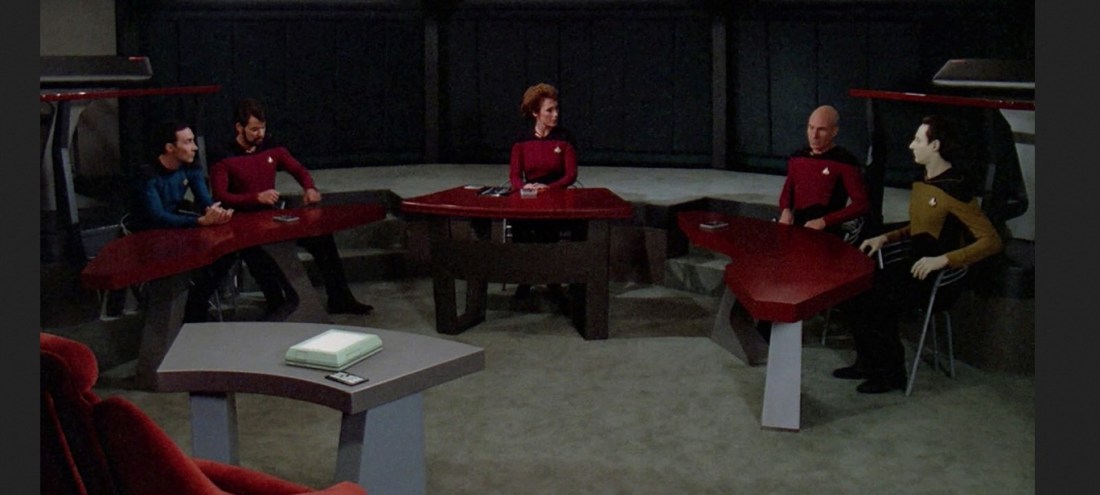
Stars End S3E36

“Never Hoard Your Silver Podcast”

Sometimes we bury the lede in the title so let’s rectify that straightaway: featuring special guest Melinda Snodgrass!

We’ve never been shy about our obligatory Star Trek references. As we’ve undertaken our long, strange trip through Asimov’s Robot Novels and some related short stories, those references skewed sharply in the direction of The Measure of a Man, which is in my opinion “the moment when The Next Generation earned the right to call itself Star Trek.” It’s great TV and great SF and a monument to themes and ideas that Asimov championed throughout his career.

So for this episode, we going to treat you to an episode-long Star Trek reference as we’re joined by the author of The Measure of a Man, the aforementioned Melinda Snodgrass!

Please excuse us, we’re all a bit starstruck.

In addition to writing the quintessential Data episode for TNG, Melinda Is a ⁠lifelong Science Fiction fan⁠ who has written many novels including the Circuit series, co-created the Wild Cards series of books, and has extensive screenwriting credits including L. A. Law, Sliders, and The Outer Limits. Within the realm of Star Trek, Melinda has written Tears of the Singers, a TOS novel, and five episodes of TNG, which also include a excellent second Data-Centric episode, The Ensigns of Command.

She was the Story Editor on Next Generation while the show transformed from a program struggling to find its voice into the science fiction juggernaut we all know and love.

As Jon puts it, this episode “slaps!” You do not want to miss this one! Let’s go!

Images used under the fair use doctrine.

Stars End S3E35

“Who Really Cares What a Podcast Looks Like Or Is Built Of Or How It Was Formed”

We finally know that season 2 of Apple TV+’s Foundation will begin on 14 July. Rather than tackling another novel, we’re wrapping up season 3 of Stars End with short stories and guests.

In our next episode, we’re both pleased and proud to announce that we’ll be interviewing Melinda Snodgrass, author of the first truly great episode of Star Trek: The Next Generation, and the source of many of our Star-Trek-related digressions, “The Measure of a Man.”

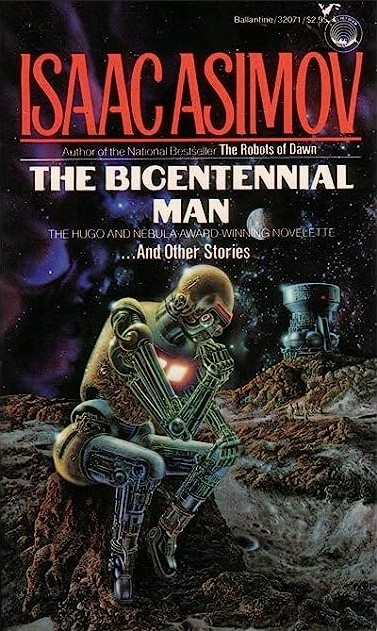
But in the meantime, for this episode, we’re reading The Great and Glorious Az’s “The Bicentennial Man,” (TBM) which is based in part on a suggestion from famed science fiction editor Judy-Lynn del Rey. To quote the good doctor, “Of all the robot stories I ever wrote, ‘The Bicentennial Man’ is my favorite and, I think, the best.” In The Complete Robot, he pairs it with our last episode’s subject, “…That Thou Art Mindful of Him” (TTAMoH) in a section entitled “Two Climaxes” where he envisions the ultimate fate of the three laws and the science of robotics.

Of the two, TBM has the less auspicious genesis. You’ll recall that TTAMoH was commissioned for an anthology entitled Final Stage which charged the authors with taking their themes to their ultimate conclusion. TBM was commissioned for an anthology entitled “The Bicentennial Man” where the stories could be anything at all so long as it was suggested by the phrase, “The Bicentennial Man.” That, to a large degree, was the way things worked in the US in 1976.

But there was an earlier suggestion from del Rey about “…a robot who has to choose between buying its own liberty and improving its own body.” After reading TBM, Judy-Lynn wanted the story, and when the original anthology fell through, Judy-Lynn got the story. It appeared in a different anthology, one that she edited, Stellar Science Fiction #2 published in February 1976.

So, don’t miss our discussion of “The Bicentennial Man, ” the Good Doctor’s favorite Robot Story, and his third favorite story overall, surpassed only by “The Last Question” and “The Ugly Little Boy.”

Let’s go!

Stars End S3E34

“That Thou Art Mindful of the Podcast”

Asimov’s story “…That Thou Art Mindful of Him” has an interesting pedigree. It was initially commissioned for an original collection entitled, Final Stage: The Ultimate Science Fiction Anthology edited by Edward L. Ferman and Barry N. Malzberg. The intent of the anthology is compelling. Here’s how the editors described the premise.


The assumption was that science fiction — that branch of literature, half beast, half-civilized —sits upon perhaps, a dozen classic themes, which, in various combinations, permutations, and convolutions, underline most of the work in the field. Like the ten to twenty basic chess attacks and defenses, these themes can lead to winning combinations of great beauty or, in less talented hands, to disastrous and obvious clichés.

Some of science fiction’s most astounding writers were each given one of these classic themes and charged with crafting that theme’s ultimate story. The assignment of “Robots and Androids” could only have gone to the good doctor. Each contributor was also tasked with writing an afterword on the theme and their story.

Thus, “…That Thou Art Mindful of Him” was born. Ed Malzberg was also editor of The Magazine of Fantasy and Science Fiction at the time. According to Peter King writing on Amazon.com, Malzberg, upon receiving the manuscript, was compelled to include it in his magazine first. It appeared in the ⁠April 1974 issue⁠. In his afterword to the story, The Great and Glorious Az proclaimed “…having followed matters through to the logical conclusion, I have possibly destroyed the Three Laws, and it made it impossible for me to ever write another positronic robot story.”

But then, of course, he qualified it, maybe not. And he said something similar after writing the Bicentennial Man two years later (that’s for next week). He qualified that as well, “But then again,” he wrote, “I might. I’m not always predictable.” Two novels and a bunch more short stories later, the good doctor might have been more predictable than he thought.

Anyway, we talk about it. Please tune in and join the fun! Let’s go!

Afterword to “…For Thou Art Mindful of Him.”

by Isaac Asimov, Final Stage: The Ultimate Science Fiction Anthology, Penguin Books, 1974

The first story I wrote in which the Three Laws of Robotics were explicitly stated, was “Runaround,” which appeared in the March 1942 issue of Astounding Science Fiction. The laws were implicit, however, in stories, I had written earlier — the earliest being “Robbie,” which appeared under the title of “Strange Playfellow” in the September 1940 issue of Super Science Stories. So I have been playing around with those Three Laws for more than a generation.

With all due modesty, (which means “very little modesty” in this case), the Three Laws were revolutionary in science, fiction development. That’s not to say that there were no sympathetic robots in the field before Robbie. There was Lester Del Rey’s “Helen O’Loy” in the December 1938 Astounding Science Fiction, for instance. The Three Laws, however, and the stories I used to explore them, represented the first honest attempt at a rationalization of robots as machines, and not as symbols of man’s overweening pride leading to his destruction, à la Frankenstein. The field did me the honor of excepting the Three Laws, and though no one but myself can use them explicitly, many writers simply assume their existence and know that the reader will assume it too.

This does not mean that I wasn’t aware from the start, that there were serious ambiguities in the Three Laws. It was out of these ambiguities, indeed, that I wove my stories. In The Naked Sun, the ambiguities could even lead to robot-induced murder.

And, of course, the deepest ambiguity and the one that had the potential for giving the greatest trouble was the question of what was meant by the phrase “human being“ in the Three Laws. John Campbell and I used to discuss the matter in the far-distant good old days of the Golden Age, and neither of us ever came to a satisfactory conclusion. It did seem likely, though, that if I were allowed to dig deeply into the question of “What is man that thou art mindful of him?” as addressed to the robot, I might upset the Three Laws altogether, — and at that I always balked.

But John is now dead, and I am in my late youth, and the Three Laws have given me good, loyal, and profitable service for thirty-four years, and maybe that’s enough. So when asked to write “the ultimate story” in robotics — or as near as I could come to one — I sighed and took up the matter of that Biblical quotation (Psalms 8:4).

I think you will agree with me that, having followed matters through to the logical conclusion, I have possibly destroyed the Three Laws, and it made it impossible for me to ever write another positronic robot story.

Well, don’t bet on it, you rotten kids.

Stars End S3E13

“The Creation of the Podcast Was Looked Upon as the Prime Example of the Overweening Arrogance of Humanity.”

Well, we’re between books this episode, so we decided to read “The Robot Chronicles” from the Great and Glorious Az’s Gold: The Final Science Fiction Collection. It’s an essay in which Asimov discusses his robot stories, their inspirations, and their milestones.

So far, I’ve found Gold enjoyable. It contains the last of Asimov’s science fiction short stories, essays about his stories, and essays about writing Science Fiction. He insists, by the way, that Science Fiction be abbreviated “SF” and not “sci-fi.” You can find out why and read “The Robot Chronicles” and the rest of Gold here.

But, really, the bulk of this episode is an engaging and free-wheeling conversation with our special guest Travis Johnson, whom you may know from Twitter as @travisjohnson and/or @startravcommand. He’s one of the hosts of the Black Alert Podcast and created, with his 11-year-old daughter, a Star Trek Prodigy podcast called Star Trek Podigy. He has also published A Matter of Right: Futures of Justice, a “science fiction comics and prose anthology” about the US criminal justice system. Join us as we discuss Robots, Foundation, all things Asimov, and more! You don’t want to miss this one!

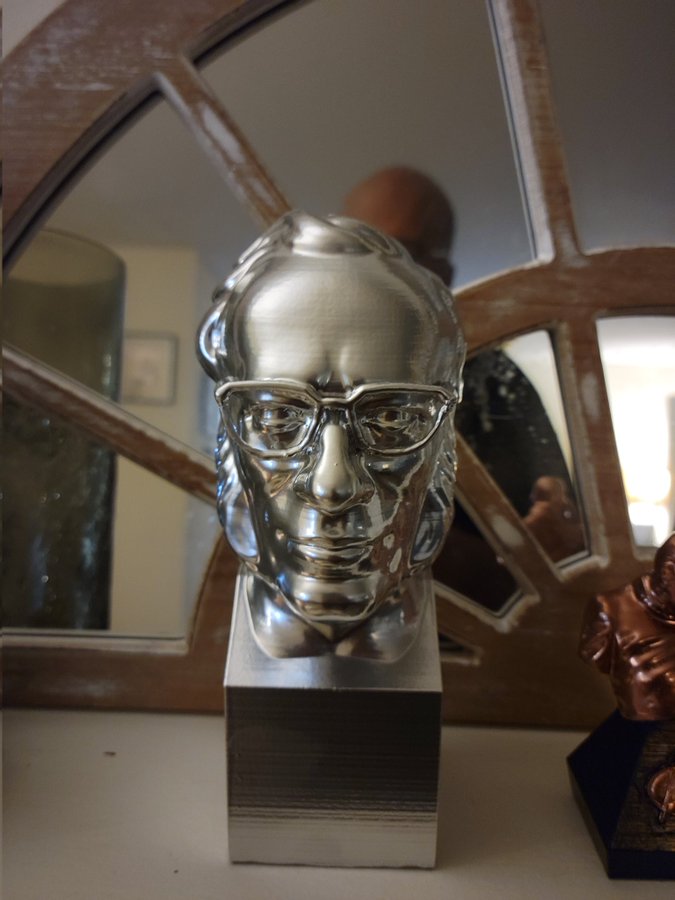
Update: sometimes I forget stuff, and I only remember when I listen to the episode after it’s published. This time it’s the Asimov bust that Travis told us he 3-D printed. It’s an impressive bit of work and here it is for your edification.