Stars End S3E35

“Who Really Cares What a Podcast Looks Like Or Is Built Of Or How It Was Formed”
We finally know that season 2 of Apple TV+’s Foundation will begin on 14 July. Rather than tackling another novel, we’re wrapping up season 3 of Stars End with short stories and guests.

In our next episode, we’re both pleased and proud to announce that we’ll be interviewing Melinda Snodgrass, author of the first truly great episode of Star Trek: The Next Generation, and the source of many of our Star-Trek-related digressions, “The Measure of a Man.”

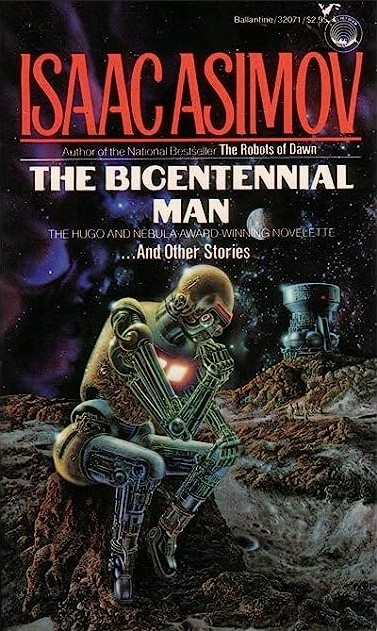
But in the meantime, for this episode, we’re reading The Great and Glorious Az’s “The Bicentennial Man,” (TBM) which is based in part on a suggestion from famed science fiction editor Judy-Lynn del Rey. To quote the good doctor, “Of all the robot stories I ever wrote, ‘The Bicentennial Man’ is my favorite and, I think, the best.” In The Complete Robot, he pairs it with our last episode’s subject, “…That Thou Art Mindful of Him” (TTAMoH) in a section entitled “Two Climaxes” where he envisions the ultimate fate of the three laws and the science of robotics.

Of the two, TBM has the less auspicious genesis. You’ll recall that TTAMoH was commissioned for an anthology entitled Final Stage which charged the authors with taking their themes to their ultimate conclusion. TBM was commissioned for an anthology entitled “The Bicentennial Man” where the stories could be anything at all so long as it was suggested by the phrase, “The Bicentennial Man.” That, to a large degree, was the way things worked in the US in 1976.

But there was an earlier suggestion from del Rey about “…a robot who has to choose between buying its own liberty and improving its own body.” After reading TBM, Judy-Lynn wanted the story, and when the original anthology fell through, Judy-Lynn got the story. It appeared in a different anthology, one that she edited, Stellar Science Fiction #2 published in February 1976.

So, don’t miss our discussion of “The Bicentennial Man, ” the Good Doctor’s favorite Robot Story, and his third favorite story overall, surpassed only by “The Last Question” and “The Ugly Little Boy.”

Let’s go!

Stars End S3E34

“That Thou Art Mindful of the Podcast”

Asimov’s story “…That Thou Art Mindful of Him” has an interesting pedigree. It was initially commissioned for an original collection entitled, Final Stage: The Ultimate Science Fiction Anthology edited by Edward L. Ferman and Barry N. Malzberg. The intent of the anthology is compelling. Here’s how the editors described the premise.


The assumption was that science fiction — that branch of literature, half beast, half-civilized —sits upon perhaps, a dozen classic themes, which, in various combinations, permutations, and convolutions, underline most of the work in the field. Like the ten to twenty basic chess attacks and defenses, these themes can lead to winning combinations of great beauty or, in less talented hands, to disastrous and obvious clichés.

Some of science fiction’s most astounding writers were each given one of these classic themes and charged with crafting that theme’s ultimate story. The assignment of “Robots and Androids” could only have gone to the good doctor. Each contributor was also tasked with writing an afterword on the theme and their story.

Thus, “…That Thou Art Mindful of Him” was born. Ed Malzberg was also editor of The Magazine of Fantasy and Science Fiction at the time. According to Peter King writing on Amazon.com, Malzberg, upon receiving the manuscript, was compelled to include it in his magazine first. It appeared in the ⁠April 1974 issue⁠. In his afterword to the story, The Great and Glorious Az proclaimed “…having followed matters through to the logical conclusion, I have possibly destroyed the Three Laws, and it made it impossible for me to ever write another positronic robot story.”

But then, of course, he qualified it, maybe not. And he said something similar after writing the Bicentennial Man two years later (that’s for next week). He qualified that as well, “But then again,” he wrote, “I might. I’m not always predictable.” Two novels and a bunch more short stories later, the good doctor might have been more predictable than he thought.

Anyway, we talk about it. Please tune in and join the fun! Let’s go!

Afterword to “…For Thou Art Mindful of Him.”

by Isaac Asimov, Final Stage: The Ultimate Science Fiction Anthology, Penguin Books, 1974

The first story I wrote in which the Three Laws of Robotics were explicitly stated, was “Runaround,” which appeared in the March 1942 issue of Astounding Science Fiction. The laws were implicit, however, in stories, I had written earlier — the earliest being “Robbie,” which appeared under the title of “Strange Playfellow” in the September 1940 issue of Super Science Stories. So I have been playing around with those Three Laws for more than a generation.

With all due modesty, (which means “very little modesty” in this case), the Three Laws were revolutionary in science, fiction development. That’s not to say that there were no sympathetic robots in the field before Robbie. There was Lester Del Rey’s “Helen O’Loy” in the December 1938 Astounding Science Fiction, for instance. The Three Laws, however, and the stories I used to explore them, represented the first honest attempt at a rationalization of robots as machines, and not as symbols of man’s overweening pride leading to his destruction, à la Frankenstein. The field did me the honor of excepting the Three Laws, and though no one but myself can use them explicitly, many writers simply assume their existence and know that the reader will assume it too.

This does not mean that I wasn’t aware from the start, that there were serious ambiguities in the Three Laws. It was out of these ambiguities, indeed, that I wove my stories. In The Naked Sun, the ambiguities could even lead to robot-induced murder.

And, of course, the deepest ambiguity and the one that had the potential for giving the greatest trouble was the question of what was meant by the phrase “human being“ in the Three Laws. John Campbell and I used to discuss the matter in the far-distant good old days of the Golden Age, and neither of us ever came to a satisfactory conclusion. It did seem likely, though, that if I were allowed to dig deeply into the question of “What is man that thou art mindful of him?” as addressed to the robot, I might upset the Three Laws altogether, — and at that I always balked.

But John is now dead, and I am in my late youth, and the Three Laws have given me good, loyal, and profitable service for thirty-four years, and maybe that’s enough. So when asked to write “the ultimate story” in robotics — or as near as I could come to one — I sighed and took up the matter of that Biblical quotation (Psalms 8:4).

I think you will agree with me that, having followed matters through to the logical conclusion, I have possibly destroyed the Three Laws, and it made it impossible for me to ever write another positronic robot story.

Well, don’t bet on it, you rotten kids.

Stars End S3E32

“The Very Word Podcast is Taboo in Polite Society”

We hit some big, philosophical issues in this episode.

As a mathematician, it seems odd that I’m frequently the one to point out that some things can’t be quantified. We’re reaching the limits of quantifiability with the Three Laws of Robotics, just as we did with Psychohistory. How do you quantify harm? Take the First Law, for example. Even within a single human, there’s psychological harm or physical harm, at least if you’re Giskard. How do you compare the two? It’s not even possible to measure the two things with the same unit. What’s bigger: 17 furlongs or 200 degrees on the Rankine scale? And there’s also social harm, financial harm, legal harm… the list goes on.

How is this not the cover for The Naked Sun?

It’s even trickier if the question is about the amount of harm between two humans. And what about the Zeroth Law? Quantifying harm between groups of humans? Species of humans? Collections of sapient beings that might be humans? That way, it seems, lies madness. What’s bigger: royal blue or next Tuesday? The only possible path to an answer is the ability to predict the consequences of any action. That brings us back to Psychohistory. It’s a vicious circle.

We get into it as Daneel continues to evolve into a Zeroth Law robot in chapters 15, 16, and 17 of Robots and Empire. Meanwhile, we revisit the caves of steel, experience the pomp and circumstance surrounding Gladia’s visit to Earth, meet a government functionary, and witness an assassination attempt! Plus: a space maneuver worthy of Captain Kirk himself! You’ll enjoy this one!

We also ask: do college professors think? We never quite get to the bottom of that one, either.

Let’s go!

Stars End S3E31

“Ceterum Censeo Delenda Est Podcast”

Joanne and I stayed in a hotel one night last week and I was delighted to discover a pancake robot while enjoying the continental breakfast.

I know that sounds pretty damn cool, but it was disappointing. Do you have a mental picture of a pancake robot? Whatever it is, I’d wager it isn’t a box. This one looks like a ⁠box⁠.

Today the feeling is more akin to bewilderment. I searched for a picture of the pancake robot and got a truly absurd number of hits. There are lots of pictures and cartoons that look like that mental picture from before. Another that ⁠looks like a 3-D printer making love to a hot plate⁠. Also, an annoyingly catchy song that even has its own video. I did not see any of that coming. Well, mostly.

But let’s get back to Daneel and Giskard, the more traditional science fictional robots who never seem to make pancakes even though they could.

In this episode, we continue our odyssey through the excellent Robots and Empire and talk about Part 4: Aurora, or, if you prefer Chapters 11 through 14, The Old Leader, The Plan and the Daughter, The Telepathic Robot, and The Duel.

Together we’ll see how Amadiro and Mandamus’ plan to destroy Earth starts to come together, Vasilia’s machinations to regain possession of Giskard, and watch in real-time as Daneel evolves into the first-ever 4-laws robot, saving Giskard from Vasilia and in turn, Giskard saving Daneel from destruction! It’s great and you’ll want to join us!

Also, there is some Latin. There may even be pancakes.

Stars End S3E30

“Keep Your Mind on the Podcast and Do Not Let the Trailing Off of a Single Thread Affect You.”

Join us as we continue our journey through Isaac Asimov’s masterpiece Robots and Empire, as we delve into chapters 7 through 10. 

In this episode, we take a closer look at “The Overseer,” “The Settler World,” “The Speech,” and “After the Speech,” as Asimov continues to link his major works into a future-historical tapestry.

We see how The First Law of Robotics can be undermined as foreshadowed in The Naked Sun.

We witness Gladia becoming the true successor to Elijah Baley’s legacy as she learns public speaking, articulates a political vision filled with peace and harmony, and changes the course of the rest of her life all in the space of a lazy afternoon.

And we watch as Elijah Baley lays the groundwork (dare I say “Foundation?”) for the Zeroth Law of Robotics from his deathbed.

And of course, Daneel and Giskard go on about the whole thing.

Please join us for our discussion about Robots and Empire, and where it’s taking the universe Asimov built.  Let’s go!

Stars End S3E29

“Humanity Whether in the form of Earth People or Spacers Must Podcast”

Join us as we continue to wind our way through Robots and Empire, the final book in Asimov’s Robot series, even if you count collections of short stories.

In this episode, we discuss chapters 3 through 6.  “The Crisis,” “Another Descendent,” “The Abandoned World,” and “The Crew.”  

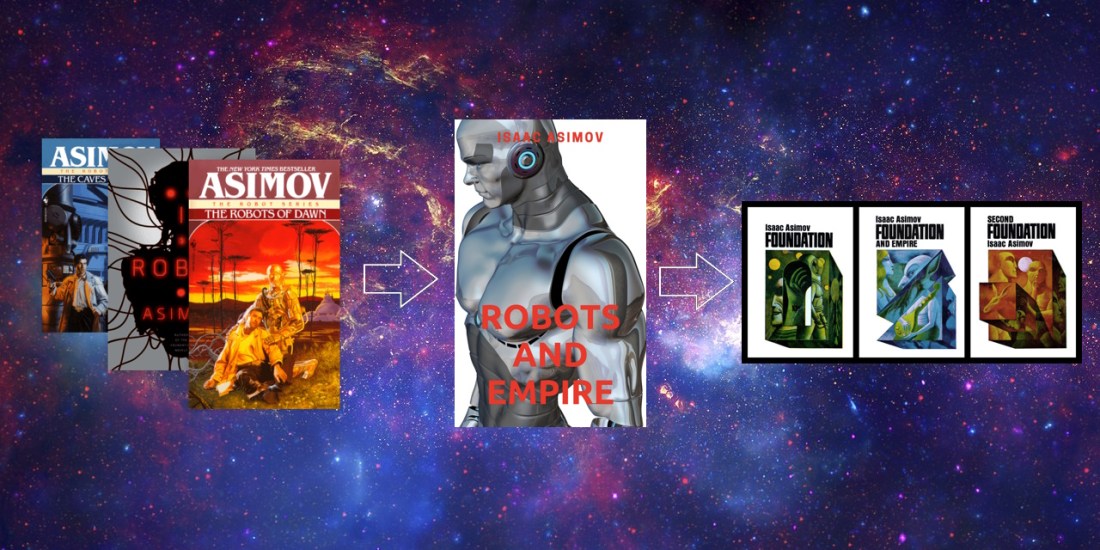
In these chapters, the Great and Glorious Az establishes Robots and Empire as an important bridge between the Robot Stories, the Galactic Empire Novels, and the Foundation Saga; it’s both a prelude and a coda.  

Elijah Baley isn’t in this novel except in flashbacks, but his presence looms large.  Daneel and Giskard try to deduce what Elijah’s nemesis, Amadiro might try in the aftermath of Fastolfe’s death.  As they do, they’re forced to ponder the Three Laws of Robotics, which seem to be impeding their efforts.  Together, these discussions wrap up the Robot Stories.

Meanwhile, these two robots are pondering Elijah’s ability to predict, in broad brushstrokes, the future that has unfolded over the past two centuries, including an oncoming crisis.  Giskard, in particular, is trying to deduce the “Laws of Humanics” that Elijah must have understood to see so clearly.  In this, of course, we see the seeds of the Foundation.

How do the Galactic Empire Novels figure into all of this? For that, you’ll have to stay tuned.

Robots and Empire

A funny thing happened on the way to the podcast.

When I went to the Apple Books store, Robots and Empire had disappeared.

I own it, but I can’t download it to my iPad because it’s not in the store. The Kindle edition seems to be missing too. I’m hoping that means Doubleday is preparing a new edition.

But what about in the meantime? Well, there are used bookstores and hard copies.

But if you want to read along with an e-book, what are your options?

Multiple versions can be checked out at archive.org.

And this one: Robots and Empire appears to be downloadable.

Should it be there? I don’t know. But it’s an option until Doubleday has a new edition out.

On a similar note, there isn’t an official audiobook available. I don’t think there’s ever been one. But there was a version with limited distribution for the print-disabled.

At least, I think that’s where this version comes from. It floats around the interwebs and most copies have terrible audio quality. It’s like it was recorded from a thirty-year-old audio cassette and the other side of the tape is bleeding through. This is by far the better copy on YouTube.

And here is the second part.

This should hold us until there’s a new edition and an audiobook from Doubleday. I’m looking forward to getting those when they come out.

Best of luck! When you’re caught up with the reading or even if you haven’t, our discussion starts here:

Our second episode on Robots and Empire, on chapters 3, 4, 5, and 6 will be out tomorrow! Enjoy the read! And the episode!

Stars End S3E28

“I Do Not Ask You to Like the Podcast – I Ask You to Trust It”

If you’re a fan of Issac Asimov, you probably like robots, the Three Laws of Robotics, and characters having long, expository conversations about interesting ideas.

If that’s true, then Robots and Empire is the book for you!  It features, except for when the plot forces its way in, our two favorite robots, Daneel and Giskard, having long, expository conversations about the Three Laws of Robotics.  Jon is quite outspoken about how those are his favorite bits.  Dan and I are more apt to keep that revelation to ourselves.

Robots and Empire lives in between the three Elijah Baley novels and the Foundation books.  As a consequence, it never seems to get the attention of Asimov’s other major novels; it’s never, for example, been made into an official mass-market audiobook.

But if you love the three Elijah Baley novels and the Foundation books and if you’ve bought into Asimov’s project to link most of his work into a tremendous future history, Robots and Empire isn’t just essential, it might even be the most important piece.

And we’re finally talking about it, starting, in this episode, with the first two chapters, “The Descendent” and  “The Ancestor.” You don’t want to miss this one!

Stars End S3E26

“It is From This Point On, Earth Itself that is the True World of the Podcast.”

The Royal Canadian Mounted Police, it is said, “always get their man.”  I haven’t checked, but I’m confident that’s been updated.  “Always get their human” might not work perfectly in the context of Asimov’s Robot Novels, so let’s settle on “always get the perpetrator.”  A perpetrator could be an animal, vegetable, or mineral.

In Elijah Baley’s time, millennia in the future, it isn’t clear whether New York City has grown to include parts of Canada but it isn’t likely.  If it had, Lije would have been part of this same tradition.  And yet, as we’ve noticed, Lije hardly ever “gets” the guilty party.  Usually, he has figured out who it is, but the actual “getting” part never actually happens.  It’s like watching an episode of Law & Order where the latter half kinda goes off the rails.  As we approach the denouement of The Robots of Dawn we have to ask… will Lije finally have an unqualified win?

You want to know!  You need to know! We know!  And we talk about it!  Let’s go!

And in one week… Episode 50!

Stars End S3E24

“Do Not For Your Own Sake Test the Force of Our Podcast”

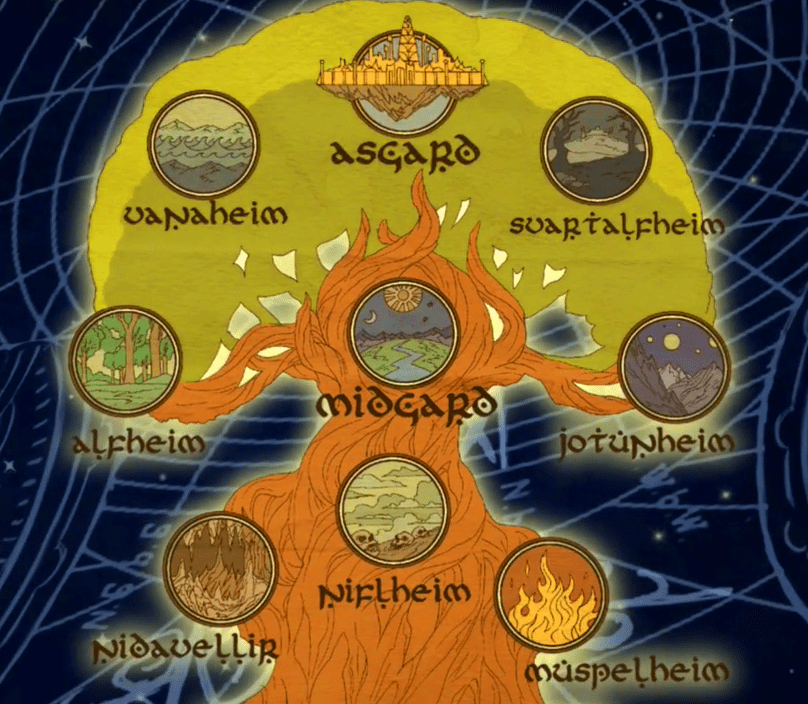
In a departure from our recent episodes, we have breaking news!  Well… probably!  The Midgard Times tells us that Apple TV+’s Foundation has been renewed for a third season.  No word yet on when season two will premiere, but there’s more information that you’ll need to listen to learn!

Who is The Midgard Times and how did they manage to scoop the competition for this vital information?  We don’t really know!  We can tell you though that if you’re looking between hard-hitting journalism like “Muspelheim in Danger of Freezing Over” and “Troll Literacy Rate Rises to 3%” it isn’t there.

You need to go to… hang on, it was here a minute ago… give me a second… here!  It’s this The Midgard Times, which appears to be a subsidiary of moviesr.net. That reminds us of nothing so much as a vanity license plate that… isn’t quite what the car’s owner really wanted.

And what of the news from Svartalfheim? Gesundheit!

Aside from this, we revisit “Mirror Image” and, of course, we continue our discussion of The Robots of Dawn. This time, it’s chapters 10, 11, and 12 in which we wrap up the interview of Vasilia and get the entirety of Baley’s conversation with Gremionois. Also, Baley goes to the bathroom and has lunch! Without this, no Asimov novel would be complete.

Meanwhile, we’ll always be at StarsEndPodcast.com and StarsEndPodcast.WordPress.com but not at StarsEnd.anything because we don’t know what those are either. We think there are squatters.