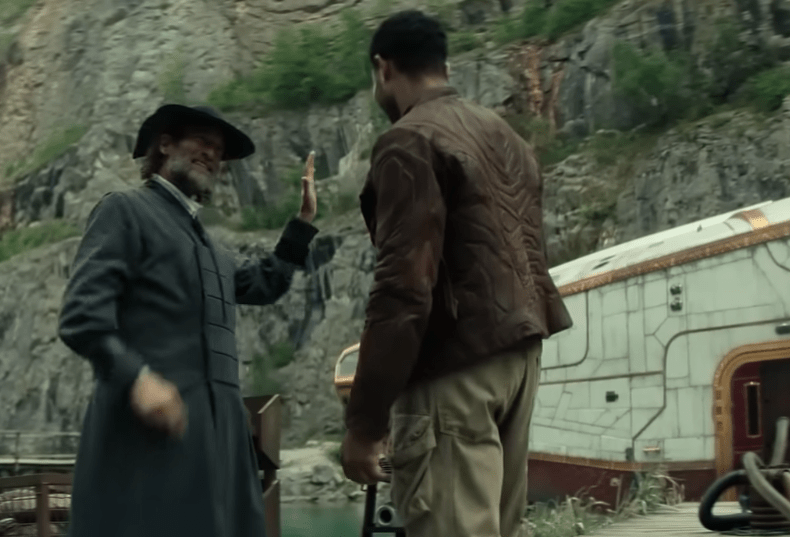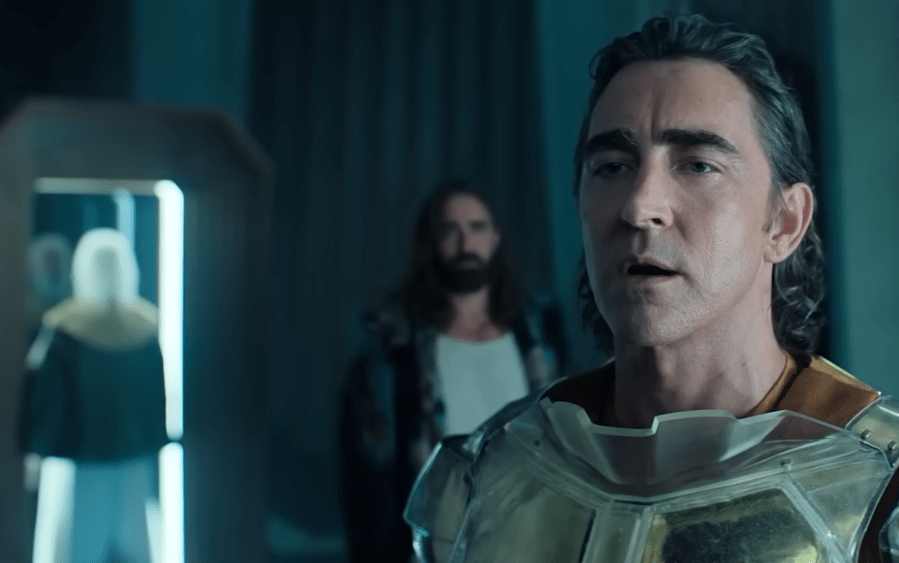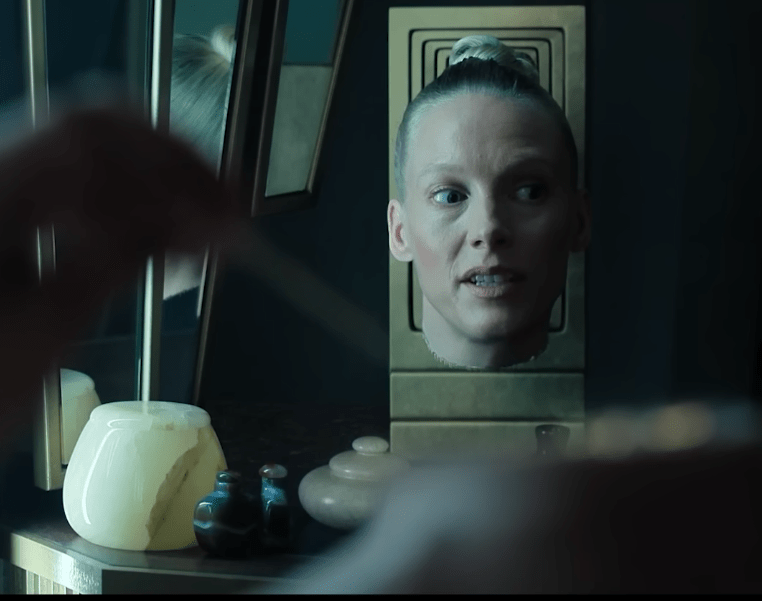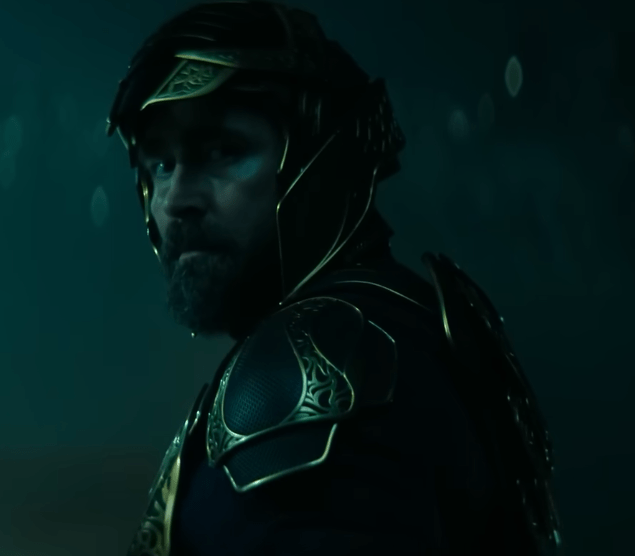
Watching Foundation: “Where Tyrants Spend Eternity”

The masthead for the "Watching Foundation" column.

As always, my reactions to the episode as I watched it and rewatched it. Unfortunately, this one did not exactly get more interesting upon closer scrutiny.

Simultaneously published at Stars End: a Foundation Podcast and Comics, The Universe, and Everything.

Watching Foundation S3E05

This is a very cool shot with the hoverbike driving vertically down the side of a building.  It does make me wonder about the topology of Trantor.  This could be C24 descending into Mycogen, except he seems to be exiting a building with a roof that we saw from above.  Could energy and technology be so cheap that we would use antigravity tech on a parking garage?  Seems a bit like using a jackhammer to drive in a thumbtack.

Mycogen

Here we go!  The whole thing has a 1940s detective movie kind of feel.

Is that C24?  They are either showing us that it is him or it isn’t him.

Those hoverbikes look like they were designed by the Federation. Two nacells, red in the front, blue in the back.  Is this what it would look like if Star Trek and Star Wars had a baby?

Dawn in Mycogen.

Hey!  Sunmaster 18!  In a very dark sector.  I bet he has seasonal affective disorder.

Did not see that coming.  But I suppose I wasn’t meant to.  C24 paid someone to take his place on the hoverbike, but showing him on the bike before is kind of a cheap trick.

“Above,” Demerzel finds Mavon’s body, and she’s tracking C25.  “My Cleons are scattered.”

“Dawn, I will deal with myself,” isn’t interesting.  “I know exactly where Day has gone.  We will not see him again. And he will not trouble us,“ is.

The Beggar, on its way to Clarion Station.

“The Mule and I have some talents in common,” says Gaal.  C25 asks, “Did you compel me to work with you?”  “I tried not to… sometimes it’s hard to tell,” is an interesting answer from Gaal.  I originally thought it was surprisingly honest.

New Terminus

Indbur is, unsurprisingly,  being an ass.  Han tries to convince him that the Mule is important, with little success.

Han is unrepentant, “I knew there’d be consequences.  I just judged it worthwhile.”

But he’s also not as intelligent as he thinks he is.  “… The Mallows may have inadvertently done something useful,“ underestimates them.

They purposely shine a flashlight on Han’s ass.  Hey! Over here! Look!!

Sephone takes Han’s necklace.  Jealousy?  She is pretty tough here; very Maria Hill.

[I noticed on YouTube somewhere that the necklace is actually the pouch that contains Gaal’s prayer stones.  That’s an intensely personal item; one that seems far too intimate given Gaal’s attitude about the relationship in episode four.]

The Millennium Torus, what I’m calling Torin and Bayta’s ship.

Did jump ships emerge from clouds in season one or two?

Is “Sweetheart” the name of the ship or the name of the OS?

The ship’s pretty banged up.  “Air conditioning is fully operational.”  But Magnifico is playing the Visi-sonor.

A good OS would give a margin of error.  “Three jumps” must mean “maybe two, maybe 4.”  Having the OS provide a probability or margin of error would make sense.

Torin snaps harshly.  Did Magnifico do that?  He’s apologetic as soon as the “music“ stops.

Radole… I mean Haven

Still no good explanation of a tidally locked planet.

They didn’t listen when the OS told them communications were down.  And they get blasted out of the sky for it.

Let this be a lesson to you: when approaching a ribbon world, fly parallel to the habitable bit.  The Torus crashes on the dark side.  They could be in real trouble, but Sunside would have been worse.

The Beggar

Gaal has a zygote from Salvor.  Instant granddaughter, just warm and serve.  Will we get Leah Harvey back in season 4?  Harvi Harden?

“We can implicate anyone; we just need a name,” is a troubling might-makes-right attitude.  The Salvor Harden from the book wouldn’t be caught dead saying that out loud.

Vynod Tarisk is wearing a movie-era Starfleet uniform.  Or something damn close to one.

They’re going to blackmail this guy to try the enclosure thing again.

In Season 2, the Empire lost its entire navy trying to “enclose” Terminus.

C25 seems conflicted but committed, “We weren’t raised to be kind.”

The boy Emperor is playing dress up and trying to be incognito, but he doesn’t even have his stupid beard.

Chekov’s blaster.

Cassion Bilton is excellent here.  Intense. Self-assured. Dominating.  He kills without hesitation or remorse.  He’s a Cleon.  Has Gaal bitten off more than she can chew?

The literal blood on 25’s hands is a bit on point.  There’s a quick glimpse of Gaal in the meeting.

The entire council is part of the Star Trek cosplay.

This is like C-Span with better acting.  They vote, raising red lights for “no,” or white lights for “yes.”  That’s more primitive than a simple set of clickers.

And just like that, Kalgan will be enclosed.

Haven

Uncle Randu boards the Millennium Torus and finds Torin, Bayta, and Magnifico safe in a handy human thermos.  I guess he didn’t burn to death in S3E01.

Back in his house, it’s clear the Traders have money.  But I wonder why they’re showing us that sword.

Randu is interesting.  I want to reread the scene where Bayta meets him in the book.  He says Magnifico over Torin would be “trading up.” Dick.

Torin leaves while Bayta tries to convince Randu to help bring Magnifico to the Foundation.  We finally hear more than a few words from Magnifico.  He’s not the erudite Mule that Joel wanted.  In fact, he sounds like he is deaf to me. But we see no ASL in contrast to Preem Palmer.  Meaning?  Maybe it’s just an accent.

Torin and Magnifico wander through a mall or an airport, and we get some backstory for Torin.

“Bayta is charming your uncle.  I’ll play a little.  Maybe it will help her.”  Magnifico seems completely innocent and kind of sweet.  Even though I’m expecting the obvious implications, will there be some kind of twist to it?  I would like that.

This bit from Bayta is nice.  She and Torin have a real bond.  “… now we’ll rise or fall together.”

And she’s figured out quite a bit and has postulated a connection between Magnifico’s music and “The Mule’s” powers.  Textually, this is what the show has been telling us. I don’t think it’s quite right, but it does give her some potential influence with the Foundation.  Randu will come along for the ride since that can only help the Traders’ cause.

That Jump Gate

We see the Enclosure of Kalgan taking shape as Empire ships flood through the jump gate.  The fact that so much of the Imperial Navy has to be committed to enclose a single planet seems like a problem of scale.  Still, it looks like it’s going smoothly even as Tersik calls to reassure his family.

It will be interesting if the Mule is able to do something.

As “the Mule” appears before the assembly, it sounds like it is Day who is laughing.  But “the Mule” is no longer on Kalgan, paying off the capture of the jump gate in S3E03.

He’s left behind a “cobalt spike.”  I’m guessing that’s a reference to Leó Szilárd terrifying the US with the idea of a cobalt bomb back in 1950.

This is from Wikipedia.

A cobalt bomb is a type of salted bomb: a nuclear weapon designed to produce enhanced amounts of radioactive fallout, intended to contaminate a large area with radioactive material, potentially for the purpose of radiological warfare, mutual assured destruction or as doomsday devices. There is no firm evidence that such a device has ever been built or tested.

The concept of a cobalt bomb was originally described in a radio program by physicist Leó Szilárd on February 26, 1950. His intent was not to propose that such a weapon be built, but to show that nuclear weapon technology would soon reach the point where a doomsday device could end human life on Earth.

What gets unleashed is a devastating weapon that appears in form and function very similar to the doomsday device built for C23.  Kalgan is gone.  The imperial fleet is gone.

So “the Mule” can do something, and it is interesting.  But it isn’t mental manipulation.  In F&E, he took control of the Empire‘s people and therefore their resources.  Why wouldn’t he do the same here?  Destroying an Armada that you could’ve taken control of makes no sense unless you’re actually unable to take control.

C25 posits, “He knew about the enclosure.”  I don’t think that’s necessarily true.  This could just be a response to a retaliation that had to come one way or the other.  It is probably more interesting if he didn’t know what was coming.

There’s an extended escape sequence where Dawn is trying to escape to the Beggar, and imperial troops are trying to get him to safety.  The key moment is a pleasant surprise that offers a glimpse of Gaal’s abilities and evokes “The Best of Both Worlds, Part 2”.

But before the escape is complete, C25 asks, “Gaal, did you know what the Mule would do?”

“I needed the enclosure to fail.  Empire needs to get smaller and die out.”  

Gaal’s answer seems nonsensical.  The galaxy had to fit Seldon‘s initial conditions so that the Foundation could defeat the Mule. But the Mule isn’t in the plan.  Hobbling the Empire, which is also opposed to the Mule, seems counterintuitive and contrary to what we know about the plan thus far.

I am not convinced that she did, but if Gaal foresaw the destruction of Kalgan and stood aside, it would be tough to root for her.

That said, if you ignore all of the stuff that doesn’t make sense here, this conversation between Gaal and C25 is intense and well-acted.  It culminates in the confrontation between C25 and Tarisk, with Dawn’s message to Dusk providing a poignant voiceover.  Dusk, gazing at the communications device and looking distraught, is the final punctuation.

However, airlock doors should be able to withstand the discharge of small weapons.

In a coda, we see the Beggar speeding away from the station. There’s an airlock breach, and Gaal thinks it’s Dawn.  That seems unlikely. Not only is a ship flying away from the station, but it also means Gaal paid no attention to the airlock exploding and did not attempt a rescue.  It’s Demerzel instead, which also seems odd.  There’s no notice that a ship has docked before someone’s in the airlock?

Demerzel is glib.  “Gaal Dornik, you look a day over 200,“ or something like that.

Review:

Despite some compelling moments and good performances, there’s just too much here that doesn’t add up. Trying to condense this story into a matter of days as opposed to the months that elapsed in the book isn’t helping matters.

Rating: 2.5 out of 5.

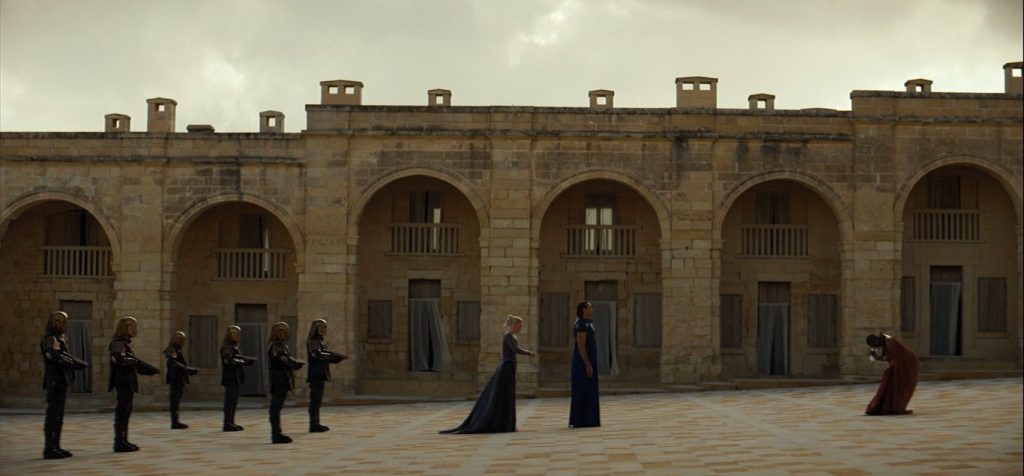
All Images from Foundation on Apple TV+.

Watching Foundation: “The Stress of Her Regard”

The masthead for the "Watching Foundation" column.

In case you don’t remember how this works, these are Joseph’s initial thoughts, reactions, and predictions from watching the episode. Spoilers follow for the show and the books past this point. Proceed at your own risk.

Simultaneously published at Comics, The Universe, and Everything.

Watching Foundation S3E04

Directed by Roxanne Dawson!  Here we go!

Aerial view of the area with the tree.

“Do you feel regret?” Followed by images of the Star Bridge.

“You sought out confession.  That seems to suggest a capacity for it.”

In retrospect, confession is a wonderful Asimovian device to quickly drive the plot through conversation.  This is as efficient as a “captain’s log“ on an episode of Star Trek.

Better because it’s a dialogue.   You don’t need a quiet voice of inner morality with a character of moral authority right there.

Jon caught this last time.  The very first time we see Demerzel in S1E01, she’s gazing up at the Star Bridge.

In the last two episodes, they’ve pinned the current episode to a previous one by repeating an exact shot.  Here we get a repeat of our initial glimpse of Demerzel.

“I have held the secret for more than three centuries.”  Chills because of the wonderful foreshadowing.  You know what’s happening, even if you don’t believe it yet.  It’s still like a slap in the face.

And then the cognitive realignment.  “For the Foundation.”  True to the prequels, Demerzel is working to help the Foundation, AND she’s working to help the Empire.  This is perfect.

And here we are, the essence of any Asimov robot story.  Conflicts in programming.  Initially, that was between the original three laws.  But Demerzel, working for the Empire in the books, was always about the Zeroth Law.  With the advent of the Foundation, the Zeroth Law stands in greater and greater conflict with her Cleonic programming.  THAT’s what prompted the need for confession.  Her worrying about what would happen after the Cleonic Dynasty collapses was the right distractor.

In a very human way, Demerzel shows herself here to be a rationalization machine.  How often have we used that phrase on the podcast?

I think back to the line “Not this one.” from the season premiere and laugh because, of course, we assumed that was about Demerzel being a robot.

“I am built to watch, and remember,” is gut-wrenching.

And the writing here actually improves with a deeper look.

“Something like regret, then?  But the casualties are not the source of the pain, are they?  The paradox is the thing that hurts.“  In Giskard, the conflict (paradox?) between the first and zeroth laws caused roblock.  That’s at play here, too, but mainly it’s the bigger conflict between new and old programming.

And Zephyr Vorellis hits the nail on the head.  Demerzel is capable of spiritual growth even if her current programming refuses to admit it.  It hits too close to home; as Demerzel removes her face, the “emotionless“ robot is angry.

Better living through technology.  Spiritual growth through software updates.  The Zen of Asenion Robots.

Are we looking at a parable for when our large language models become actual artificial intelligence?  Or is it bigger?  This might not be the realm of “Measure of a Man.”  There’s already a religion in Mycogen that worships robots. We could be encroaching on the territory of “The Last Question.”

I’m circling back to an Arthur C. Clarke quote that I probably first encountered in Report on Planet Three: “Perhaps our role on this planet is not to worship God — but to create Him.”  Followed by, “And then our work will be done. It will be time to play.”

It’s interesting to think about the bigger picture within the show.  In the Foundation books, we initially had a conflict between the Foundation and the coming chaos.  In the show, it’s more of a balancing act.  Humanity needs the Empire to survive long enough for the Foundation to get its act together.  Initially, the Zeroth Law and the Cleonic programming are in concert.  Eventually, they’ll be in conflict.  And there, Demerzel is, right in the middle.  Demerzel is the show.  And there she sits in a place evocative of the Garden of Eden, looking at us.

Nice transition.  Very 2001.

Ignus

As if we didn’t have any doubt already, Han Pritcher is a Second Foundationer.

Although Preem Palver’s little poem desperately needs a fourth line.

This is taking me out of the moment a little bit, but I don’t think ASL and English (Galactic Standard?) are similar enough to share a rhyming scheme.  And is PP a deaf-mute or merely mute?  This would suggest that he is hearing.  Han communicating in sign language suggests Preem is deaf.

Han and Gaal.  Well, that explains that line from the season opener.  “My loyalties lie elsewhere.”  If we’d noticed that he was touching a necklace identical to Gaal‘s we’d have gotten much more information.

Or maybe that is Gaal’s necklace; she isn’t wearing it here.

Somebody needs to say, “My mind to your mind…”

And very quickly, we know how “The Mule” learns about Gaal and set up the Search for the Second Foundation.

Preem is the smart one here. He deduces a lot of stuff about “the Mule.”  It mainly underlines the questions about “the Mule” and Magnifico, though.

“We are the unknown.  He can be made to fear us,” seems pretty far off the mark.

Gaal in water.  Shades of season one.  No counting primes though.

False bravado from Gaal.  If she isn’t scared, she should be.  But it does give us a quick glimpse of the scope of the Second Foundation’s influence.

Now we’re back to free will vs. predestination centered around Gaal’s vision of “the Mule.”  She cannot see anything in the future beyond this vision.  That must be the glitch in the Prime Radiant.

Now that reminds me of Dr. Manhattan in Watchmen.  That can’t be the origin of the trope, but it’s a pretty effective one.

But essentially, we should’ve known about the glitch for a century and a half.

Here we have an interesting critique of “violence is the last refuge of the incompetent.“  It makes sense and is so much better than “It’s an old man’s philosophy…”

Then, sexy time in the water.

New Terminus

Yay!  Ebling!  “Unprintable bastard” is pretty good and nice to see.

Ebling calls the Federation ambassador.  She’s pissed when she learns that Empire has a/the Prime Radiant.

Cherry Jones and Terrence Mann are both great here.

We’ve already had Dawn co-opted by the Second Foundation.  If Dusk collaborates with the First Foundation, does that enhance Dude’s position as a pivotal force?  Or possibly Demerzel if Brother Dude shuffles off to Mycogen.

The ED joke implies a level of intimacy between these two.  We’ve already got that, but still.

And from Ambassador Quent, we see the near-religious regard the Foundation clearly has for Hari Seldon.  That was especially strong in Foundation and Empire.

These two are actually sweet together.

Back to Ignus

Gaal and Han are reminiscing.  He’s mostly known her as a popsicle (rather than a pickle).  It seems somewhat interesting how their different views of the relationship are shaped by the context.  He’s known her for years, but she thinks the relationship has only lasted a matter of days.

On the other hand, it may be no more complicated than “absence makes the heart grow fonder.“

Now they are conflating mathematics and arithmetic.

“If you are awake, be awake.” That’s a little on the simplistic side.

Trantor

Evidently, the pet ferret following you around is documented behavior.

Dude wants to speak to the animatronic Cleon 1.  Shades of Disney World.

This thing seemed to have some agency in season two.  But regressing to the age-appropriate version of himself for Dude’s question is a nice trick.  It also means Lee Pace gets to talk to himself.  When does such become a monologue?

“You may have overstated the resemblance,” is funny.

C1 went down to Mycogen in search of some tools.  He slaughtered all of the Inheritors when they refused to give them up.  He wants 24 to kill every member of the “cult.”

Mycogen does feed the planet.  Agriculture is insufficient to feed 40 billion people.  It must be the yeast turned into who knows what?

It gets contentious, and Dude spits on (at?  Through?) C1.  If this is the same entity as season two, there will be repercussions.

That was way more Daylike than Dudelike.  He’s not so chill without the spores.

Demerzel’s Quarters

Demerzel looks disconcerting even before we realize her head has been separated from her body.  Apparently, she is giving herself an oil change.  It’s a minor point, but how does she see what she’s doing?

“The thing I had for a mother doesn’t have any idea what it is to feel a connection with someone.”  We all know that isn’t true.  Will we hear the story of Elijah and “Danny” as we did in Prelude?  Pretty sure that was in Dahl.

“I was meant to connect to others of my kind… robots shared one mind when we wanted.”

Dude is going to palm one of the tools.

“I’m compelled to keep you safe even if it causes you pain.”  Or kills 100,000,000 tourists on the space elevator.

Claviger Mavon’s apartment

Mavon returns home, and Dude is there. He is alternately intimidating and disarming.  Introducing Capillus, the ferret, to the daughter is the former, but the wife is very reasonably terrified.

Dude says he needs to leave for Mycogen immediately.

Mavon knows that’s dicey.  “Even we don’t go to Mycogen.  Not unless we’re in full force.”

There are many vehicles in this show.  Now, Dude and Mavon are on hoverbikes.

These claviger uniforms are what you would get if the civilization from the Star Trek episode “Bread and Circuses,“ where the Roman Empire never fell, had its own version of Tron.

Dawn’s Quarters

Dawn gets a message on his device, but we don’t get a good look at it.  He’s off to that same café with the mediocre tea.

Why is it raining indoors?  I know it’s faux outdoors, but what then is the purpose of a shell around the entire planet? 

Gaal is there in person.  “It must be really bad,” says Dawn.  There’s some political back and forth.  Gaal wants him to leave Trantor.  He is obviously reluctant; he’s about to be promoted to his grown-up job. That only took King Charles what? Three generations?

“You were followed, you have to trust me,” seems wildly suspicious, but off they go!  

Cut to Dude and Mavon continuing their trek.  

There are lots of dark, moody, film-noiresque shots both here and in the Dawn/Gaal situation.

Dude throwing away his personal aura seems dumb. I suppose it must be one of the many ways the Empire has him lo-jacked.  

When he starts removing his nanites, I think: is he going to keep his word?  I did not see that coming.  

There’s a nice moment between the two here.  A bit of small talk.  Mavon’s daughter can keep Capillus… etc.

But the word doesn’t get kept.  Dude shoots Mavon.  

Here’s the payoff to the scene in S3E02 where Dude seems to be cheating to lose.  He knows the clavigers’ tells.  He caught on to Mavon betraying him.  And of course, in true Bond-villain style, Dude gets to explain all this before the killshot.

Cut to a wide shot as Mavon dies; the Dude is now small.  But he does show an inkling of remorse, putting him at odds with all the other Brothers Day.  Not too much at odds.  Dude loads Mavon up with the nanites to create a false trail.  This was always the plan; there was nothing within Dude for Mavon to betray after all.  Dude’s remorse, however, lingers.  Does this make him better or worse than mere ruthlessness?

“No one can escape Empire.  Not even Empire… but I’m gonna see how far I can go.”

This ends with a big, expansive outdoor shot. Water, trees, and a skyline are visible in the distance.  I suppose it’s artistic license, but it just seems like the writers have forgotten how Trantor is constructed.  It’s their right, I suppose, but it’s taking me out of the story.

The Imperial Palace

Demerzel is staring at a section of the mural depicting her robotic nature.  If you want to keep a secret, don’t tell anyone there’s a secret.  And for crying out loud, don’t paint a damn picture.

She learns Brother Dude’s nanites have become inactive, and so she returns to her quarters to discover that one of her tools is missing.  This seems iffy because Demerzel must have put all the tools neatly back in their case.  She must have noticed then.

Cut again to Gaal and Dawn.

We’re back to a nice, moody, film-noir kind of shots.  They run through a tunnel that looks like a tunnel.  Presumably, one floor up is huge and looks like the outdoors. And one floor down is also huge and looks like the outdoors.

Gaal uses her powers, the two dive around a corner and then, “They can’t see us.  They’re going to forget they were ever in this tunnel.”

These Cleons are either arrogant or gullible.  Gaal is doing mind control tricks, and yet, Dawn isn’t suspicious.  

It looks like as they’re escaping they use a gravitic lift from Prelude to Foundation.

“Well, we can get there a lot faster if we use a gravitic lift. Not many people use it and I must tell you that I’m not overjoyed at the idea myself, but if you think you can handle it, we had better.”

“What’s a gravitic lift?”

“It’s experimental. The time may come when it will be widespread over Trantor, provided it becomes psychologically acceptable—or can be made so to enough people. Then, maybe, it will spread to other worlds too. It’s an elevator shaft without an elevator cab, so to speak. We just step into empty space and drop slowly—or rise slowly—under the influence of antigravity. It’s about the only application of antigravity that’s been established so far, largely because it’s the simplest possible application.”

—Prelude to Foundation

Gaal gets the final word, what about her organization?  “We call ourselves the Second Foundation.”

Review:

This one is pretty much everything you should want in an episode. Fascinating reveals, significant developments, high stakes, and compelling storytelling. It falls just shy of being perfect. I’m on the edge of my seat waiting to find out what will become of the Demerzel/ robots/Mycogen arc. Best episode of the season so far!

Rating: 4.5 out of 5.

All Images from Foundation on Apple TV+.

Stars End S6E03

The featured image for S6E03 "Shadows in the Podcast."

In which we talk about Foundation S3E02, “Shadows in the Math.”

“Shadows in the Podcast”

Spoiler Alert! You know what to do!

The pieces are starting to fall into place!

S3E02 begins with a brief review of how the Second Foundation has evolved over the past 150 years! We see the Mule trying to consolidate power on Kalgan and get to meet Torin and Bayta! Meanwhile, the Cleons each seem to be going off the rails in their own, wildly diverging directions!

We talk about it. Do we make sense of it all? There are still a lot more questions than answers!

Plus, our first Laura Burn! Don’t miss it!

And don’t forget to join the conversation at ⁠r/StarsEndPodcast⁠ on Reddit!

Let’s GO!

Here’s the link to the Episode on Apple Podcasts: Shadows in the Podcast

Stars End S6E02

Kalganian ships fire at each other.

In which we discuss Apple TV+’s Foundation, S3E01, “A Song For The End of Everything.”

“A Podcast for the End of Everything”

Now we’re into the meat of our new, even-numbered season as we finally have a real teevee episode to talk about! As always, this way lies spoilers. If you care about such things, get thee to the platform! We’ll be here when you’re ready!

The premier is dense, and it’s a barn-burner! We welcome the return of friend of the podcast, Alexander Siddig! We recognize Brothers Dawn and Dusk, but we’re not sure what we should call the other guy. Is Demerzel having a mid-life crisis? Is that guy really the Mule? Where’s Bayta? What are these new games? And what is it with the name “Han,” anyway?

So we have questions! Do we have answers? Tune in and see! Let’s GO!

Next Time on Stars End

Season 5 Episode 19 is on its way!

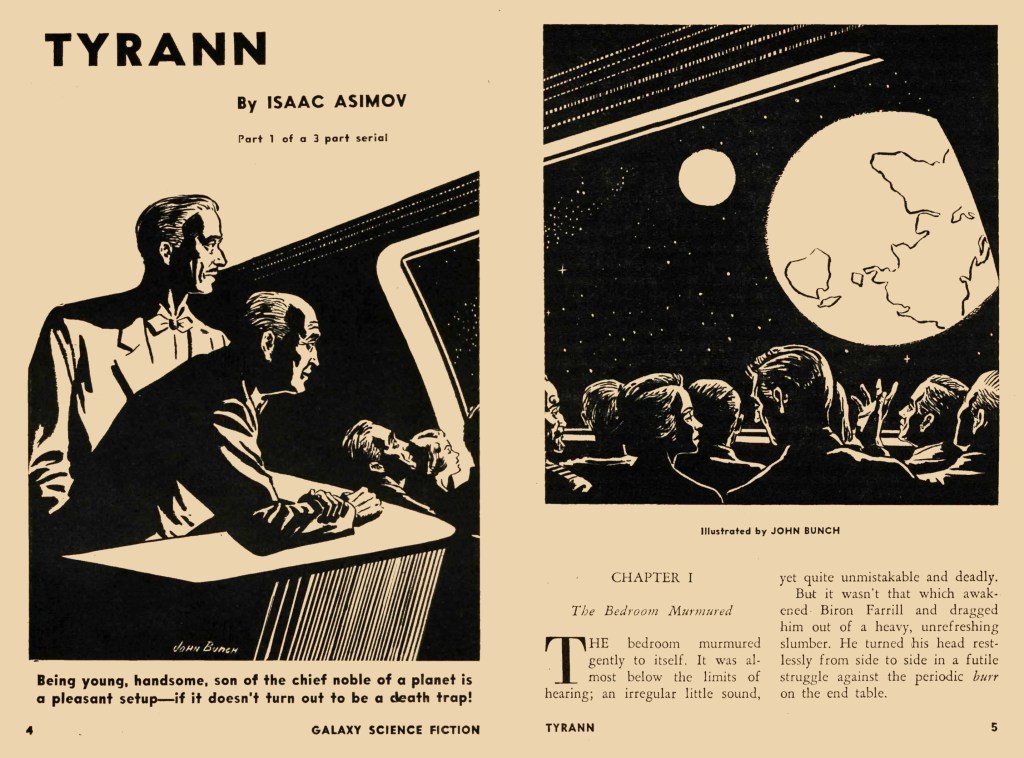
One of the fundamental properties of Horace Gold’s Galaxy Science Fiction, especially at the outset, was ambition. Gold was determined that Galaxy wouldn’t be just another SF magazine, but an excellent one. We’re only on Galaxy’s sixth issue as we reach the final installment of The Stars Like Dust ―, or Tyrann as it’s called in the magazine. Gold’s editorial for the issue concerns a readers’ poll about the magazine’s future and what will come as a result. The Five Star Shelf column will remain unchanged. An issue of self-contained stories will follow the conclusion of a serial. Stories with themes “too adult, too profound or revolutionary in concept” to be published elsewhere will continue. The editorial culminates with Gold’s plan for the magazine’s artwork which he describes thusly.

…we have been experimenting both in art and in technical processes, since we believe that a rebirth in science fiction should not be breeched by art of the forceps school. This month marks another experiment: halftone reproduction of photographs and wash drawings. This could not be done without trying out our technical processes. As we extend control, we will present other improvements that are now being worked on.

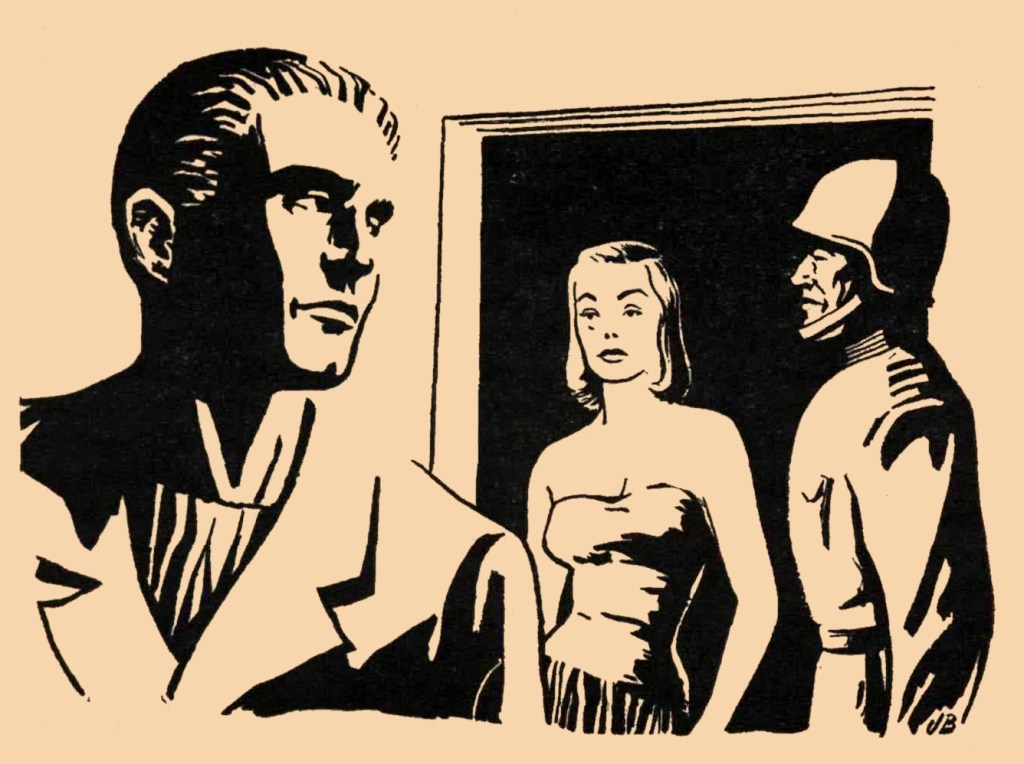
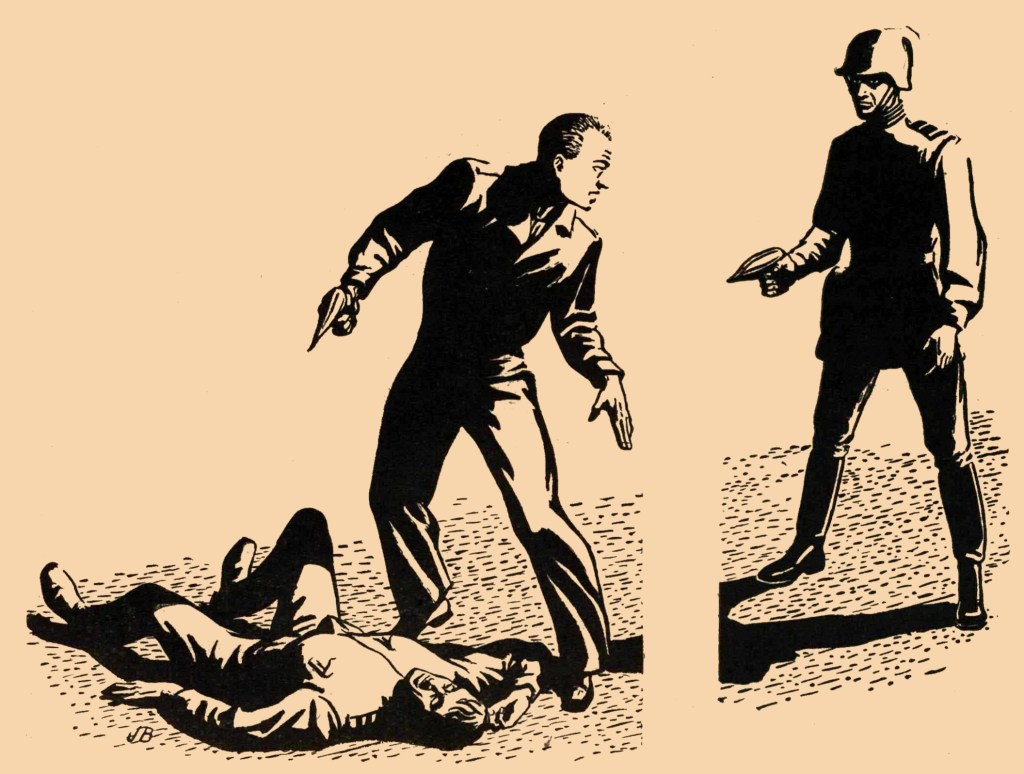
John Bunch once again illustrates the issue and it seems the decision to introduce wash drawings happened between his first and second illustration. These drawings give the artwork for this issue a distinctly different feel from the first two installments. Let’s take a look! Here’s the opening image.

The opening two-page spread from the third installment of "The Stars, Like Dust —" as published in Galaxy Science Fiction, March 1951,

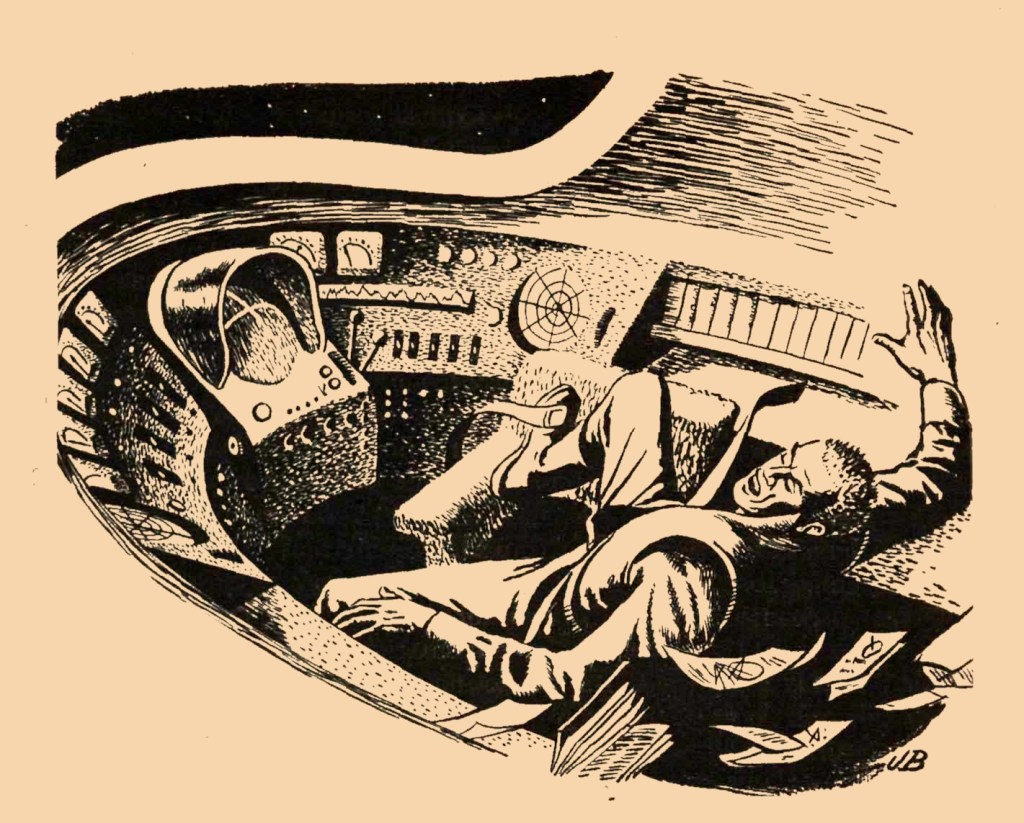
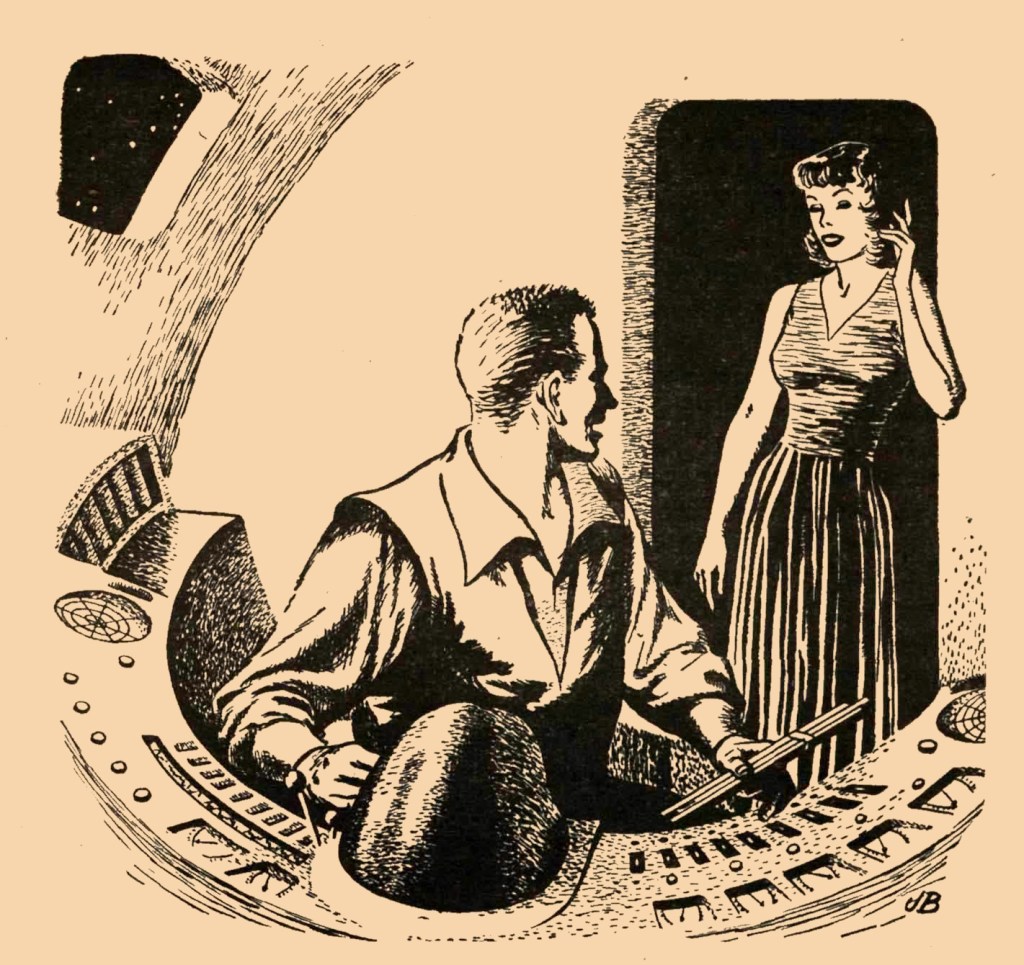
And here are the wash drawings. All but one of these span two pages.

If you’re interested in how the artwork in Galaxy developed, take a look at our coverage of The Caves of Steel which appeared in Galaxy two and a half years later.

And when you’re done reading The Stars Like Dust ― join us as we wrap up our conversation about the novel in our next episode!

Resources

Next Time on Stars End

There’s probably an argument to be made that the “Big Three” of Golden Age Science Fiction, rather than Clarke, Asimov, and Heinlein, are Astounding, Galaxy, and The Magazine of Fantasy and Science Fiction. A quick Duck-Duck-Go search confirms this and reminds me that I should really read more A. E. van Vogt.

We’re not there yet, though; we’re at a place where Galaxy Science Fiction had blasted off a mere five months before. It was largely an auspicious beginning, with the inaugural issue containing Richard Matheson’s “Third from the Sun” which was adapted into an excellent episode of The Twilight Zone ten years later. That reminds me, I should really read more Richard Matheson. That first issue also included Asimov’s “The Darwinian Pool Room” which the Good Doctor said was “among the least satisfactory stories I have ever written” so maybe the lift-off wasn’t flawless.[1]

Our focus here though is the fifth issue cover dated February 1951. It contains the second installment of Isaac Asimov’s Tyrann, and that is the subject of our next episode. Galaxy’s editor, Horace Gold was notorious for retitling stories and we, of course, know Tyrann as The Stars Like Dust ―.

So, how is Isaac’s second novel progressing? Have we defeated “Second Novel Syndrome” yet? And are we observing the protoplasmic form of Asimov’s unlikeable protagonists like Golan Trevize? Plus, what’s up with that infamous subplot? All that and more is in the episode!

By the way, I was surprised to learn that this issue of Galaxy also contained “The Fireman” by Ray Bradbury. That novella eventually grew into Fahrenheit 451, undeniably one of the classics of Science Fiction. Even if the lift-off wasn’t flawless, the launch was impressive and accelerating.

While we wait for our next episode, hopefully coming on Sunday, let’s enjoy the illustrations from this installment once again featuring some interesting use of negative space by John Bunch.

You can find the complete Issue here: Galaxy Science Fiction, February 1951.


The opening Two-page spread of Tyrann.

Resources

Next Time on Stars End

Galaxy SF, January 1951

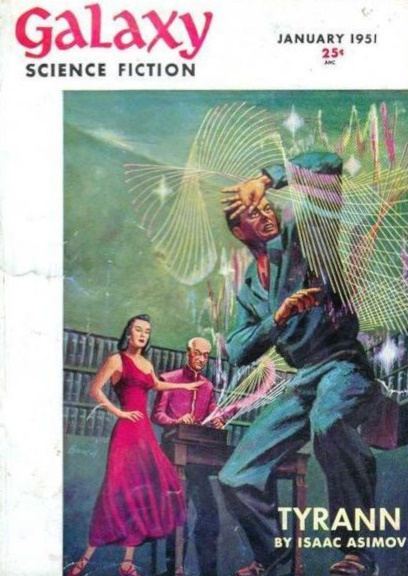
Right now I’m listening to Magnets, the second album by the Vapors. Their initial outing, New Clear Days, most famous for the song “Turning Japanese,” remains one of my favorite albums. When I discovered New Clear Days, Magnets was already out of print. I literally spent years trying to track it down to no avail. Eventually, it reappeared with both albums packaged on one CD. At the time, it was a bit of a letdown. Today I’m finding it a much better listen than I remembered. The song “Linena” remains my favorite cut. Still, when I think about the “Second Album Curse,” I invariably think back to Magnets.

There’s a related notion in the publishing world, namely “Second Novel Syndrome.” The Stars, Like Dust — is the Good Doctor’s second novel. Did he escape the syndrome? Let’s save that for the podcast.

The Stars, Like Dust was written while Horace Gold was trying to get Galaxy Science Fiction off the ground and he was anxious to include something by an author as popular as Asimov. Dust was serialized in Galaxy under the title Tyrann, starting in January of 1951, with art by John Bunch. That’s only the fourth issue. Let’s take a look at the illustrations; which I’ve cleaned up a bit.

Four of the six images are spread across two pages including this title page. I’ve kept the text in place so you can see it in context.

Without the text, I’m able to better align the two pieces.

One of the things that stands out in these illustrations is the extensive and effective use of solid black. Notice that Biron is entirely inside the negative space here.

This is one of the stand-alone images.

I’ve left the text here to highlight that this is an excellent use of layout. Biron feels both constrained and isolated, things highlighted by depicting him inside a cramped image, boxed in by the text.

Another example of effective use of negative space; our attention, like Biron’s, is drawn to Artemisia.

We end with one more three-column, two-page image.

Look for Stars End, Season 5, Episode 17 this weekend! We’ll talk about chapters 1 through 8 of The Stars, Like Dust or, if you prefer, Part 1 of Tryann as published in the January 1951 issue of Galaxy Science Fiction.

Resources

Next Time on Stars End

I like to try things I haven’t done before and, on Thursday I decided to make a serious attempt at learning some video editing skills. It’s still a work in progress because, as one of my professors in graduate school once said, “Everything takes longer than it does.” 9999 more videos and I’ll be an expert.

Meanwhile, Season 5, Episode 13 will be out tomorrow. In the meantime please enjoy this preview.

Once you do, you’ll want to follow these links!

Image Credits:

  • Featured Image: From “The Fun They Had” in Tomorrow’s TV, from the Raintree Reading Series 2, 1982 Fair Use

Watching Foundation: “Death and the Maiden”

Finishing up the Season 1 rewatch. Look for episode 7 in about 12 hours.

Watching Foundation – S1E06

Spoiler Alert! Joseph’s random thoughts about Season 1 Episode 6, Simultaneously published at ComicsTheUniverseAndEverything.net.

Spacers. Weird. They look like Gollum.

“I barely consider them human,” says 13.

“The human mind can’t tolerate the discontinuity” of space folding.

Maiden, mother, and crone. There’s an interesting parallel between the Cleons and the Goddesses of Lumenism. The central themes of Luminism: are cycles, Ouroboros, and nature seeking completion.

The Luminists believe that the goddesses were once a single entity. That’s very Catholic. As is the fact that they are a trinity.

Demerzel is a Luminist, which seems odd. She bypasses the “How is it that you believe” by answering why. How is the more interesting question.

“The search for meaning is not always about the answer.”

“At every point in our lives, we have the power to choose our own path.” A Three-Laws robot does not always have the power to choose.

The goddesses guide us towards service and truth “as though towards the center of a great spiral.”

So spiritual geometry. Luminists are circles and Cleons are lines.

Zephyr Halima gained fame by spearheading the recovery after an earthquake. She has been a Zephyr for less than a year.

13 is expecting clamoring masses. Halima meets him alone. And highlights what 13’s trip means about the importance of Luminism to the empire. She’s a skilled politician.

By offering 13 a drink, she gets him to symbolically reject the faith and the opportunity to surpass his impure intentions even if Demerzel is the one to voice it.

“I’m afraid whatever impurities I may harbor will have to remain hidden.” The rejection said out loud.

“Something tells me that’s how you prefer it.” And Halima spikes the ball.

“Triple blessings to you all.” The Catholicism references are pretty loud too. Of course, they are.

“I don’t think anyone with pure intentions would wheedle their way onto my welcoming committee.” So he gets it but he should have seen it coming.

Back to Terminus.

“Empire ships are as good at preserving their peoples’ lives as they are at taking others’.”

Lord Dorwin is still alive. Where’s everybody else? Dead.

The Anacreonians straight-up murdering people is gut-wrenching. They’re suddenly a lot less nuanced.

Talk of the Invictus and redemption from Phara. That eye is disconcerting.

Phara’s trying to crew a ship. The librarian is also skilled in Astronautics.

The jump ship was shot down to capture Dorwin.

More straight-up super villainy from Phara as she shoots Jacenta’s husband in the leg.

14 is wooing the gardener again. “A foolish attempt to control the uncontrollable.”

12 and 14 hunt for “Ghillie raptors” with powerful camouflage.

“I’d rather mold it myself.”

Invictus is a legendary powerful warship. Phara’s found it.

“Thank Seldon.”

Salvor has a plan. “This is the first Seldon crisis.” She’s convinced herself that she’s part of the plan. “Hari put me here to stop the Anacreons, and he’s helping me figure out how.”

Back to the Maiden. 13 is bitchy about being greeted by “a heretic.” He throws his weight behind Zephyr Gilat which is probably counterproductive.

Desalination plants might have worked in a popular election but the enclave is a tight group of politicians. They might see through it and water for the people Might not bolster their self-interests.

He smiles at Halima like “I got you.”

Terminus. Abbas talks about Trantor. “Miracles everywhere.” Built on a mountain of lies. Why did he join the Foundation? He believed in a girl called Mari Hardin. “I got you out of it didn’t I?” Dodging the question.

Trantor: 14 doesn’t want 12 to know how many raptors he killed. 12 takes 14 to a brothel where the girls’ memories are wiped.

Didn’t get the obvious? They have to force the resemblance between this girl and the gardener. Of course, 12 gets a report from her after her time with 14.

Salvor gets another vision. This time she’s in the body of Gaal.

Hari to Raych. “It has to become impossible for you to remain onboard.” Hari can’t fix things. He’s a lot less certain than the Hari in the book.

“This whole thing collapses because you stay with her.” Sacrifices waisted. “An entire galaxy pivoting around the actions of an individual.” The cryopod was programmed for Raych.

Abbas martyrs himself to destroy the “Corvettes.” Salvor melts down. “Daddy!”

So many ways that 14 is different. He’s reaching out to people outside the family. He’s showing concern for other people and a willingness to put himself at risk. 14 is colorblind. But “Cleons are exact copies.”

Shadowmaster Olbracht finds the raptors that 14 hid. Probably realizes the color blindness.

Meanwhile, Salvor is growing toward seeing violence as a problem.

And we’re doubling down on the part of the episode recognizing that psychohistory doesn’t work. Maybe. But Salvor’s also starting to see herself as a piece of the plan which is problematic.

The Desalination system should not be front and center at a funeral. Just saying.

And Halima walks in to interrupt Gilat and steal the show. It’s classic politics. Gilat and 13 are appealing to reason. Halima wins hearts and minds by connecting on an emotional level.

Souls used to be like candle wax burned down and snuffed out. “The mother took the straight line of life and sewed it into a circle.” Reincarnation is not about ascending to the highest planes of enlightenment. There is no end because our capacity for growth is infinite. “Even a soul that appeared holy 400 years ago would not be holy today.” “We must embrace the value of transformation, of evolution, of difference!” “We rejoice that her soul is not bound to a single immutable body.“

It’s extra odd that Demerzel would be an adherent to this religion. Is it aspirational?

Also bowing and leaving 13 to stand is a powerful statement.

Salvor and Hugo are captured. Phara & Company take Hugo’s ship and leave with the hostages who can crew a jump ship.

The episode ends with one defiant coin flip.

Rating: 3 out of 5.

All Images from Foundation on Apple TV+.
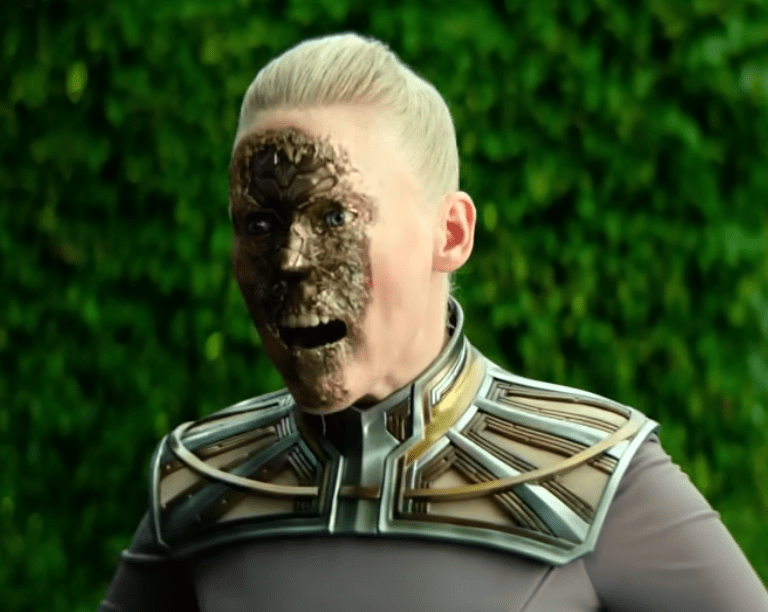
Stars End S3E36

“Never Hoard Your Silver Podcast”

Sometimes we bury the lede in the title so let’s rectify that straightaway: featuring special guest Melinda Snodgrass!

We’ve never been shy about our obligatory Star Trek references. As we’ve undertaken our long, strange trip through Asimov’s Robot Novels and some related short stories, those references skewed sharply in the direction of The Measure of a Man, which is in my opinion “the moment when The Next Generation earned the right to call itself Star Trek.” It’s great TV and great SF and a monument to themes and ideas that Asimov championed throughout his career.
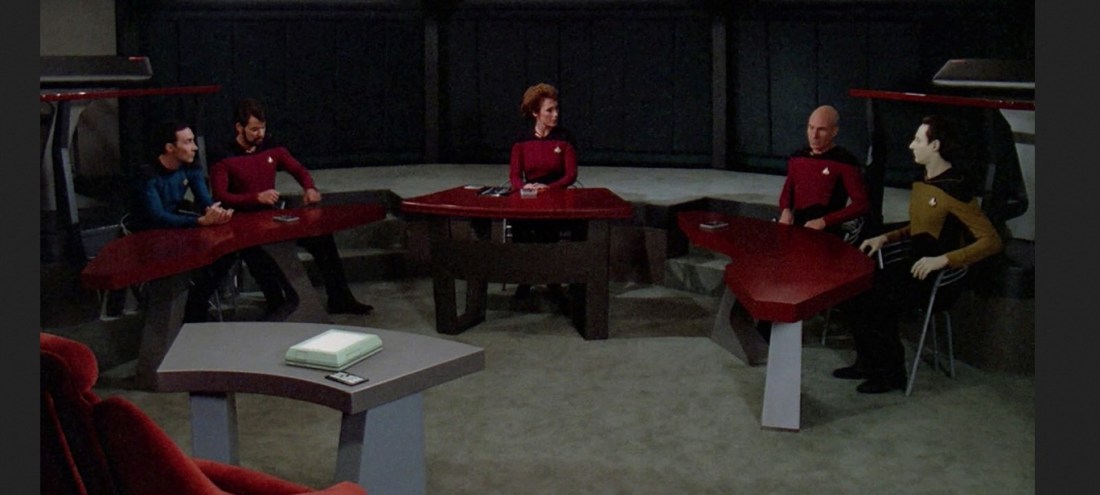
So for this episode, we going to treat you to an episode-long Star Trek reference as we’re joined by the author of The Measure of a Man, the aforementioned Melinda Snodgrass!

Please excuse us, we’re all a bit starstruck.

In addition to writing the quintessential Data episode for TNG, Melinda Is a ⁠lifelong Science Fiction fan⁠ who has written many novels including the Circuit series, co-created the Wild Cards series of books, and has extensive screenwriting credits including L. A. Law, Sliders, and The Outer Limits. Within the realm of Star Trek, Melinda has written Tears of the Singers, a TOS novel, and five episodes of TNG, which also include a excellent second Data-Centric episode, The Ensigns of Command.

She was the Story Editor on Next Generation while the show transformed from a program struggling to find its voice into the science fiction juggernaut we all know and love.

As Jon puts it, this episode “slaps!” You do not want to miss this one! Let’s go!

Images used under the fair use doctrine.