Stars End S5E19

We conclude our coverage of The Stars Like Dust ―, with chapters 15 through 22. That corresponds to part 3 of Tyrann as published in The March 1951 issue of Galaxy Science Fiction.
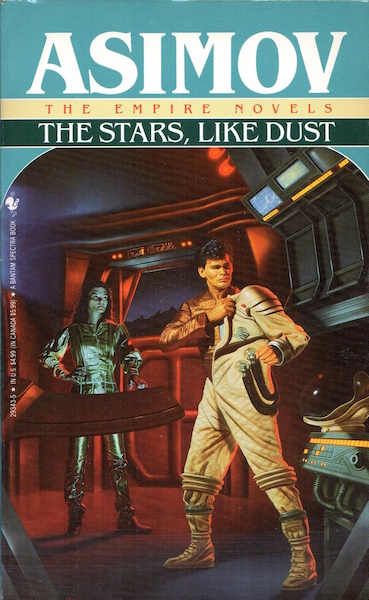
The cover of a paperback edition of "The Stars, Like Dust."

“We the People… Do Ordain and Establish this Podcast.”

As we rejoin our heroes The USS Enterprise, trailer firmly attached by tractor beam, is approaching planet Omega 4. There they find the derelict USS Exeter in orbit. Kirk, Spock, McCoy, and Galloway beam over to the Exeter where the entire crew has mysteriously been turned into common rock salt, just like you can buy from any neighborhood hardware store.

No, wait. I’m confused. That’s the “Omega Glory,” S2E23 of Star Trek. I swear, sometimes these Star Trek references just write themselves.

A still from Star Trek: The Omega Glory.  Fair Use.

Anyway, the beginning of the episode is actually pretty good, but the ending is very, very dumb. So dumb that it lands it in the “So bad you have to see it to believe it” category. Unfortunately for the episode, people only seem to remember that ending.

To Asimov’s credit, we know that he did not like that ending, Strangely he didn’t like it even some 15 years or so before the episode aired. How does that work? I guess you’ll have to listen to our episode.

Meanwhile, being of a certain age myself, I can’t seem to get this little earworm out of my head.

Let’s all sing along! “Ee Plannista, enor durtofo amo orper fectyoo nion…” Everybody!!

Next Time on Stars End

Season 5 Episode 19 is on its way!

One of the fundamental properties of Horace Gold’s Galaxy Science Fiction, especially at the outset, was ambition. Gold was determined that Galaxy wouldn’t be just another SF magazine, but an excellent one. We’re only on Galaxy’s sixth issue as we reach the final installment of The Stars Like Dust ―, or Tyrann as it’s called in the magazine. Gold’s editorial for the issue concerns a readers’ poll about the magazine’s future and what will come as a result. The Five Star Shelf column will remain unchanged. An issue of self-contained stories will follow the conclusion of a serial. Stories with themes “too adult, too profound or revolutionary in concept” to be published elsewhere will continue. The editorial culminates with Gold’s plan for the magazine’s artwork which he describes thusly.

…we have been experimenting both in art and in technical processes, since we believe that a rebirth in science fiction should not be breeched by art of the forceps school. This month marks another experiment: halftone reproduction of photographs and wash drawings. This could not be done without trying out our technical processes. As we extend control, we will present other improvements that are now being worked on.

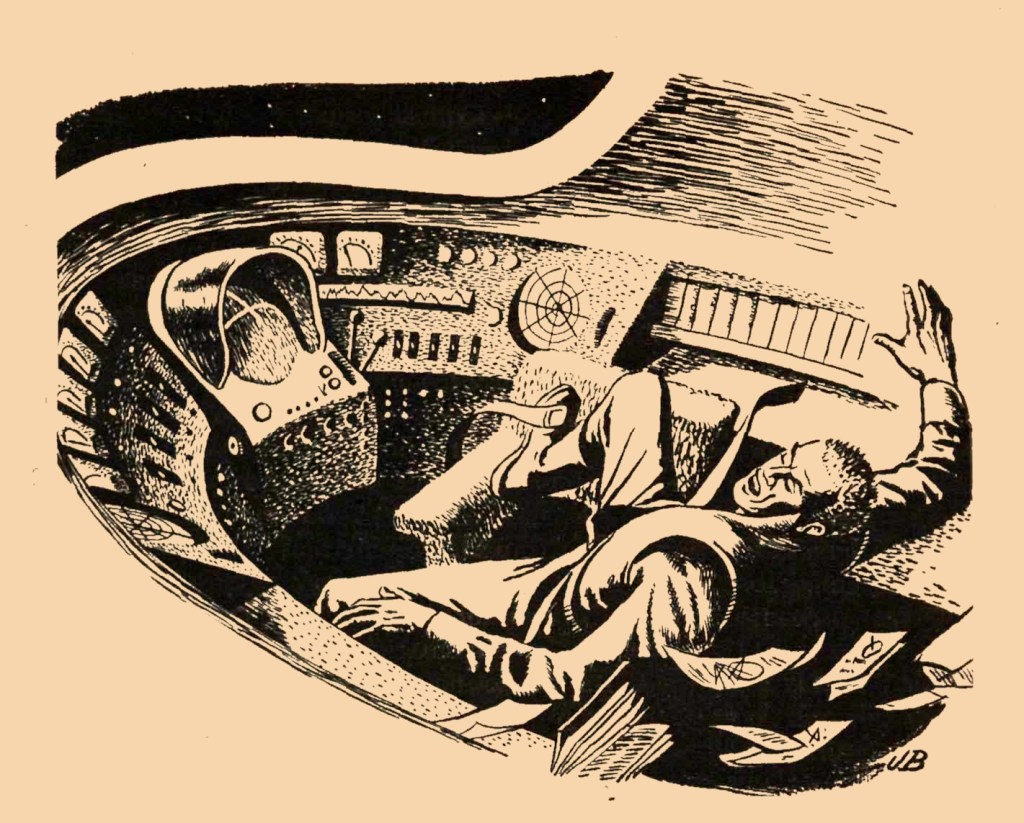
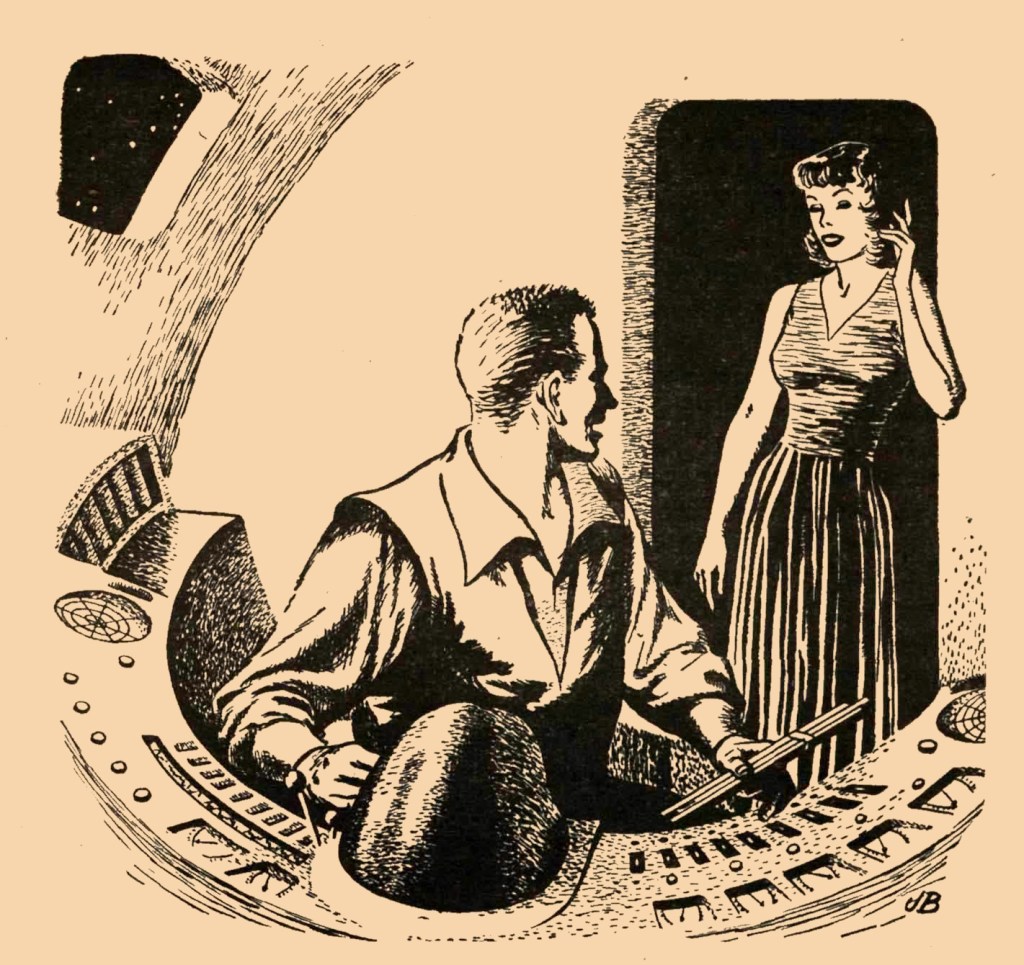
John Bunch once again illustrates the issue and it seems the decision to introduce wash drawings happened between his first and second illustration. These drawings give the artwork for this issue a distinctly different feel from the first two installments. Let’s take a look! Here’s the opening image.

The opening two-page spread from the third installment of "The Stars, Like Dust —" as published in Galaxy Science Fiction, March 1951,

And here are the wash drawings. All but one of these span two pages.

If you’re interested in how the artwork in Galaxy developed, take a look at our coverage of The Caves of Steel which appeared in Galaxy two and a half years later.

And when you’re done reading The Stars Like Dust ― join us as we wrap up our conversation about the novel in our next episode!

Resources

John Jenkins

The latest episode of Stars End begins with a short tribute to John Jenkins and his wonderful “Spoiler-Laden Guide to Isaac Asimov,” which I typically refer to as the “Asimov Reviews” site. Asimov Reviews is what the internet should be but only rarely is. If you’re a fan of The Good Doctor it’s a treasure trove of information about everything Asimov within which it’s easy to get lost. If you’re putting together an Asimov podcast like Stars End it’s an invaluable resource. If you have even a passing interest in Asimov and his work you owe it to yourself to check it out. You can find the site here: Asimov Reviews.

We’d been meaning to invite John onto the podcast for a while. Shortly before we recorded this episode I visited the blog portion of his site and learned that John had passed away. We don’t know if it’s possible to miss someone you’ve never met but we regret never having the opportunity to chat with him about Daneel, Hari Seldon, or “The Last Question.” We’ll remain in awe of what he accomplished with Asimov Reviews and be thankful that it exists.

Stars End S5E18

And now we settle in for the second part of the Good Doctor’s second novel! Join us as we dust The Stars, Like Dust— with commentary like powdered sugar on a doughnut! Let’s chat about chapters nine through fourteen!

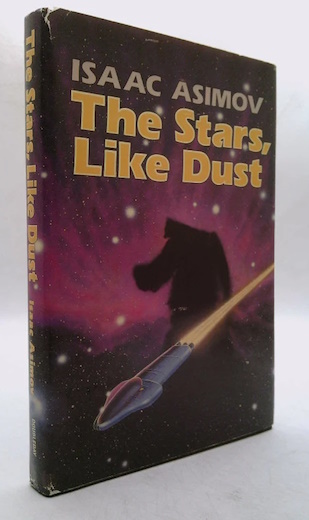
A 1980s book jacket for The Stars Like Dust—.

“The Podcast Was Located in a Little Niche Just Outside the Cabin”

But first, a quick note: our episode begins with a short tribute to John Jenkins and his wonderful “Spoiler-Laden Guide to Isaac Asimov,” which I typically refer to as the “Asimov Reviews” site. It’s what the internet should be and rarely is. You can read more about that here.

If this novel feels a little non-Asenion for your tastes, this installment might be for you! If you love Golan Treveze or the version of Hari Seldon who inhabits the Foundation Prequels, you’ll like Biron Ferrill better as this installment goes forward. If you think that there is a bit too much buckling and swashing in the first section, there is a bit of action where Biron overpowers a guard, tying him up with a pair of pantyhose. But once Gil and Artemisia help steal a space ship things settle down to storytelling and discussing galactic goings on as opposed to any actual going or actually doing anything story-inspiring. Plus, it’s something that passes for a plot twist!

So, let’s go! Help us bust the stars like dust with the vacuum of space!

Next Time on Stars End

There’s probably an argument to be made that the “Big Three” of Golden Age Science Fiction, rather than Clarke, Asimov, and Heinlein, are Astounding, Galaxy, and The Magazine of Fantasy and Science Fiction. A quick Duck-Duck-Go search confirms this and reminds me that I should really read more A. E. van Vogt.

We’re not there yet, though; we’re at a place where Galaxy Science Fiction had blasted off a mere five months before. It was largely an auspicious beginning, with the inaugural issue containing Richard Matheson’s “Third from the Sun” which was adapted into an excellent episode of The Twilight Zone ten years later. That reminds me, I should really read more Richard Matheson. That first issue also included Asimov’s “The Darwinian Pool Room” which the Good Doctor said was “among the least satisfactory stories I have ever written” so maybe the lift-off wasn’t flawless.[1]

Our focus here though is the fifth issue cover dated February 1951. It contains the second installment of Isaac Asimov’s Tyrann, and that is the subject of our next episode. Galaxy’s editor, Horace Gold was notorious for retitling stories and we, of course, know Tyrann as The Stars Like Dust ―.

So, how is Isaac’s second novel progressing? Have we defeated “Second Novel Syndrome” yet? And are we observing the protoplasmic form of Asimov’s unlikeable protagonists like Golan Trevize? Plus, what’s up with that infamous subplot? All that and more is in the episode!

By the way, I was surprised to learn that this issue of Galaxy also contained “The Fireman” by Ray Bradbury. That novella eventually grew into Fahrenheit 451, undeniably one of the classics of Science Fiction. Even if the lift-off wasn’t flawless, the launch was impressive and accelerating.

While we wait for our next episode, hopefully coming on Sunday, let’s enjoy the illustrations from this installment once again featuring some interesting use of negative space by John Bunch.

You can find the complete Issue here: Galaxy Science Fiction, February 1951.


The opening Two-page spread of Tyrann.

Resources

Stars End S5E17

Let’s dig into the Great and Glorious Az’s second novel! Join us for The Stars, Like Dust—! In this episode, we sift through chapters one through eight.

“The Podcast Murmured to itself Gently”

The Stars, Like Dust is book #003 in the Asimov canon. That’s a little misleading. Book #002 I, Robot is a fix-up; most of it had been written years before. This was the second time the Good Doctor sat down to write a book and he intended to write a Novel with a capital “N.” He wasn’t having a good time of it. Walter Bradbury, Asimov’s editor, had liked Pebble in the Sky and wanted a follow-up but he also wanted an outline and a couple of sample chapters. Bradbury rejected the first two proposals. John Jenkins of AsimovReviews.net put it this way.

…now that he was a Novelist, Asimov was thinking he needed to write like one and was getting carried away. Rather than his sticking to his usual sparse prose, he was getting distinctly florid, and he needed to tone things down.

That’s what comes from trying to write a Novel with a capital “N” I suppose. To make matters worse, when Galaxy Science Fiction bought the right to serialize the novel Horace Gold insisted on a subplot that Asimov really didn’t care for.

But now it was time to sit down and write, which is what our good friend Isaac does best. Join us to see how the book turned out! This reading coincides with the installment published in the January 1951 issue of Galaxy Science Fiction under the title Tyrann.

Next Time on Stars End

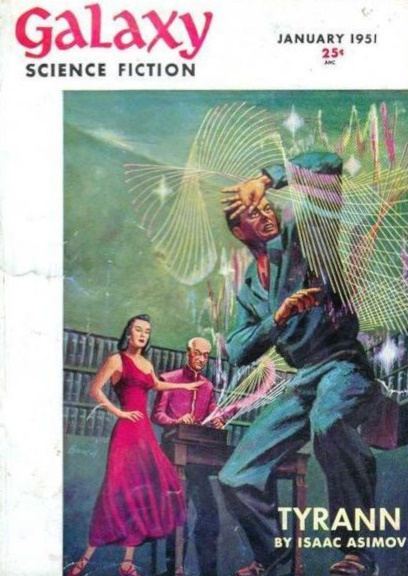
Galaxy SF, January 1951

Right now I’m listening to Magnets, the second album by the Vapors. Their initial outing, New Clear Days, most famous for the song “Turning Japanese,” remains one of my favorite albums. When I discovered New Clear Days, Magnets was already out of print. I literally spent years trying to track it down to no avail. Eventually, it reappeared with both albums packaged on one CD. At the time, it was a bit of a letdown. Today I’m finding it a much better listen than I remembered. The song “Linena” remains my favorite cut. Still, when I think about the “Second Album Curse,” I invariably think back to Magnets.

There’s a related notion in the publishing world, namely “Second Novel Syndrome.” The Stars, Like Dust — is the Good Doctor’s second novel. Did he escape the syndrome? Let’s save that for the podcast.

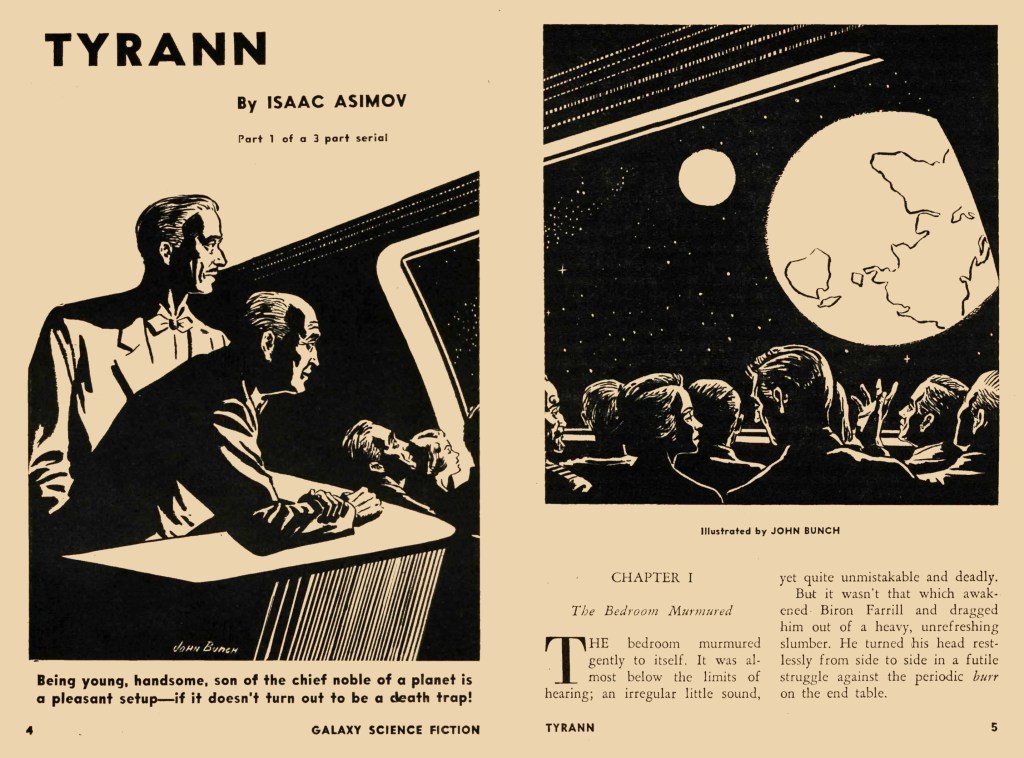
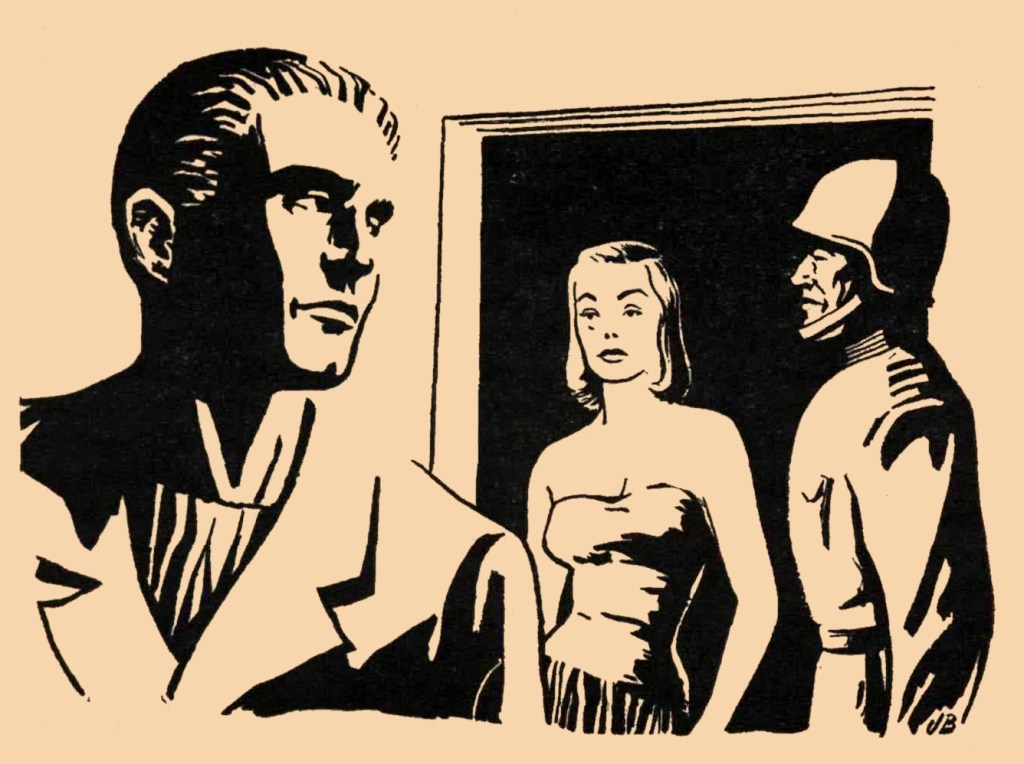
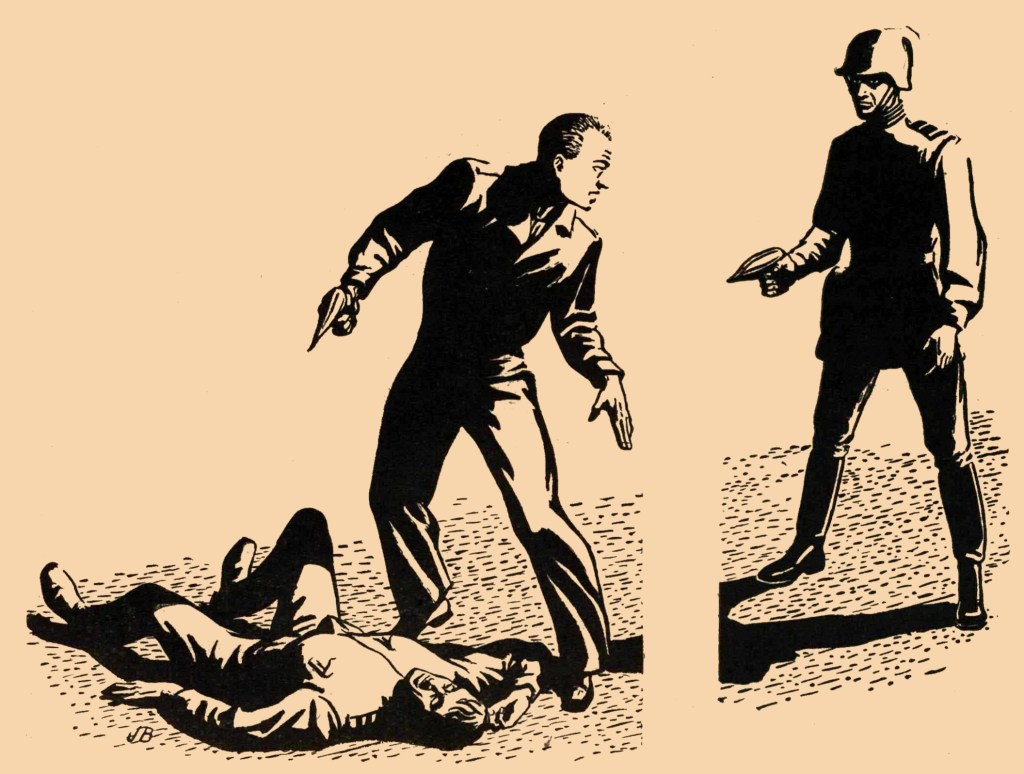
The Stars, Like Dust was written while Horace Gold was trying to get Galaxy Science Fiction off the ground and he was anxious to include something by an author as popular as Asimov. Dust was serialized in Galaxy under the title Tyrann, starting in January of 1951, with art by John Bunch. That’s only the fourth issue. Let’s take a look at the illustrations; which I’ve cleaned up a bit.

Four of the six images are spread across two pages including this title page. I’ve kept the text in place so you can see it in context.

Without the text, I’m able to better align the two pieces.

One of the things that stands out in these illustrations is the extensive and effective use of solid black. Notice that Biron is entirely inside the negative space here.

This is one of the stand-alone images.

I’ve left the text here to highlight that this is an excellent use of layout. Biron feels both constrained and isolated, things highlighted by depicting him inside a cramped image, boxed in by the text.

Another example of effective use of negative space; our attention, like Biron’s, is drawn to Artemisia.

We end with one more three-column, two-page image.

Look for Stars End, Season 5, Episode 17 this weekend! We’ll talk about chapters 1 through 8 of The Stars, Like Dust or, if you prefer, Part 1 of Tryann as published in the January 1951 issue of Galaxy Science Fiction.

Resources

Stars End S5E16

We encounter the back cover of the Good Doctor’s first actual book as we wrap up The Pebble in the Sky with chapters 14 through 22.

Cover of the Bantam Paperback edition of Pebble in the Sky (1957)

“Podcast Along With Me The Best is Yet to Be.”

If you’ve been around for a while you probably remember our discussions of the “Great Man Theory of History” vs the “Bottom-Up” paradigm. In other words, do remarkable individuals with unique characteristics write history or is it driven by powerful historical forces that generate great leaders when they are needed? It’s a false dichotomy, but a useful one. In the Foundation Universe the bottom-up theory must dominate otherwise psychohistory could not work the way it does.

But Joseph Schwartz is just the right Jewish tailor with a special kind of trick memory who is accidentally thrust to an exact moment in Earth’s future. Once there he is brought to the only scientist on Earth doing a particular type of brain research. He then survives a dangerous experiment that gives him an unlikely set of psychic powers which he uses to save the lives of nearly every human in the galaxy.

Put those numbers into your Prime Radiant and crunch them!

This probably delayed the creation of psychohistory by hundreds of years. “I just don’t understand it, Hari, the math says everyone in the galaxy should be dead right now.”

You’ll want to hear this! Let’s GO!

Stars End S5E15

Here’s your chance to join the discussion about Pebble in the Sky, Chapters 7 through 13! Also, we’ll open up the “Stars End Mailbag” and talk about Star Trek: Discovery!

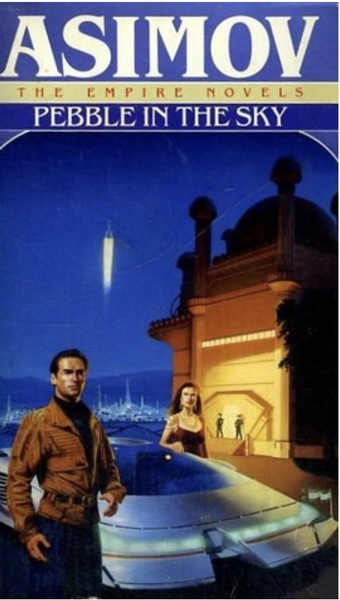
Cover of Pebble in the Sky, paperback ed. , circa 1992

“There is Only One Reason Why a Synapsifier Can Possibly Be Used – To Improve a Podcast”

A lot of us who are past the point where we would be culled by the 60 take supplements to, theoretically, help improve our memory. Just the other day I couldn’t remember the title of the Star Trek episode “Return to Tomorrow.” That was no fun. I think most of us would like to be at least a little smarter and maybe some of what would come from a device like the synapsifier could be helpful.

I’ll pass on the parts about being lost in the department store, wandering about the automat, or being driven mad by the thoughts of strangers though. Those don’t sound fun either. “Lost in the Supermarket” by the Clash might sum up all of these potential side effects.

It would though, improve a podcast, to a point. Remembering what we want to say would help quite a bit. And having perfect recall would save a lot of note-taking. But telepathic communications would ruin things even with state-of-the-art recording equipment unless an hour of silence would be an improvement.

In the meantime, we’ll muddle through and bring you the best podcast possible with regular human brains and imperfect memory! Let’s GO!

Stars End S5E14

We begin our conversation about Pebble in the Sky with Chapters 1 through 6.

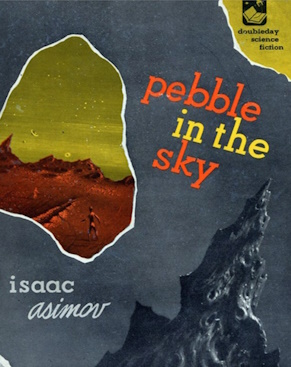
Pebble In The Sky First Edition Cover

“Between One Podcast and the Next.”

Isaac Asimov is famously prolific; if you know one thing about the Great and Glorious Az it might be that he wrote more than 500 books. Asimov-Reviews.net puts the number at 514 counting the Good Doctor’s dissertation. Asimov.Fandom.com puts the number at a much more modest 506.

The Back Cover of Opus 100. Asimov’s First 100 books.

Why is this relevant? Well, Pebble in the Sky is Asimov Book #001; it’s the first thing he wrote that got stuck between its own two covers (unless you count his dissertation, which he did not). It’s also only his first novel even though he had already been writing professionally for eleven years. Most of I, Robot and the Foundation Trilogy were in the rearview mirror; those quickly became books 002, 004, 006, and 009. Pebble in the Sky is also a lot of fun!

Don’t miss it as we delve into this significant moment in Asenion history! Let’s GO!