In which we talk about “Cal” and “The Fun They Had” with special guest Rachel from the Menuscript Podcast.
“The Podcasts They Had”
“Cal” has been called “the last great Asimov short story” and it looks like it’s his very last robot story. Cal is a robot who learns how to write fiction and develops into an odd sort of Asimov avatar throughout the story.
“The Fun They Had,” is one of the Great and Glorious Az’s most reprinted works featuring a student thinking back to how great school must have been back in the long, long ago of the 20th century.
We’re joined by special guest Rachel Schwartzbard who has just started her own podcast, the Menuscript, which is excellent. She’ll talk about it in this episode. You don’t want to miss that; afterward, you’ll want to check out her podcast!
The stories and Rachel’s podcast can be found right here.
I like to try things I haven’t done before and, on Thursday I decided to make a serious attempt at learning some video editing skills. It’s still a work in progress because, as one of my professors in graduate school once said, “Everything takes longer than it does.” 9999 more videos and I’ll be an expert.
Meanwhile, Season 5, Episode 13 will be out tomorrow. In the meantime please enjoy this preview.
“Who Really Cares What a Podcast Looks Like Or Is Built Of Or How It Was Formed”
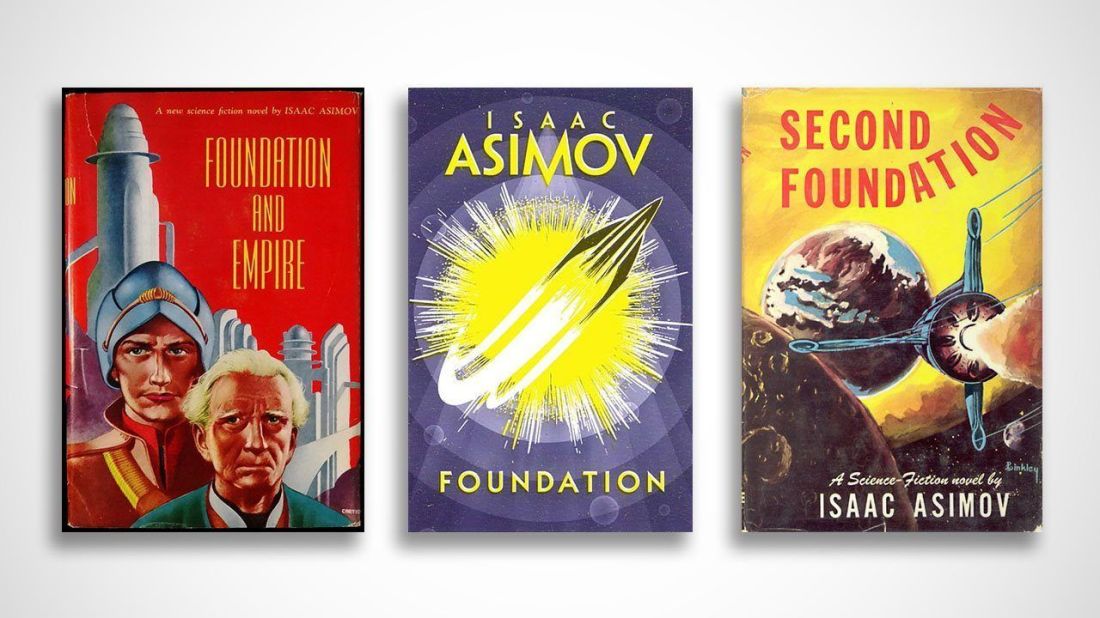
We finally know that season 2 of Apple TV+’s Foundation will begin on 14 July. Rather than tackling another novel, we’re wrapping up season 3 of Stars End with short stories and guests.
In our next episode, we’re both pleased and proud to announce that we’ll be interviewing Melinda Snodgrass, author of the first truly great episode of Star Trek: The Next Generation, and the source of many of our Star-Trek-related digressions, “The Measure of a Man.”
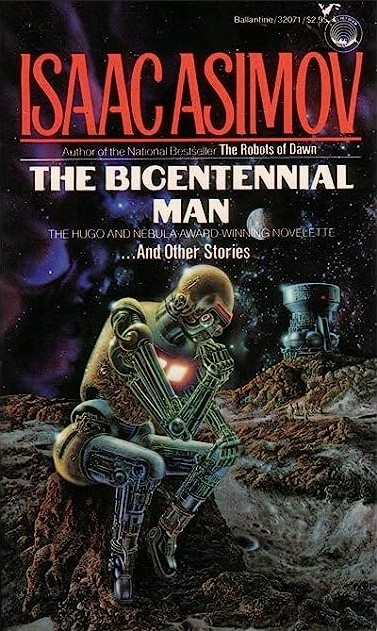
But in the meantime, for this episode, we’re reading The Great and Glorious Az’s “The Bicentennial Man,” (TBM) which is based in part on a suggestion from famed science fiction editor Judy-Lynn del Rey. To quote the good doctor, “Of all the robot stories I ever wrote, ‘The Bicentennial Man’ is my favorite and, I think, the best.” In The Complete Robot, he pairs it with our last episode’s subject, “…That Thou Art Mindful of Him” (TTAMoH) in a section entitled “Two Climaxes” where he envisions the ultimate fate of the three laws and the science of robotics.
Of the two, TBM has the less auspicious genesis. You’ll recall that TTAMoH was commissioned for an anthology entitled Final Stage which charged the authors with taking their themes to their ultimate conclusion. TBM was commissioned for an anthology entitled “The Bicentennial Man” where the stories could be anything at all so long as it was suggested by the phrase, “The Bicentennial Man.” That, to a large degree, was the way things worked in the US in 1976.
But there was an earlier suggestion from del Rey about “…a robot who has to choose between buying its own liberty and improving its own body.” After reading TBM, Judy-Lynn wanted the story, and when the original anthology fell through, Judy-Lynn got the story. It appeared in a different anthology, one that she edited, Stellar Science Fiction #2 published in February 1976.
So, don’t miss our discussion of “The Bicentennial Man, ” the Good Doctor’s favorite Robot Story, and his third favorite story overall, surpassed only by “The Last Question” and “The Ugly Little Boy.”
Asimov’s story “…That Thou Art Mindful of Him” has an interesting pedigree. It was initially commissioned for an original collection entitled, Final Stage: The Ultimate Science Fiction Anthology edited by Edward L. Ferman and Barry N. Malzberg. The intent of the anthology is compelling. Here’s how the editors described the premise.
The assumption was that science fiction — that branch of literature, half beast, half-civilized —sits upon perhaps, a dozen classic themes, which, in various combinations, permutations, and convolutions, underline most of the work in the field. Like the ten to twenty basic chess attacks and defenses, these themes can lead to winning combinations of great beauty or, in less talented hands, to disastrous and obvious clichés.
Some of science fiction’s most astounding writers were each given one of these classic themes and charged with crafting that theme’s ultimate story. The assignment of “Robots and Androids” could only have gone to the good doctor. Each contributor was also tasked with writing an afterword on the theme and their story.
Thus, “…That Thou Art Mindful of Him” was born. Ed Malzberg was also editor of The Magazine of Fantasy and Science Fiction at the time. According to Peter King writing on Amazon.com, Malzberg, upon receiving the manuscript, was compelled to include it in his magazine first. It appeared in the April 1974 issue. In his afterword to the story, The Great and Glorious Az proclaimed “…having followed matters through to the logical conclusion, I have possibly destroyed the Three Laws, and it made it impossible for me to ever write another positronic robot story.”
But then, of course, he qualified it, maybe not. And he said something similar after writing the Bicentennial Man two years later (that’s for next week). He qualified that as well, “But then again,” he wrote, “I might. I’m not always predictable.” Two novels and a bunch more short stories later, the good doctor might have been more predictable than he thought.
Anyway, we talk about it. Please tune in and join the fun! Let’s go!
Afterword to “…For Thou Art Mindful of Him.”
by Isaac Asimov, Final Stage: The Ultimate Science Fiction Anthology, Penguin Books, 1974
The first story I wrote in which the Three Laws of Robotics were explicitly stated, was “Runaround,” which appeared in the March 1942 issue of Astounding Science Fiction. The laws were implicit, however, in stories, I had written earlier — the earliest being “Robbie,” which appeared under the title of “Strange Playfellow” in the September 1940 issue of Super Science Stories. So I have been playing around with those Three Laws for more than a generation.
With all due modesty, (which means “very little modesty” in this case), the Three Laws were revolutionary in science, fiction development. That’s not to say that there were no sympathetic robots in the field before Robbie. There was Lester Del Rey’s “Helen O’Loy” in the December 1938 Astounding Science Fiction, for instance. The Three Laws, however, and the stories I used to explore them, represented the first honest attempt at a rationalization of robots as machines, and not as symbols of man’s overweening pride leading to his destruction, à la Frankenstein. The field did me the honor of excepting the Three Laws, and though no one but myself can use them explicitly, many writers simply assume their existence and know that the reader will assume it too.
This does not mean that I wasn’t aware from the start, that there were serious ambiguities in the Three Laws. It was out of these ambiguities, indeed, that I wove my stories. In The Naked Sun, the ambiguities could even lead to robot-induced murder.
And, of course, the deepest ambiguity and the one that had the potential for giving the greatest trouble was the question of what was meant by the phrase “human being“ in the Three Laws. John Campbell and I used to discuss the matter in the far-distant good old days of the Golden Age, and neither of us ever came to a satisfactory conclusion. It did seem likely, though, that if I were allowed to dig deeply into the question of “What is man that thou art mindful of him?” as addressed to the robot, I might upset the Three Laws altogether, — and at that I always balked.
But John is now dead, and I am in my late youth, and the Three Laws have given me good, loyal, and profitable service for thirty-four years, and maybe that’s enough. So when asked to write “the ultimate story” in robotics — or as near as I could come to one — I sighed and took up the matter of that Biblical quotation (Psalms 8:4).
I think you will agree with me that, having followed matters through to the logical conclusion, I have possibly destroyed the Three Laws, and it made it impossible for me to ever write another positronic robot story.
“A Small Podcast Yet to the Humans Involved Astonishingly Large”
We didn’t set out to do it, but we did it.
What, you might ask? We’ve created an episode that’s an excellent jumping-on point for anyone who’s been itching to try the podcast but doesn’t know where to start.
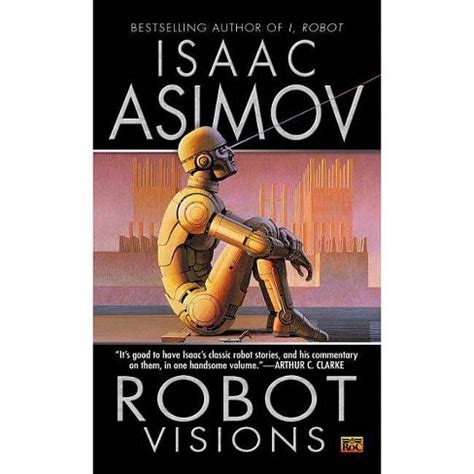
How? Well to start with, we’re talking about a short story. You don’t need to read the books or watch the shows we talk about to enjoy the podcast, but we certainly understand if want to! We’re talking about “Mirror Image” from Robot Visions, in which Lije Baley and R. Daneel Olivaw help to solve a dispute between two mathematicians. It’s about 19 pages long, a comfortable, digestible chunk.
And? And we have guests! Episodes are better with guests and we’re joined by two charming mathematicians, Coleen and Charlie Jacobson, long-time science fiction readers and friends of Joseph from Elmira College. They’ll help us decide if the off-screen mathematicians are true to life! On a personal note, if you remember Joseph from EC you might enjoy hearing from half of what he calls, the “Mathematics Faculty Classic” that existed from 2012 to 2014.
So, if you’re a regular listener, settle in for another excellent episode. If you’re new to the podcast, buckle up! You’re in for a fun ride! Let’s go!
Two notes on the Featured Image: The background is some board work from 2016 when Joseph taught Geometry from Charlie’s notes. In the foreground are two images of Paul Erdös, one at age 20 and one much later in his life, drawn by LeUyen Pham from The Boy Who Loved Math. Erdös is famous for being one of the most prolific mathematicians of all time and for having a multitude of collaborators.
If you follow our podcast you know that we’ve discussed Asimov’s reluctance to rewrite stuff many times. Even more frequently we’ve discussed… let’s call it the Great and Glorious Az’s ability to write female characters. We’ve speculated that, after attending Boys High School in Brooklyn, Seth Low Junior College, and Columbia University, neither of which were co-educational, it’s possible that Asimov simply hadn’t spent time with many women. Aside, of course, from his mother and sister.
The Robot Chronicles
We were therefore intrigued by the following quote from “The Robot Chronicles” as published in Asimov’s Gold: the Final Science Fiction Collection. At this point in the essay, Asimov writes about his individual Robot stories and what made them significant. Here’s what he had to say about “Liar!”
In the very next issue of Astounding, that of May 1941, my third robot story, “Liar!” appeared. The importance of this story was that it introduced Susan Calvin, who became the central character in my early robot stories. This story was originally rather clumsily done, largely because it dealt with the relationship between the sexes at a time when I had not yet had my first date with a young lady. Fortunately, I’m a quick learner, and it is one story in which I made significant changes before allowing it to appear in I, Robot.
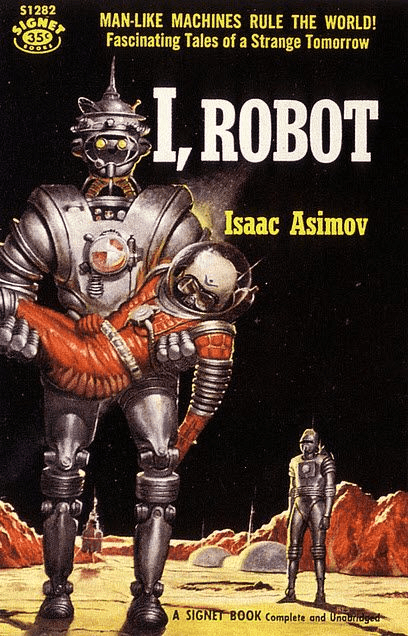
You can find the story in any edition of I, Robot or The Complete Robot and you can see the original version in the May 1941 edition of Astoundinghere.
The original artwork for “Liar!” by Charles Schneeman
If you haven’t read it, “Liar!” tells the story of Herbie, a robot accidentally created with the ability to read minds. As the roboticists at U. S. Robots and Mechanical Men work to find out what caused this ability we get a first-hand look at how Herbie’s ability to read minds interacts with the three laws. We also get to see how Herbie’s subsequent behaviors affect the humans around him.
For those of us on the podcast, it was nice to get some confirmation for the theory we’d proposed on the show. For anyone who considers themself an Asimovologist, the changes to “Liar!” are intriguing for two reasons. The first is to see how Asimov’s treatment of women progressed to address the clumsiness that he perceived. The second asks how much of a rewrite he considers “significant.”
The Individual Edits
So let’s take a look at the changes. The first occurs in the fifteenth paragraph. Here’s the text from Astounding.
“Bogert is right,” said Dr. Calvin. “Ever since the Interplanetary Code was modified to allow robot models to be tested in the plants before being shipped out to space, antirobot propaganda has increased. If any word leaks out about a robot being able to read minds before we can announce complete control of the phenomenon, Tyrone and his demagogs (sic) could make pretty effective capital out of it.”
In the I, Robot version, the underlined part has been changed to, “pretty effective capital could be made out of it.” This change does not seem substantive. The mention of Tyrone was likely Asimov teasing a story that was ultimately never written. We would need evidence before we could say that for sure.
The next change occurs shortly after the first section break. Again and going forward, we start with the Astounding version.
“She paused to readjust the huge ‘No Entrance’ sign upon the door and then approached the robot with a friendly smile.”
Here, Susan Calvin is entering a room to bring books to Herbie. In the revised version the underlined text is omitted, which makes sense. Between this version and the publication of I, Robot, the character of Susan Calvin evolved into a no-nonsense professional thus the friendly smile seems to be a bit out of character. In a larger sense though, a disarming smile might ease interaction with another human but there is no reason to try that with a robot, much less a mind-reading one. The brilliant robopsychologist would have known this so the original neither fits the character nor the story.
Dr. Calvin and Herbie have a conversation about Milton Ashe. Eventually, we get this.
“The psychologist paused in thought and then looked up suddenly. ‘A girl visited him here at the plant half a year ago. She was pretty, I suppose—blond and slinky. And, of course, could scarcely add two and two.’”
In the book, “slinky” becomes “slim,” a more conservative and genteel description that seems more in keeping with Calvin’s personality. “Slinky” implies things about the way the woman holds herself and how she dresses. The combination of “slinky” with the remark about the young lady’s intelligence creates a different and less complimentary image of the character.
A bit later, we see this bit of conversation about Susan Calvin.
“He opened his eyes wide and frowned, “Say, Bogie, have you been noticing anything queer about the dame lately?”
The revised version replaces “dame” with “lady.” Another move toward more respectful language.
Next, we encounter one of the less substantive changes.
“Are you crazy? If you’ll reread Mitchell’s original paper in the Mathematical Journal—”
“Mathematical Journal—” becomes “Transactions of the Far—.” The latter sounds more like an actual journal, but it loses the emphasis that the paper appeared in a mathematics publication. That should have been clear from the context, however.
The most substantive change comes when Milton Ashe shows Calvin a sketch of a house he’s planning to buy. All of the underlined text is removed from the later version.
“Susan Calvin gazed across at him with melting eyes. There had been a preliminary self-consciousness when she had first forced her hair into curls and lacquered her fingernails a bright red — a silly everyone-is-snickering-at-me feeling — but it always vanished when she was with him. There was nothing then but the hard metallic voice of Herbie whispering in her ear —. ‘It’s really beautiful,’ she sighed…”
It’s an edit that improves the story. This sentence seems more suited to a cheesy romance comic or a movie like Beach Blanket Bingo than it does to an Asimovian robot story. This sentence seems especially out of character for Susan Calvin as the character had developed over many stories and many years.
Most of the remaining edits were made because the “Three Laws of Robotics” weren’t carefully codified until published in “Runaround,” which appeared ten months after “Liar!” It makes sense for the collection to use the language to which the readers had become accustomed. Thus, instead of this,
She faced them and spoke wearily. “You know the fundamental law impressed upon the positronic brain of all robots, of course.”
we get this.
“She faced them and spoke sarcastically, “Surely you know the fundamental First Law of Robotics.”
There’s the additional change from “wearily” to “sarcastically.” That’s more in keeping with Calvin’s character and because the two men she was talking to would unquestionably know the three laws; this isn’t a case of having to remind someone of the three laws; Calvin is making a rhetorical point.
But it’s also an opportunity to remind the reader of what the first law says, so while we initially got this,
“Certainly,” said Bogert. “On no conditions is a human being to be injured in any way, even when such injury is directly ordered by another human.”
After “Runaround,” we get the now-familiar wording.
“The other two nodded together. “Certainly,” said Bogert, irritably, “a robot may not injure a human being or, through inaction, allow him to come to harm.”
The insertion of “irritably” follows nicely from the inclusion of “sarcastically.” We get one more edit concerning the three laws. In Astounding, the exchange above is followed by this.
“How nicely put,” sneered Calvin. “But what kind of injury?”
And in I, Robot, “injury” becomes “harm,” which seems to fit better with the revised version of the First Law.
The first use of “robotics” in “Liar!”
An interesting aside: In “The Robot Chronicles” Asimov claims that the term “robotics” first appeared in print in the initial printing of “Runaround.” The Oxford English Dictionary, notes this and gives Asimov credit for inventing the word. The use of “robotics” predates that, however, as it’s used twice in “Liar!” in addition to the time noted above, which exists only in the revised version.
The final edit in “Liar!” aside from one that appears to fix a typo, comes in the following passage at the very end of the story.
“It was minutes after the two scientists left that Dr. Susan Calvin regained part of her mental equilibrium. Slowly, her eyes turned to the living-dead Herbie and the tight smile returned to her face.”
“Tight smile” is aptly changed to “tightness,” as the operant emotion at this point is anger. This again seems to fit Susan Calvin’s character better than the original.
A Holistic Look
It’s more apparent in retrospect than it would have been in 1950 when I, Robot was compiled but “Liar!” is an important story in the Asimov canon. It’s the first time the idea of a robot with mental powers is discussed, an idea that becomes a pillar of Asimov’s later work, and the Oxford English Dictionary recognizes it as the earliest known use of the word “robotics.” more importantly though, “Liar!” is the first appearance of Susan Calvin, one of Asimov’s most consequential and well-known characters. She’s so central to the early robot stories that the framing sequence of I, Robot is written as a conversation between Calvin and a biographer. Through this conversation, she introduces each chapter. I, Robot is Susan Calvin’s story and the introduction tells us that “In 2008, she obtained her Ph.D. and joined United States Robots as a ‘robopsychologist’ becoming the first great practitioner of a new science.”
So, let’s look at the changes holistically. There appear to be three categories.
There seems to be one change to smooth out the prose, where “Mathematical Journal—” becomes “Transactions of the Far—.” This reads better because the partial title seems more believable for an academic journal.
There are several bookkeeping changes, namely the one removing “Tyrone and his demagogues” and all those updating the Three Laws of Robotics. These are exactly the kinds of edits one should expect in a fix-up like I, Robot. In any series of stories, details will never be completely determined initially. The book will feel more cohesive if small changes are made for the sake of consistency.
The changes that remain must be what Asimov was referring to when he wrote, “This story was originally rather clumsily done, largely because it dealt with the relationship between the sexes at a time when I had not yet had my first date with a young lady.”
I’m not sure that these edits hit that mark and I’m certain that they fall short of being significant.
Let’s recap these changes. We have:
Calvin doesn’t approach Herbie “with a friendly smile.”
Calvin describes Ashe’s girlfriend as “slim” rather than “slinky.”
Ashe refers to Calvin as a “lady” rather than a “dame.”
The removal of the sentence where Calvin feels self-conscious about changing her hair and wearing make-up, but that feeling disappears when she’s with him.
So, are women written better as a result of these edits? When Asimov wrote about “significant” changes, it is reasonable to expect something like a fundamentally different subplot for Susan Calvin. Her subplot still resolves around a cringeworthy mistaken impression. It depends on some unfortunate tropes, like Calvin changing her hair and makeup to attract Ashe and destroying Herbie in a fit of pique. That subplot remains “clumsy,” and Asimov’s treatment of female characters isn’t significantly better. For example, although Ashe’s unnamed girlfriend is no longer “slinky,” she remains unable to add two to two.
But the changes are likely more about Susan Calvin than writing women in general or making the story less clumsy. It’s disappointing to ponder “Liar!” as Calvin’s initial appearance because it means that Asimov had the silly unrequited love subplot in mind and Calvin was created because the subplot required a female character. But over the following nine years Calvin and the characters surrounding her became the centerpiece of Asimov’s robot stories; they turned into the brilliant, serious professionals who drove the plots and resolved the problems. These edits are just enough to make this story fit with the rest of the book but is it a consistent portrayal? Let’s look at the framing sequence. In the run-up to “Liar!” Calvin tells the biographer “I was foolish once, young man. Would you believe that?” “No,” he replied.
Resources
Asimov, Isaac. “Liar!” Astounding Science Fiction, May 1941, pp. 43-55.
“The Creation of the Podcast Was Looked Upon as the Prime Example of the Overweening Arrogance of Humanity.”
Well, we’re between books this episode, so we decided to read “The Robot Chronicles” from the Great and Glorious Az’s Gold: The Final Science Fiction Collection. It’s an essay in which Asimov discusses his robot stories, their inspirations, and their milestones.
So far, I’ve found Gold enjoyable. It contains the last of Asimov’s science fiction short stories, essays about his stories, and essays about writing Science Fiction. He insists, by the way, that Science Fiction be abbreviated “SF” and not “sci-fi.” You can find out why and read “The Robot Chronicles” and the rest of Goldhere.
But, really, the bulk of this episode is an engaging and free-wheeling conversation with our special guest Travis Johnson, whom you may know from Twitter as @travisjohnson and/or @startravcommand. He’s one of the hosts of the Black Alert Podcast and created, with his 11-year-old daughter, a Star Trek Prodigy podcast called Star Trek Podigy. He has also published A Matter of Right: Futures of Justice, a “science fiction comics and prose anthology” about the US criminal justice system. Join us as we discuss Robots, Foundation, all things Asimov, and more! You don’t want to miss this one!
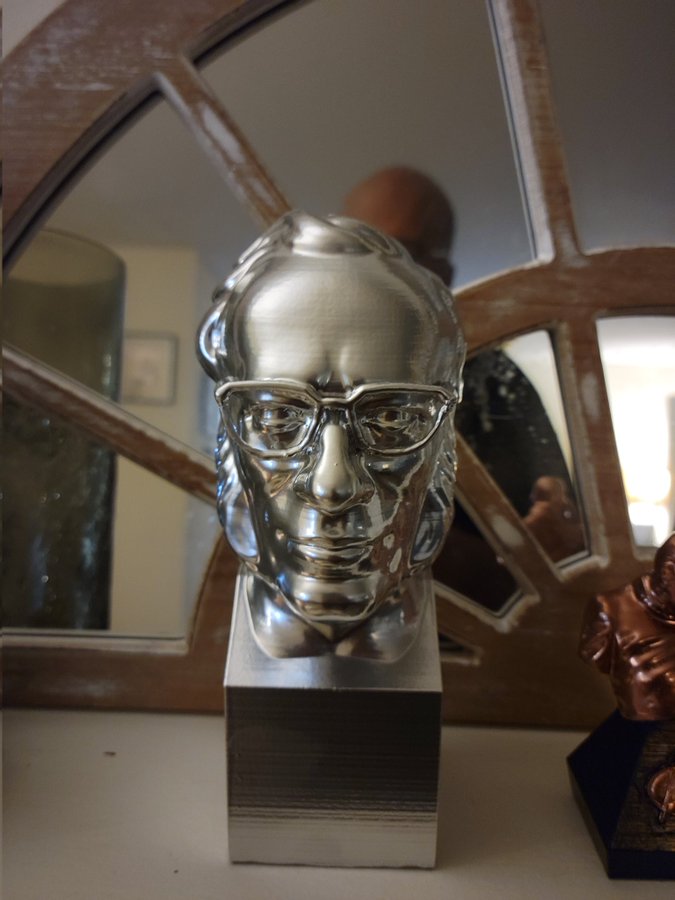
Update: sometimes I forget stuff, and I only remember when I listen to the episode after it’s published. This time it’s the Asimov bust that Travis told us he 3-D printed. It’s an impressive bit of work and here it is for your edification.

















 Stars End: A Foundation Podcast