Next Time on Stars End

Season 5 Episode 19 is on its way!

One of the fundamental properties of Horace Gold’s Galaxy Science Fiction, especially at the outset, was ambition. Gold was determined that Galaxy wouldn’t be just another SF magazine, but an excellent one. We’re only on Galaxy’s sixth issue as we reach the final installment of The Stars Like Dust ―, or Tyrann as it’s called in the magazine. Gold’s editorial for the issue concerns a readers’ poll about the magazine’s future and what will come as a result. The Five Star Shelf column will remain unchanged. An issue of self-contained stories will follow the conclusion of a serial. Stories with themes “too adult, too profound or revolutionary in concept” to be published elsewhere will continue. The editorial culminates with Gold’s plan for the magazine’s artwork which he describes thusly.

…we have been experimenting both in art and in technical processes, since we believe that a rebirth in science fiction should not be breeched by art of the forceps school. This month marks another experiment: halftone reproduction of photographs and wash drawings. This could not be done without trying out our technical processes. As we extend control, we will present other improvements that are now being worked on.

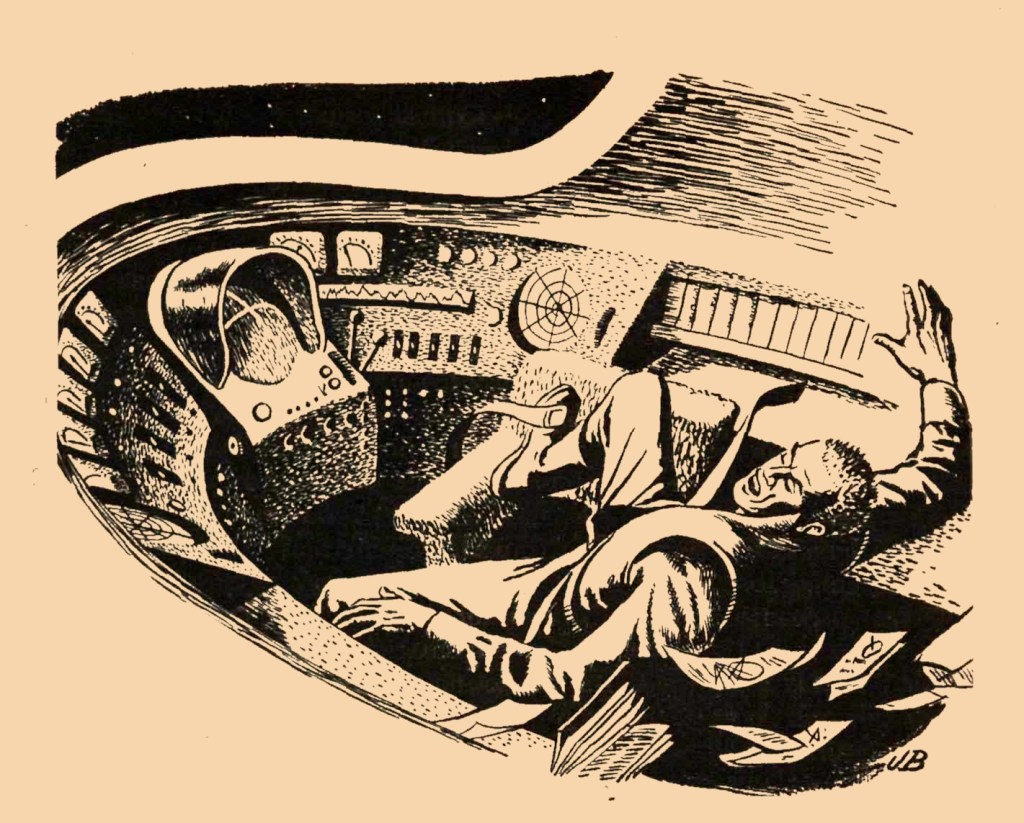
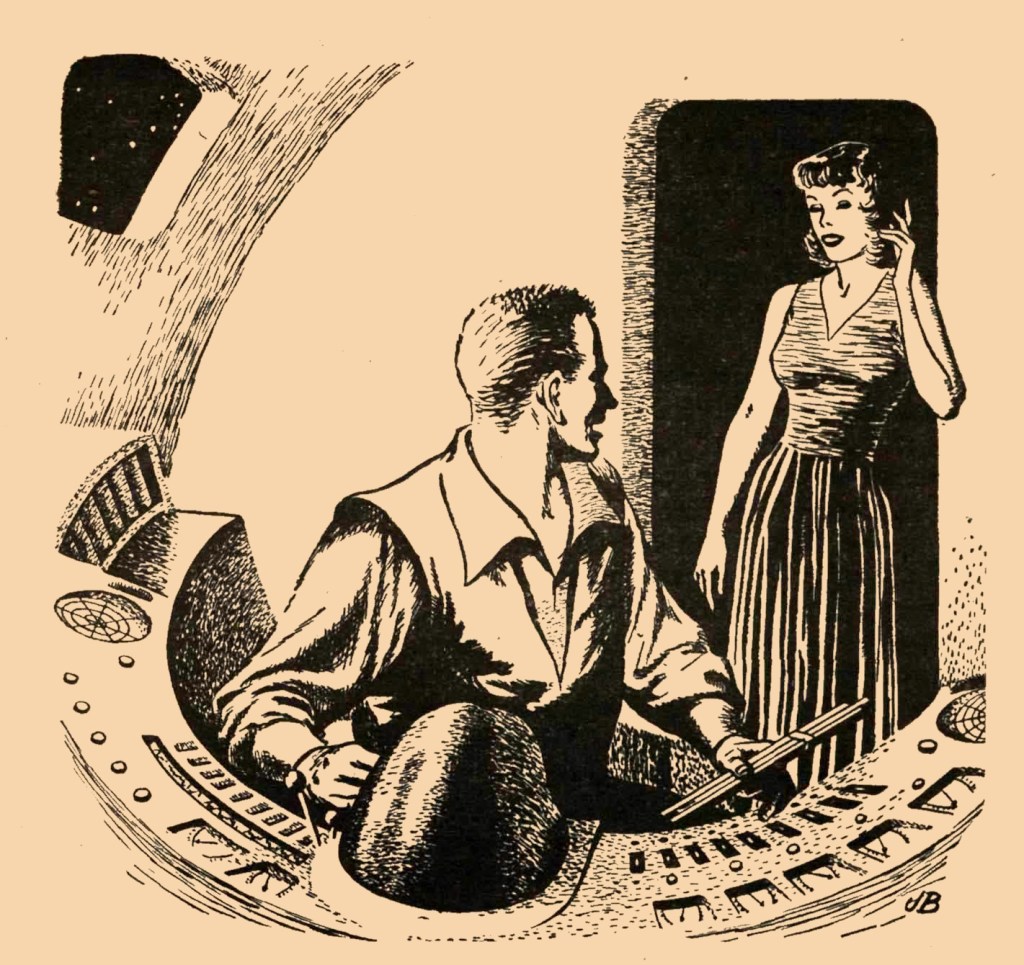
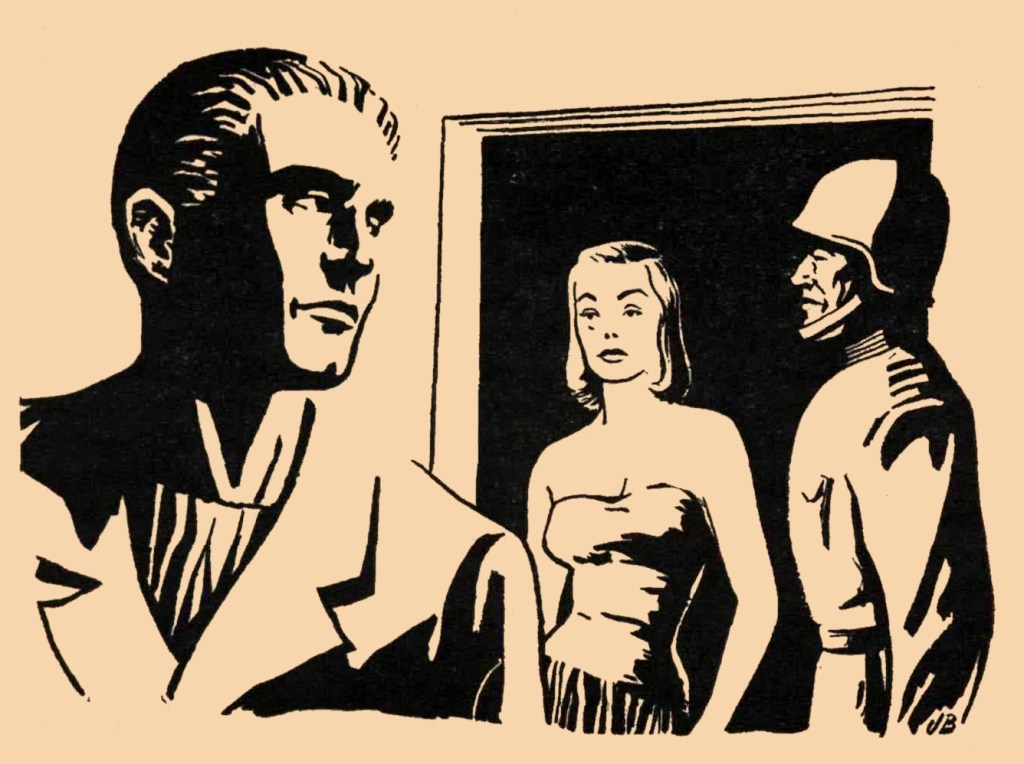
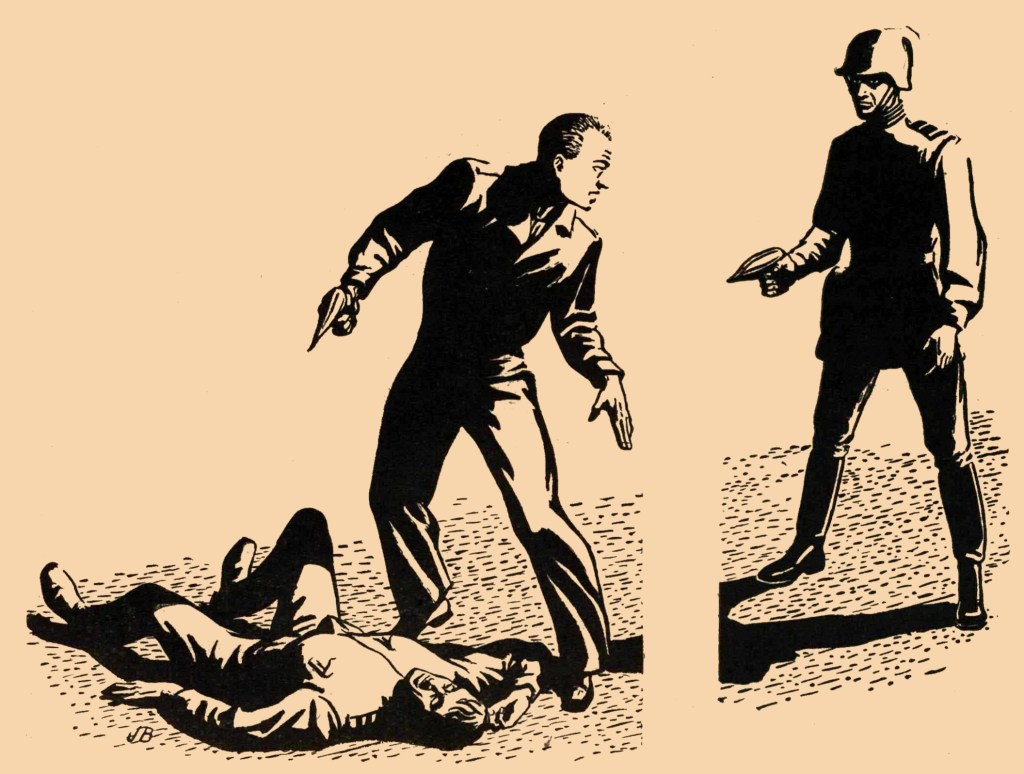
John Bunch once again illustrates the issue and it seems the decision to introduce wash drawings happened between his first and second illustration. These drawings give the artwork for this issue a distinctly different feel from the first two installments. Let’s take a look! Here’s the opening image.

The opening two-page spread from the third installment of "The Stars, Like Dust —" as published in Galaxy Science Fiction, March 1951,

And here are the wash drawings. All but one of these span two pages.

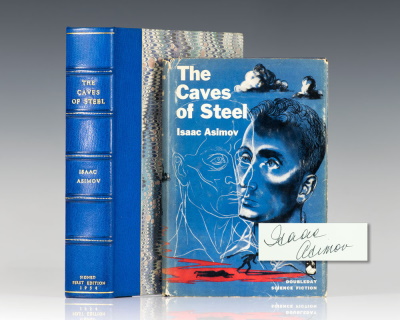
If you’re interested in how the artwork in Galaxy developed, take a look at our coverage of The Caves of Steel which appeared in Galaxy two and a half years later.

And when you’re done reading The Stars Like Dust ― join us as we wrap up our conversation about the novel in our next episode!

Resources

Next Time on Stars End

There’s probably an argument to be made that the “Big Three” of Golden Age Science Fiction, rather than Clarke, Asimov, and Heinlein, are Astounding, Galaxy, and The Magazine of Fantasy and Science Fiction. A quick Duck-Duck-Go search confirms this and reminds me that I should really read more A. E. van Vogt.

We’re not there yet, though; we’re at a place where Galaxy Science Fiction had blasted off a mere five months before. It was largely an auspicious beginning, with the inaugural issue containing Richard Matheson’s “Third from the Sun” which was adapted into an excellent episode of The Twilight Zone ten years later. That reminds me, I should really read more Richard Matheson. That first issue also included Asimov’s “The Darwinian Pool Room” which the Good Doctor said was “among the least satisfactory stories I have ever written” so maybe the lift-off wasn’t flawless.[1]

Our focus here though is the fifth issue cover dated February 1951. It contains the second installment of Isaac Asimov’s Tyrann, and that is the subject of our next episode. Galaxy’s editor, Horace Gold was notorious for retitling stories and we, of course, know Tyrann as The Stars Like Dust ―.

So, how is Isaac’s second novel progressing? Have we defeated “Second Novel Syndrome” yet? And are we observing the protoplasmic form of Asimov’s unlikeable protagonists like Golan Trevize? Plus, what’s up with that infamous subplot? All that and more is in the episode!

By the way, I was surprised to learn that this issue of Galaxy also contained “The Fireman” by Ray Bradbury. That novella eventually grew into Fahrenheit 451, undeniably one of the classics of Science Fiction. Even if the lift-off wasn’t flawless, the launch was impressive and accelerating.

While we wait for our next episode, hopefully coming on Sunday, let’s enjoy the illustrations from this installment once again featuring some interesting use of negative space by John Bunch.

You can find the complete Issue here: Galaxy Science Fiction, February 1951.


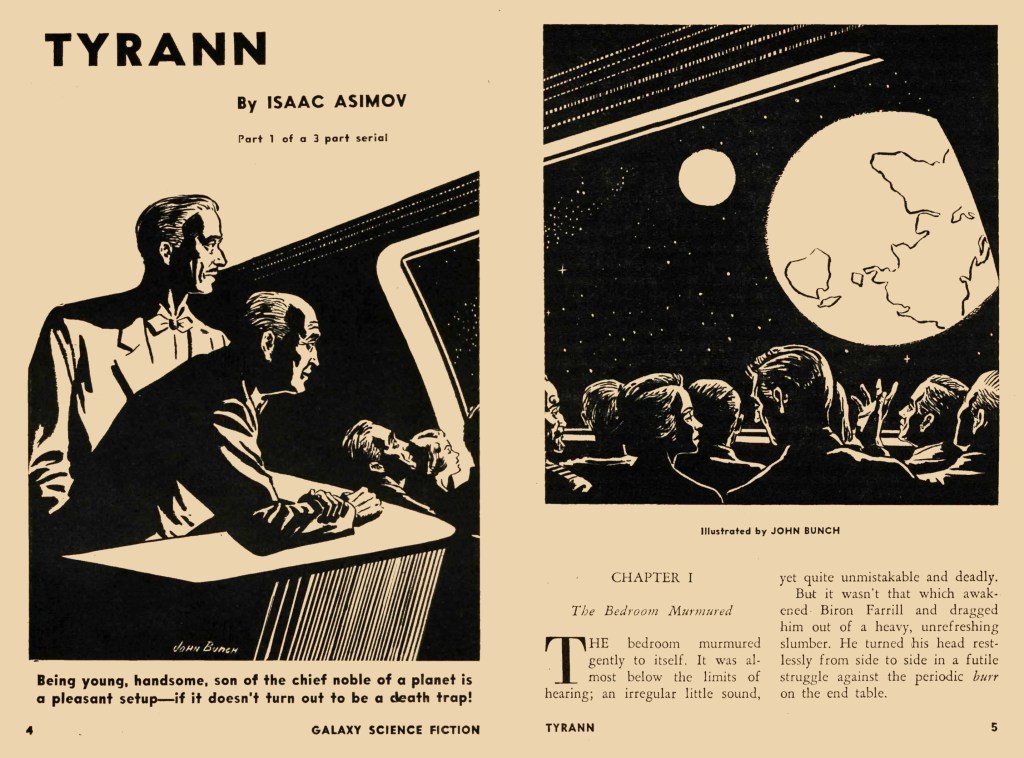
The opening Two-page spread of Tyrann.

Resources

Next Time on Stars End

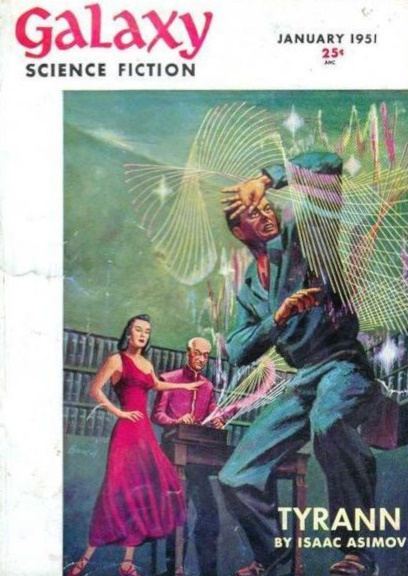
Galaxy SF, January 1951

Right now I’m listening to Magnets, the second album by the Vapors. Their initial outing, New Clear Days, most famous for the song “Turning Japanese,” remains one of my favorite albums. When I discovered New Clear Days, Magnets was already out of print. I literally spent years trying to track it down to no avail. Eventually, it reappeared with both albums packaged on one CD. At the time, it was a bit of a letdown. Today I’m finding it a much better listen than I remembered. The song “Linena” remains my favorite cut. Still, when I think about the “Second Album Curse,” I invariably think back to Magnets.

There’s a related notion in the publishing world, namely “Second Novel Syndrome.” The Stars, Like Dust — is the Good Doctor’s second novel. Did he escape the syndrome? Let’s save that for the podcast.

The Stars, Like Dust was written while Horace Gold was trying to get Galaxy Science Fiction off the ground and he was anxious to include something by an author as popular as Asimov. Dust was serialized in Galaxy under the title Tyrann, starting in January of 1951, with art by John Bunch. That’s only the fourth issue. Let’s take a look at the illustrations; which I’ve cleaned up a bit.

Four of the six images are spread across two pages including this title page. I’ve kept the text in place so you can see it in context.

Without the text, I’m able to better align the two pieces.

One of the things that stands out in these illustrations is the extensive and effective use of solid black. Notice that Biron is entirely inside the negative space here.

This is one of the stand-alone images.

I’ve left the text here to highlight that this is an excellent use of layout. Biron feels both constrained and isolated, things highlighted by depicting him inside a cramped image, boxed in by the text.

Another example of effective use of negative space; our attention, like Biron’s, is drawn to Artemisia.

We end with one more three-column, two-page image.

Look for Stars End, Season 5, Episode 17 this weekend! We’ll talk about chapters 1 through 8 of The Stars, Like Dust or, if you prefer, Part 1 of Tryann as published in the January 1951 issue of Galaxy Science Fiction.

Resources

Stars End S3E16

“Podcast and Sin No More”

It was right about this time last year; one of us got up in the middle of the night to share the latest Foundation trailer with you right here on this website.

This year there was a sneak peek of Foundation season 2 at San Diego Comic-Con.  It’s more than a week later and we haven’t seen it anywhere.  If that’s about generating interest, they’re missing the mark.

Luckily, we have our own news!

Available NOW! Our very own Jon Blumenfeld stars as Librarian Homir Munn in “Search by the Foundation, Part 1” on Joel McKinnon’s excellent Seldon Crisis Podcast!

Also, in S3E13, we talked about how Asimov said he made “extensive changes” to “Liar!” when he revised it for I, Robot.  Want to know why?  Want to know how extensive?  We plug our line-by-line comparison!

Also, also way back in S1E01, we talked about Joseph’s Grandfather’s artwork.  There’s now a website where you can see and enjoy that artwork!  Please visit JosephFranke.com and see why there’s such a fuss! 

All this plus: we wrap up our conversation about The Caves of Steel!  Jessie is revealed as a Medievalist!  Another murder rocks the NYPD… wait… is it murder? And in the final denouement, we discover who did it in this who done it!  You don’t want to miss all that!  Let’s go!

Next Time on Stars End

Episode 15 of Season 3 dropped this morning and episode 16 is already in post-production. in it, we’ll be finishing up The Caves of Steel, reading and discussing the third and final installment that ran in Galaxy Science Fiction in December 1953.

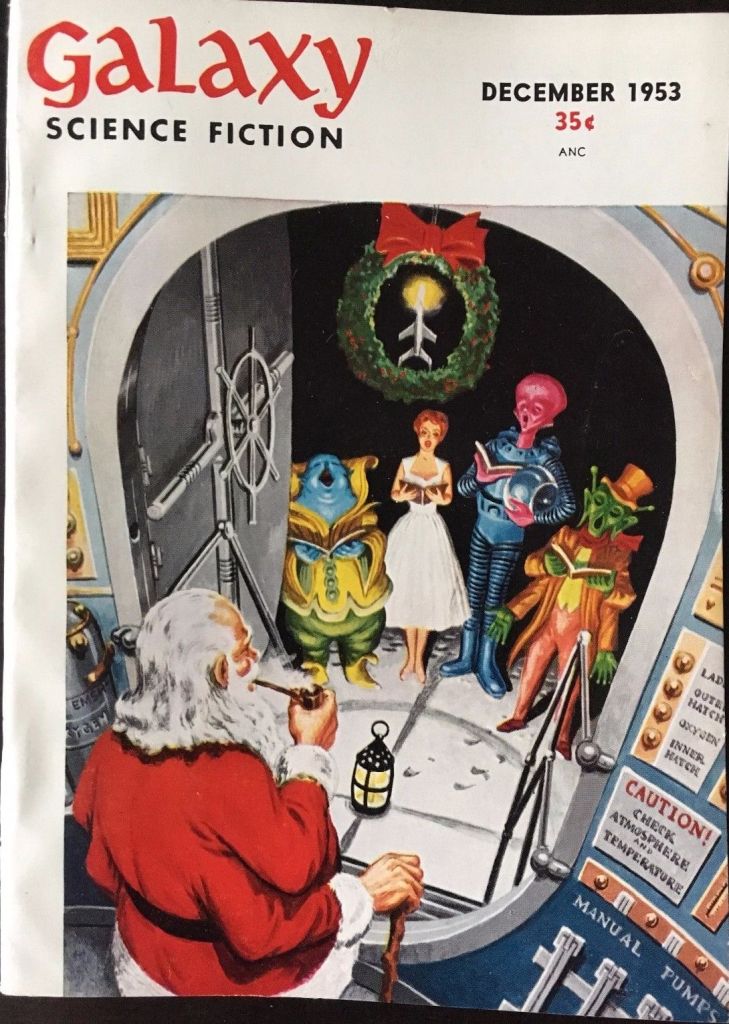
Our novel is not featured on the cover again, this time passed over for a nice holiday-themed illustration. Galaxy, evidently had a series of those.

In this concluding installment, Jessie confesses to conspiracy, Lije and Daneel play bad cop, uncomfortably robotic cop with a suspect and Baley cracks the case!

Here’s the promotion for this installment of The Caves of Steel from Galaxy’s November Issue.

Ed Emshwiller provides the artwork and we once again open with a two-page spread.

And here’s the rest of the synopsis if you want to refresh your memory about what’s already happened before you read the last installment or listen to our next episode.

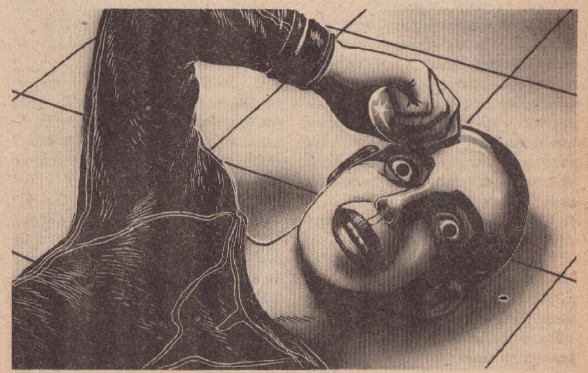
And here are the remaining illustrations from the story. Below we see Daneel closing on Clousarr during the interrogation (left), and R. Sammy as a murder vic… uh… property damage (right). We should keep our legal terms straight.

The final image shows Baley projecting the crime scene for Daneel and the commissioner.

Season 3, Episode 16 will be available soon!

Stars End S3E15

“I’m sure that if non-Asenion podcasts were ever designed or if the mathematical theory were worked out we’d hear of it.”

We’re not an etymology podcast even though we sometimes make up our own words.  Nevertheless, if you follow our blog you’ve recently read about the origins of the words “robot” and “robotics.”  Asimov has been known to make up his own words too.  In fact, he’s credited in the Oxford English Dictionary as the originator of the word “robotics.”  

In this episode, we learn the origin of the word “Asenion” through a miraculous combination of brilliance, scholarship, and real-time detective work which the uninitiated might dismiss as mere Google-fu.  Did the Great and Glorious Az invent the word “Asenion?”  You’ll have to listen to find out!

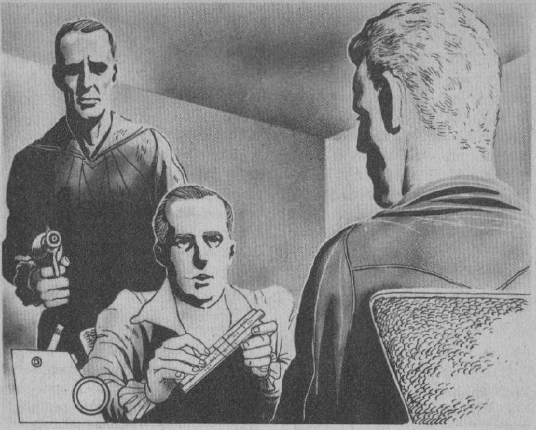
Meanwhile, we ruminate over the second section of the Caves of Steel in which Baley throws around some wild theories, learns the sinister,  not-so-sinister, or not-sinister-at-all designs of Spacetown, and sees an object eerily similar to a slide rule.  If you think that sounds like fun, you’re in for a wild ride!  Join us!

Next Time on Stars End

We’re not recording our next episode until Saturday, but if you’re reading ahead, we’ll be discussing chapters 8-13 of The Caves of Steel, corresponding to the second installment that was published in Galaxy Science Fiction in November 1953.

Galaxy SF, 11/1953

It’s an interesting issue. Asimov didn’t score the cover this time. The cover references the non-fiction piece about the famous experiment that saw complex amino acids generating spontaneously when the conditions on primordial Earth were recreated in a laboratory.

Also of interest is “Galaxy’s 5-Star Shelf.” which reviews a compilation of Olaf Stapledon’s work, the non-fiction Man in Space by Heinz Haber, Second Stage Lensman by E. E. (Doc) Smith, Against the Fall of Night by Arthur C. Clarke and Second Foundation. In that last review, Groff Conklin calls the now-completed Foundation Trilogy “Our first great sociological space opera.” He compares it favorably with Smith’s Lensman series saying, “…Asimov’s work, based as it is on fairly sound social principles and the activities of fairly normal human beings, has a pressing sense of reality that Smith’s fairy tales lack…” He concludes “it is a thoroughly satisfying and adult play of the scientific imagination.”

But back to The Caves of Steel. Here’s the promotion for this installment in Galaxy’s October Issue.

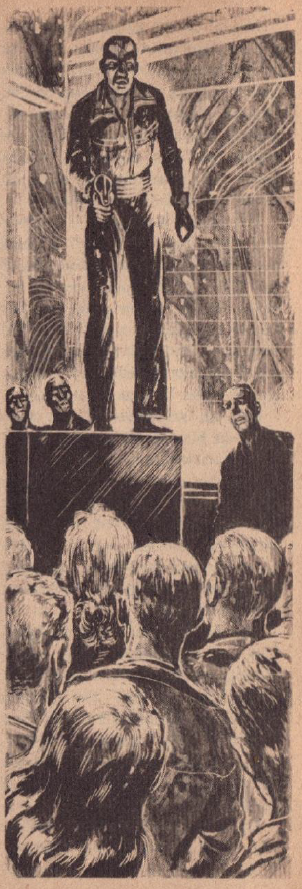
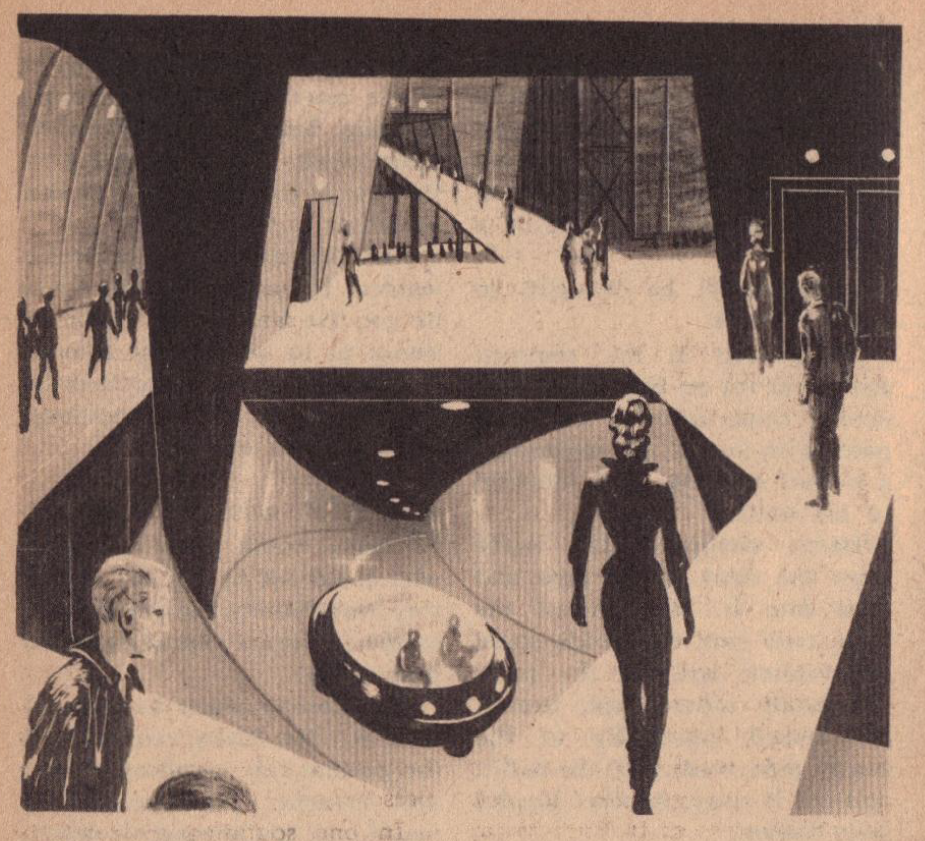
And here are some pages from the story.

i

I’m particularly liking the opening two-page spread, with artwork once again by Ed Emshwiller. It depicts the encounter in Chapter 8. The synopsis is nicely done as well and continues for the entire next page. Here’s the remainder in case you want to remind yourself of the last installment before continuing to read this one.

Finally, here are the rest of the illustrations from the story. We have Lije and Daneel leaving Space Town (top right), traveling through a power plant (left), and Daneel being examined by Dr. Gerrigel, a roboticist.

Season 3, Episode 15 will be available soon!

Simultaneously published at: Comics, The Universe, and Everything.

Stars End S3E14

“There are Rs that Can Do Your Podcast and Mine.”

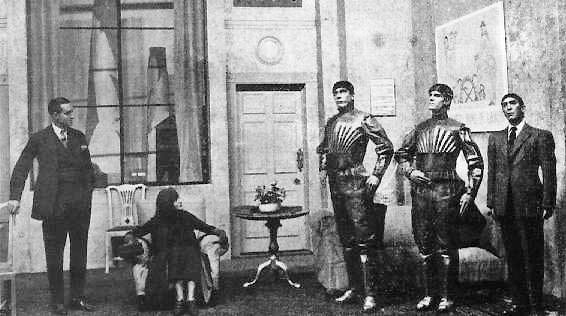
Just over a century ago, the word “robot,” derived from the Czech word “robota” which means “forced labor,” was introduced to the English language in the play R. U. R. by Karel Čapek. In it, a scientist has created artificial humans, called “roboti” or “robots.” Robots replace workers in factories, then become the basis of the economy. Eventually, the robots revolt, supplant humanity and ultimately cause humankind’s extinction.

In an interesting coincidence, R. U. R. debuted on 2 January 1921, The Great and Glorious Az’s first birthday! Who would have suspected that Ol’ Isaac and the word “robot” would be astrologically equivalent?

In this episode, we start discussing Asimov’s The Caves of Steel where the theme of robots replacing humans looms large. There’s already a palpable sense of economic anxiety within the New York Police Department as lower-level employees have already been replaced. Now Detective Elijah Baley is assigned a robot partner named R. Daneel Olivaw who is all but indistinguishable from a human being. It’s essential that Baley not only solve a murder but solve it in a way that doesn’t lead to many more humans being supplanted by robots.

If you’re reading along, we talk about Chapters 1 through 7 which coincide with the first installment of the novel as it was published in Galaxy Science Fiction.

This is Asimov at the height of his abilities and it’s going to be a blast! Let’s go!

Next Time on Stars End

Galaxy SF, 10/1953

We just recorded our latest episode last night and we’re back to reading the works of the Great and Glorious Az.

We’re thrilled to announce that, by popular demand, we’ll be reading the Robot Novels beginning at the beginning with The Caves of Steel. That’s my go-to novel if I want to introduce someone to Asimov’s work.

This novel was written at a time when Asimov was trying to get away from being a “one-editor-writer” and so he was working with, among others, Horace Gold of Galaxy Science Fiction. Gold had serialized The Stars, Like Dust in Galaxy under the title Tyrann and he was anxious to serialize another. He suggested a novel about robots, but Asimov declined. Robots, thought Asimov, were for short stories; the ideas wouldn’t carry an entire novel.

So Gold suggested that Asimov write a detective story where the detective had a robot partner and Elijah Baley and R. Daneel Olivaw were born. John W. Campbell had always claimed that a science fiction mystery story was a contradiction-in-terms and Asimov wanted to prove him wrong. The Caves of Steel became Asimov’s most successful book up to that point.

But first, it was serialized in Galaxy Science Fiction in October, November, and December of 1953. For this episode, we’re reading the first installment which corresponds to chapters 1-7 in the book. If you’re interested in reading The Caves of Steel as it first appeared, you can find that issue of Galaxy here courtesy of Archive.org but either way, you can enjoy the original artwork by Ed Emshwiller right here. Our episode will be out in a few days!