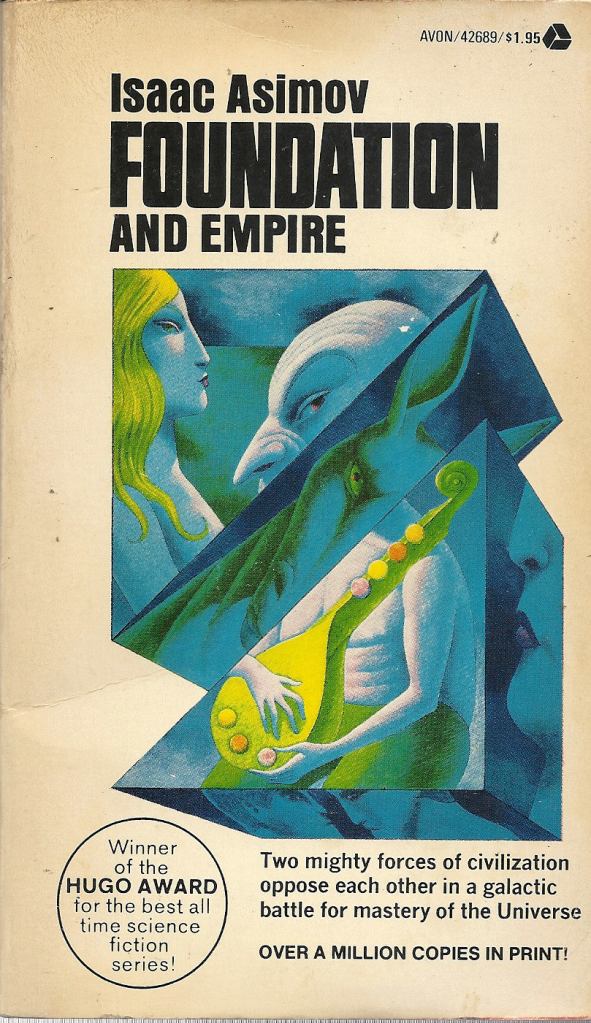
If you’re following our podcast Episode 6 dropped on Wednesday and in it, we discuss “The General” from Foundation and Empire. If you’re reading along I’m sure that Apple and/or the publishing company have made sure that it’s available in all sorts of places and there is of course your public library or Archive.org.
The Empire was the theoretical obstacle to the growth of the Foundation in the first book. In “The General” we meet Bel Riose a general loyal to the Empire who will be the first to oppose the Foundation directly. What will this mean for Seldon’s Plan? You’ll have to read it and then listen to our podcast to find out.
And if you’re looking for a more nostalgic or, dare we say interestingly atavistic (to borrow Emperor Cleon’s description of Bel Riose) way to read “The General” we can again turn to Archive.org.
This story appeared for the first time under the title “Dead Hand” in the April 1945 issue of John W. Campbell’s Astounding Science Fiction. The cover proclaims “A Foundation Story by Isaac Asimov!” Evidently, the series has developed a following as well as the Author.
The story as it appears it’s very similar to the book’s version. Mostly the text is word-for-word the same, but there are some differences. The Encyclopedia Galactica entry, seemingly obligatory in the books is absent. In its place, we get this preview.
The Foundation had always been weak — but heretofore the sharp wits of it’s leaders had protected it. But this time — Foundation’s leaders were stupid men , and a clever general, under a strong Emperor was attacking.
As well as this abbreviated prologue.
Four centuries of internal wrenchings subsided into another faint interval of quiet and order, that was half-exhausting, and for twenty-five years under Cleon II the Galactic Empire experienced the milky feeble gleam of a last Indian Summer.
The other big difference is the internal artwork, four nice images by Paul Orban who seems to be settling in as the Foundation series illustrator.
The presentations of the image have evolved here. The opening drawing depicts the most exciting moment in the story rather than something that happens toward the beginning. In previous installments, the illustrations are square or nearly so. Here the second and third images are “L” shaped; strategically placing some white space allows for larger images without sacrificing space for the story. The final image is tall and narrow, taking up an entire column on one page. It seems that Campbell is allowing Orban more freedom to change up his layouts to good effect.
The internet has since its inception been a remarkable tool for gathering and sharing information. Lately, it’s been both better and worse than it used to be and one of the reasons that it’s both is Archive.org.
It’s a literal treasure trove of information. Think of it as an internet library. If you’re looking for something, especially something out of print, there’s a good chance that it’s there, scanned and ready to be checked out. Archive.org was especially gracious during the lockdown. In May 2020, when I taught Science Fiction, all the novels we covered as well as most of the short stories were available there for my students to use free of charge. It was a huge help.
So, why better and worse? Well, having access to “a literal treasure trove of information” has a bit of a downside. When I’m researching something like, for example, Asimov Trivia there are things to find that I’ve never even heard of and didn’t know I needed. Sometimes this is helpful, like when I discovered Isaac Asimov Presents: SuperQuiz (See Episode 5). Other times it’s not; I take a long and winding road that doesn’t lead anywhere. Next thing I know I’m 6 books over and barely even aware of where I started or what I was doing. That’s fun, but it’s not productive unless serendipity lends a hand. No kidding. Paragraph two got put on hold while I looked up something random.
Suffice it to say that Archive.org is, well, astounding. But “What does this have to do with Foundation?” you might be wondering. If you’re following Stars End: A Foundation Podcast or even if you’re merely looking forward to the forthcoming Apple TV+ series you might be wanting to reread the books. They’re all there for sure.
But what I’m really excited about is that Archive.org has many issues of John W. Campbell’s Astounding Science Fiction. That’s the seminal SF pulp that defined the genre. There we find the original Foundation stories 8 years before they were collected into book form. This is the DNA of the Foundation series. As the story was developing, while Asimov was figuring out how psychohistory works, we can see this universe evolve in Astounding. And as an added bonus, we can read the stories with their original artwork, enjoying them as few have been able for almost eight decades. So here are the pieces of Foundation as they appeared in Astounding Science Fiction. Not too different. With his prodigious output, Asimov was known for writing rather than rewriting but I’ll note the changes that I noticed.
Foundation isn’t actually a novel, it’s what is known as a “fix-up,” a collection of short stories linked together with a framing sequence. “The Psychohistorians” is that framing sequence and is the only part of Foundation that was original to the book. It introduces Hari Seldon and sets up the universe replacing a much shorter introduction that ran as part of the next story.
“The Encyclopedists” originally ran in the May 1942 issue of Astounding under the title “Foundation.” Other than the short introduction that was supplanted by “The Psychohistorians” it’s largely the same as the version from the book.
There are two lovely illustrations by Manuel Islp and the issue also features “Asylum” by A. E. Van Vogt and “Beyond this Horizon” by Robert Heinlein writing as Anson MacDonald.
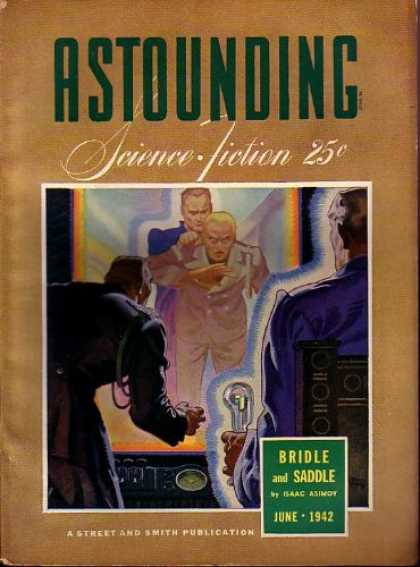
The story continues just a month later as “The Mayors” was published under the title “Bridle and Saddle.”
John W. Campbell showed a lot of enthusiasm for this story. Taking up half of the previous issue’s coming attractions, it was the lead story for the month, it was featured on the cover and was graced with 4 (Count ’em! 4!) lovely illustrations by Charles Schneeman. You can click on any image in the gallery for a better look.
For a science fiction adventure story the art work sure shows a lot of people sitting in chairs.
The issue also includes “My Name is Legion” by Lester Del Rey, “Proof” by Hal Clement and “The Slaver” by L. Ron Hubbard who actually wrote some Science Fiction before branching out into… let’s call it other areas.
“The Traders,” the shortest section of Foundation was published as “The Wedge” in Astounding’s October 1944 issue with little or no fanfare. This story has the most significant difference between the magazine and book versions. Here the main character is named Lathan Devers rather than Limmar Ponyets as it is in Foundation. The story has three illustrations by Frank Kramer.
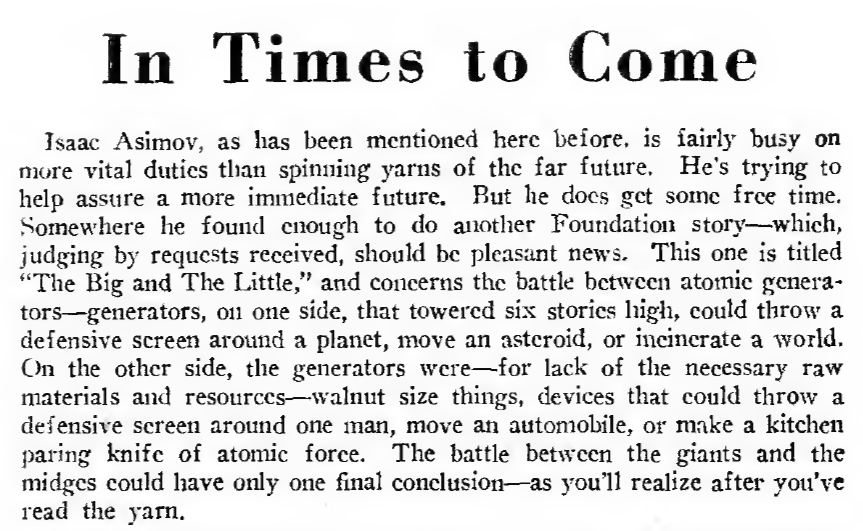
“The Big and the Little” appeared in the August 1944 Issue of Astounding and once again it’s very similar to “The Merchant Princes.” There’s a difference that’s noticeable immediately though, rather than opening with a quote from the Encyclopedia Galactica, it begins with a different quote that prefigures the names of the sections of Foundation.
“Three Dynasties molded the Beginning: the Encyclopedists, the Mayors, and the Traders…”
Ligurn Vier, ‘Essays on History’
We never really see the traders as a formal dynasty leading the Foundation but perhaps we can infer one; in this story, we meet the third major figure in Foundation History after Hari Seldon and Salvor Hardin the first of the Merchant Princes, Hober Mallow.
Like “Bridal and Saddle,” “The Big and the Little” is both the lead and cover story for this issue. It is illustrated with six pictures rendered by Paul Orban.
We just recorded our fifth episode last night. Five isn’t a big, round number, it isn’t even a round number. But it is half of a round number. Also it is prime. Prime numbers are cool. Let’s call it a minor milestone.
Five episodes is almost as many as Manimal, which was quality programming. It was a philosophical examination of the human state and its relationship to the environment in the postindustrial age. Probably. I never watched it but I’m sure that’s what it was about. That or a werewolf detective or something but probably the first thing. Anyway, almost as many as Manimal and we did it without being notoriously terrible or infamously offensive! Mostly.
Unlike “the Wedge” (aka The Traders), which was published with little to no fanfare, John W. Campbell was a lot more enthusiastic about “The Big and the Little” (aka The Merchant Princes). It takes up the lion’s share of July’s coming attractions (above) and, like “Bridle and Saddle” it was Astounding’s cover when it ran in August of 1944.
So, next time we discuss “The Merchant Princes” and foreshadow a bit of Foundation and Empire. We’ll also have another Apple TV+ minute for you, which will inspire a tangent into the DC Comics Extended Universe of all things.
A quick bit of Trivia: I just learned that “The Traders” and “The Merchant Princes” were both nominated for Retro Hugo’s in 2020, 75 years after they first would have been eligible had there been a World Science Fiction Convention in 1945. Neither won its category.
And speaking of trivia we’ll also have another installment of Asimov Trivia for you! Is there drama in the game this time? You’ll have to listen to see!
We hope you’re enjoying our podcast so far and if you are, you’re probably as anxious to see the resolution of the cliffhanger that ended our second episode as we are! Do you think what has to be done to keep Terminus safe from Anachreon was obvious? We didn’t particularly think so despite 20-year-old Isaac’s assurances to the contrary. “The Enyclopedeaists” appeared as “Foundation” in Astounding Science Fiction for May, 1942. Here are the coming attractions from that issue.
It’s clear that John W. Campbell expected that riddle to bring people back to Astounding for the June issue. He didn’t stop there though, “Bridle and Saddle” was featured on the cover as well.
Of course, we now know “Bridle and Saddle” as “The Mayors,” the title it was given in Foundation.
We’ll also bring you up to date on what we know about the show so far and we’ll treat you to another edition of Asimov Trivia.
In future episodes, we’ll continue to work our way through the books, have show news as it become available and more!






 Stars End: A Foundation Podcast