It was right about this time last year; one of us got up in the middle of the night to share the latest Foundation trailer with you right here on this website.
This year there was a sneak peek of Foundation season 2 at San Diego Comic-Con. It’s more than a week later and we haven’t seen it anywhere. If that’s about generating interest, they’re missing the mark.
Also, in S3E13, we talked about how Asimov said he made “extensive changes” to “Liar!” when he revised it for I, Robot. Want to know why? Want to know how extensive? We plug our line-by-line comparison!
Also, also way back in S1E01, we talked about Joseph’s Grandfather’s artwork. There’s now a website where you can see and enjoy that artwork! Please visit JosephFranke.com and see why there’s such a fuss!
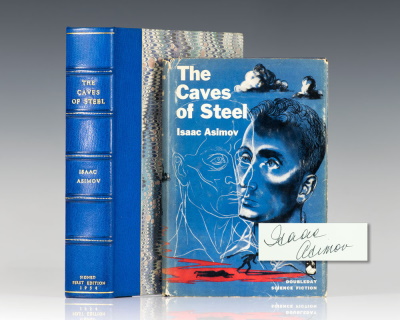
All this plus: we wrap up our conversation about The Caves of Steel! Jessie is revealed as a Medievalist! Another murder rocks the NYPD… wait… is it murder? And in the final denouement, we discover who did it in this who done it! You don’t want to miss all that! Let’s go!
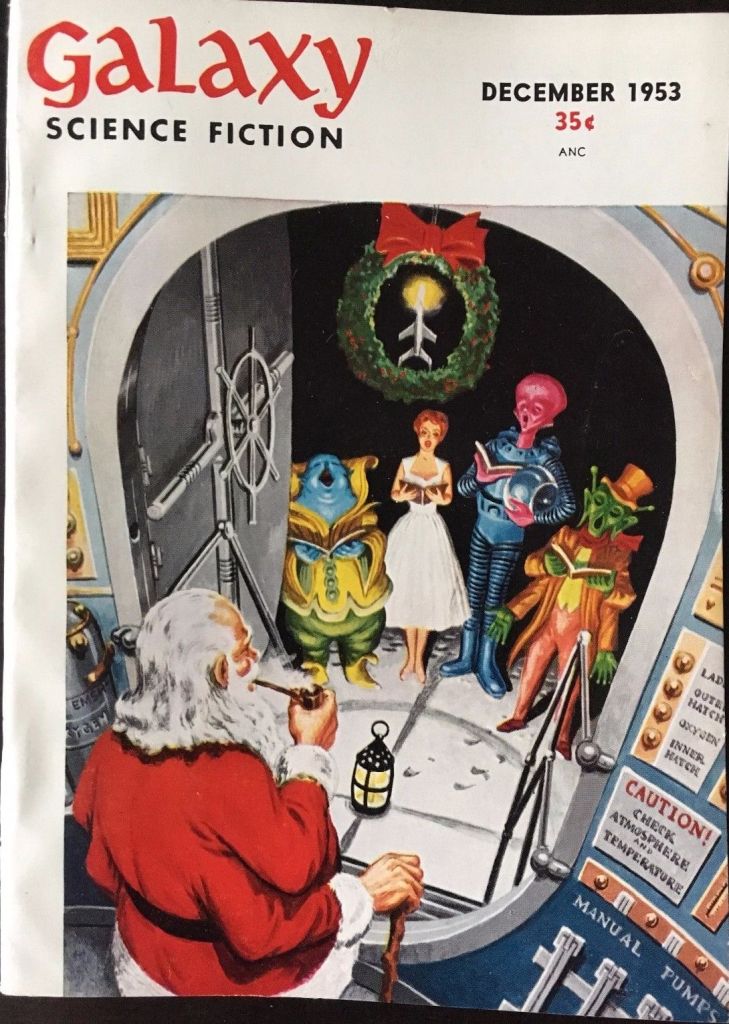
Episode 15 of Season 3 dropped this morning and episode 16 is already in post-production. in it, we’ll be finishing up The Caves of Steel, reading and discussing the third and final installment that ran in Galaxy Science Fiction in December 1953.
Our novel is not featured on the cover again, this time passed over for a nice holiday-themed illustration. Galaxy, evidently had a series of those.
In this concluding installment, Jessie confesses to conspiracy, Lije and Daneel play bad cop, uncomfortably robotic cop with a suspect and Baley cracks the case!
Here’s the promotion for this installment of The Caves of Steel from Galaxy’s November Issue.
Ed Emshwiller provides the artwork and we once again open with a two-page spread.
And here’s the rest of the synopsis if you want to refresh your memory about what’s already happened before you read the last installment or listen to our next episode.
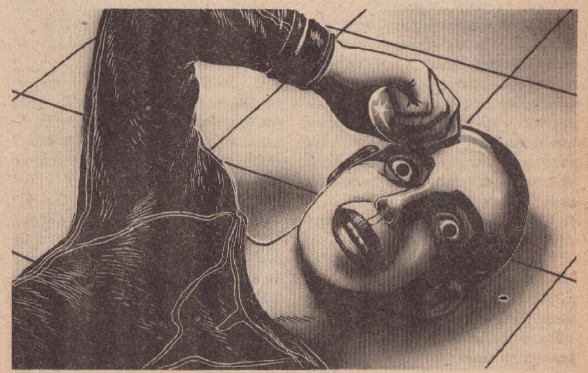
And here are the remaining illustrations from the story. Below we see Daneel closing on Clousarr during the interrogation (left), and R. Sammy as a murder vic… uh… property damage (right). We should keep our legal terms straight.
The final image shows Baley projecting the crime scene for Daneel and the commissioner.
“I’m sure that if non-Asenion podcasts were ever designed or if the mathematical theory were worked out we’d hear of it.”
We’re not an etymology podcast even though we sometimes make up our own words. Nevertheless, if you follow our blog you’ve recently read about the origins of the words “robot” and “robotics.” Asimov has been known to make up his own words too. In fact, he’s credited in the Oxford English Dictionary as the originator of the word “robotics.”
In this episode, we learn the origin of the word “Asenion” through a miraculous combination of brilliance, scholarship, and real-time detective work which the uninitiated might dismiss as mere Google-fu. Did the Great and Glorious Az invent the word “Asenion?” You’ll have to listen to find out!
Meanwhile, we ruminate over the second section of the Caves of Steel in which Baley throws around some wild theories, learns the sinister, not-so-sinister, or not-sinister-at-all designs of Spacetown, and sees an object eerily similar to a slide rule. If you think that sounds like fun, you’re in for a wild ride! Join us!
If you follow our podcast you know that we’ve discussed Asimov’s reluctance to rewrite stuff many times. Even more frequently we’ve discussed… let’s call it the Great and Glorious Az’s ability to write female characters. We’ve speculated that, after attending Boys High School in Brooklyn, Seth Low Junior College, and Columbia University, neither of which were co-educational, it’s possible that Asimov simply hadn’t spent time with many women. Aside, of course, from his mother and sister.
The Robot Chronicles
We were therefore intrigued by the following quote from “The Robot Chronicles” as published in Asimov’s Gold: the Final Science Fiction Collection. At this point in the essay, Asimov writes about his individual Robot stories and what made them significant. Here’s what he had to say about “Liar!”
In the very next issue of Astounding, that of May 1941, my third robot story, “Liar!” appeared. The importance of this story was that it introduced Susan Calvin, who became the central character in my early robot stories. This story was originally rather clumsily done, largely because it dealt with the relationship between the sexes at a time when I had not yet had my first date with a young lady. Fortunately, I’m a quick learner, and it is one story in which I made significant changes before allowing it to appear in I, Robot.
You can find the story in any edition of I, Robot or The Complete Robot and you can see the original version in the May 1941 edition of Astoundinghere.
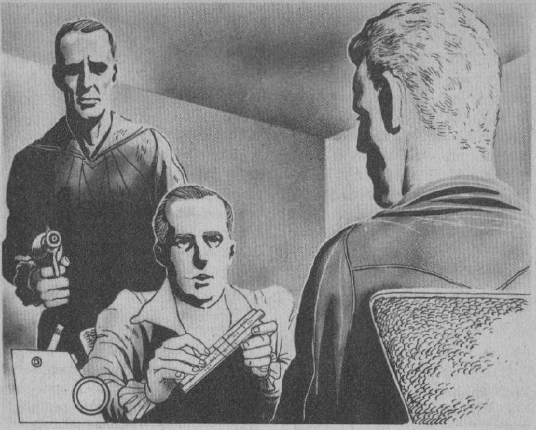
The original artwork for “Liar!” by Charles Schneeman
If you haven’t read it, “Liar!” tells the story of Herbie, a robot accidentally created with the ability to read minds. As the roboticists at U. S. Robots and Mechanical Men work to find out what caused this ability we get a first-hand look at how Herbie’s ability to read minds interacts with the three laws. We also get to see how Herbie’s subsequent behaviors affect the humans around him.
For those of us on the podcast, it was nice to get some confirmation for the theory we’d proposed on the show. For anyone who considers themself an Asimovologist, the changes to “Liar!” are intriguing for two reasons. The first is to see how Asimov’s treatment of women progressed to address the clumsiness that he perceived. The second asks how much of a rewrite he considers “significant.”
The Individual Edits
So let’s take a look at the changes. The first occurs in the fifteenth paragraph. Here’s the text from Astounding.
“Bogert is right,” said Dr. Calvin. “Ever since the Interplanetary Code was modified to allow robot models to be tested in the plants before being shipped out to space, antirobot propaganda has increased. If any word leaks out about a robot being able to read minds before we can announce complete control of the phenomenon, Tyrone and his demagogs (sic) could make pretty effective capital out of it.”
In the I, Robot version, the underlined part has been changed to, “pretty effective capital could be made out of it.” This change does not seem substantive. The mention of Tyrone was likely Asimov teasing a story that was ultimately never written. We would need evidence before we could say that for sure.
The next change occurs shortly after the first section break. Again and going forward, we start with the Astounding version.
“She paused to readjust the huge ‘No Entrance’ sign upon the door and then approached the robot with a friendly smile.”
Here, Susan Calvin is entering a room to bring books to Herbie. In the revised version the underlined text is omitted, which makes sense. Between this version and the publication of I, Robot, the character of Susan Calvin evolved into a no-nonsense professional thus the friendly smile seems to be a bit out of character. In a larger sense though, a disarming smile might ease interaction with another human but there is no reason to try that with a robot, much less a mind-reading one. The brilliant robopsychologist would have known this so the original neither fits the character nor the story.
Dr. Calvin and Herbie have a conversation about Milton Ashe. Eventually, we get this.
“The psychologist paused in thought and then looked up suddenly. ‘A girl visited him here at the plant half a year ago. She was pretty, I suppose—blond and slinky. And, of course, could scarcely add two and two.’”
In the book, “slinky” becomes “slim,” a more conservative and genteel description that seems more in keeping with Calvin’s personality. “Slinky” implies things about the way the woman holds herself and how she dresses. The combination of “slinky” with the remark about the young lady’s intelligence creates a different and less complimentary image of the character.
A bit later, we see this bit of conversation about Susan Calvin.
“He opened his eyes wide and frowned, “Say, Bogie, have you been noticing anything queer about the dame lately?”
The revised version replaces “dame” with “lady.” Another move toward more respectful language.
Next, we encounter one of the less substantive changes.
“Are you crazy? If you’ll reread Mitchell’s original paper in the Mathematical Journal—”
“Mathematical Journal—” becomes “Transactions of the Far—.” The latter sounds more like an actual journal, but it loses the emphasis that the paper appeared in a mathematics publication. That should have been clear from the context, however.
The most substantive change comes when Milton Ashe shows Calvin a sketch of a house he’s planning to buy. All of the underlined text is removed from the later version.
“Susan Calvin gazed across at him with melting eyes. There had been a preliminary self-consciousness when she had first forced her hair into curls and lacquered her fingernails a bright red — a silly everyone-is-snickering-at-me feeling — but it always vanished when she was with him. There was nothing then but the hard metallic voice of Herbie whispering in her ear —. ‘It’s really beautiful,’ she sighed…”
It’s an edit that improves the story. This sentence seems more suited to a cheesy romance comic or a movie like Beach Blanket Bingo than it does to an Asimovian robot story. This sentence seems especially out of character for Susan Calvin as the character had developed over many stories and many years.
Most of the remaining edits were made because the “Three Laws of Robotics” weren’t carefully codified until published in “Runaround,” which appeared ten months after “Liar!” It makes sense for the collection to use the language to which the readers had become accustomed. Thus, instead of this,
She faced them and spoke wearily. “You know the fundamental law impressed upon the positronic brain of all robots, of course.”
we get this.
“She faced them and spoke sarcastically, “Surely you know the fundamental First Law of Robotics.”
There’s the additional change from “wearily” to “sarcastically.” That’s more in keeping with Calvin’s character and because the two men she was talking to would unquestionably know the three laws; this isn’t a case of having to remind someone of the three laws; Calvin is making a rhetorical point.
But it’s also an opportunity to remind the reader of what the first law says, so while we initially got this,
“Certainly,” said Bogert. “On no conditions is a human being to be injured in any way, even when such injury is directly ordered by another human.”
After “Runaround,” we get the now-familiar wording.
“The other two nodded together. “Certainly,” said Bogert, irritably, “a robot may not injure a human being or, through inaction, allow him to come to harm.”
The insertion of “irritably” follows nicely from the inclusion of “sarcastically.” We get one more edit concerning the three laws. In Astounding, the exchange above is followed by this.
“How nicely put,” sneered Calvin. “But what kind of injury?”
And in I, Robot, “injury” becomes “harm,” which seems to fit better with the revised version of the First Law.
The first use of “robotics” in “Liar!”
An interesting aside: In “The Robot Chronicles” Asimov claims that the term “robotics” first appeared in print in the initial printing of “Runaround.” The Oxford English Dictionary, notes this and gives Asimov credit for inventing the word. The use of “robotics” predates that, however, as it’s used twice in “Liar!” in addition to the time noted above, which exists only in the revised version.
The final edit in “Liar!” aside from one that appears to fix a typo, comes in the following passage at the very end of the story.
“It was minutes after the two scientists left that Dr. Susan Calvin regained part of her mental equilibrium. Slowly, her eyes turned to the living-dead Herbie and the tight smile returned to her face.”
“Tight smile” is aptly changed to “tightness,” as the operant emotion at this point is anger. This again seems to fit Susan Calvin’s character better than the original.
A Holistic Look
It’s more apparent in retrospect than it would have been in 1950 when I, Robot was compiled but “Liar!” is an important story in the Asimov canon. It’s the first time the idea of a robot with mental powers is discussed, an idea that becomes a pillar of Asimov’s later work, and the Oxford English Dictionary recognizes it as the earliest known use of the word “robotics.” more importantly though, “Liar!” is the first appearance of Susan Calvin, one of Asimov’s most consequential and well-known characters. She’s so central to the early robot stories that the framing sequence of I, Robot is written as a conversation between Calvin and a biographer. Through this conversation, she introduces each chapter. I, Robot is Susan Calvin’s story and the introduction tells us that “In 2008, she obtained her Ph.D. and joined United States Robots as a ‘robopsychologist’ becoming the first great practitioner of a new science.”
So, let’s look at the changes holistically. There appear to be three categories.
There seems to be one change to smooth out the prose, where “Mathematical Journal—” becomes “Transactions of the Far—.” This reads better because the partial title seems more believable for an academic journal.
There are several bookkeeping changes, namely the one removing “Tyrone and his demagogues” and all those updating the Three Laws of Robotics. These are exactly the kinds of edits one should expect in a fix-up like I, Robot. In any series of stories, details will never be completely determined initially. The book will feel more cohesive if small changes are made for the sake of consistency.
The changes that remain must be what Asimov was referring to when he wrote, “This story was originally rather clumsily done, largely because it dealt with the relationship between the sexes at a time when I had not yet had my first date with a young lady.”
I’m not sure that these edits hit that mark and I’m certain that they fall short of being significant.
Let’s recap these changes. We have:
Calvin doesn’t approach Herbie “with a friendly smile.”
Calvin describes Ashe’s girlfriend as “slim” rather than “slinky.”
Ashe refers to Calvin as a “lady” rather than a “dame.”
The removal of the sentence where Calvin feels self-conscious about changing her hair and wearing make-up, but that feeling disappears when she’s with him.
So, are women written better as a result of these edits? When Asimov wrote about “significant” changes, it is reasonable to expect something like a fundamentally different subplot for Susan Calvin. Her subplot still resolves around a cringeworthy mistaken impression. It depends on some unfortunate tropes, like Calvin changing her hair and makeup to attract Ashe and destroying Herbie in a fit of pique. That subplot remains “clumsy,” and Asimov’s treatment of female characters isn’t significantly better. For example, although Ashe’s unnamed girlfriend is no longer “slinky,” she remains unable to add two to two.
But the changes are likely more about Susan Calvin than writing women in general or making the story less clumsy. It’s disappointing to ponder “Liar!” as Calvin’s initial appearance because it means that Asimov had the silly unrequited love subplot in mind and Calvin was created because the subplot required a female character. But over the following nine years Calvin and the characters surrounding her became the centerpiece of Asimov’s robot stories; they turned into the brilliant, serious professionals who drove the plots and resolved the problems. These edits are just enough to make this story fit with the rest of the book but is it a consistent portrayal? Let’s look at the framing sequence. In the run-up to “Liar!” Calvin tells the biographer “I was foolish once, young man. Would you believe that?” “No,” he replied.
Resources
Asimov, Isaac. “Liar!” Astounding Science Fiction, May 1941, pp. 43-55.
We’re not recording our next episode until Saturday, but if you’re reading ahead, we’ll be discussing chapters 8-13 of The Caves of Steel, corresponding to the second installment that was published in Galaxy Science Fiction in November 1953.
Galaxy SF, 11/1953
It’s an interesting issue. Asimov didn’t score the cover this time. The cover references the non-fiction piece about the famous experiment that saw complex amino acids generating spontaneously when the conditions on primordial Earth were recreated in a laboratory.
Also of interest is “Galaxy’s 5-Star Shelf.” which reviews a compilation of Olaf Stapledon’s work, the non-fiction Man in Space by Heinz Haber, Second Stage Lensman by E. E. (Doc) Smith, Against the Fall of Night by Arthur C. Clarke and Second Foundation. In that last review, Groff Conklin calls the now-completed Foundation Trilogy “Our first great sociological space opera.” He compares it favorably with Smith’s Lensman series saying, “…Asimov’s work, based as it is on fairly sound social principles and the activities of fairly normal human beings, has a pressing sense of reality that Smith’s fairy tales lack…” He concludes “it is a thoroughly satisfying and adult play of the scientific imagination.”
But back to The Caves of Steel. Here’s the promotion for this installment in Galaxy’s October Issue.
And here are some pages from the story.
i
I’m particularly liking the opening two-page spread, with artwork once again by Ed Emshwiller. It depicts the encounter in Chapter 8. The synopsis is nicely done as well and continues for the entire next page. Here’s the remainder in case you want to remind yourself of the last installment before continuing to read this one.
Finally, here are the rest of the illustrations from the story. We have Lije and Daneel leaving Space Town (top right), traveling through a power plant (left), and Daneel being examined by Dr. Gerrigel, a roboticist.
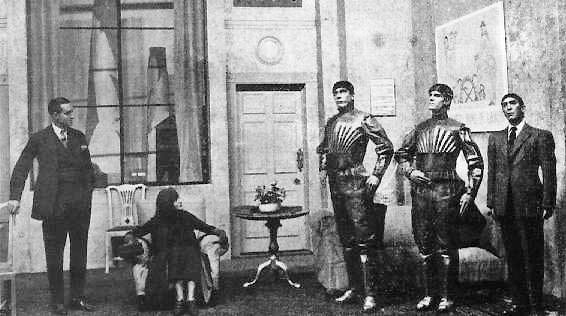
Just over a century ago, the word “robot,” derived from the Czech word “robota” which means “forced labor,” was introduced to the English language in the play R. U. R. by Karel Čapek. In it, a scientist has created artificial humans, called “roboti” or “robots.” Robots replace workers in factories, then become the basis of the economy. Eventually, the robots revolt, supplant humanity and ultimately cause humankind’s extinction.
In an interesting coincidence, R. U. R. debuted on 2 January 1921, The Great and Glorious Az’s first birthday! Who would have suspected that Ol’ Isaac and the word “robot” would be astrologically equivalent?
In this episode, we start discussing Asimov’s The Caves of Steel where the theme of robots replacing humans looms large. There’s already a palpable sense of economic anxiety within the New York Police Department as lower-level employees have already been replaced. Now Detective Elijah Baley is assigned a robot partner named R. Daneel Olivaw who is all but indistinguishable from a human being. It’s essential that Baley not only solve a murder but solve it in a way that doesn’t lead to many more humans being supplanted by robots.
“Softly Beaming, A Steady Light of Hope… the Stars End Podcast.”
Are you troubled by premonitions of unsavory equations or non-standard beverages?
Do you experience feelings of dread from your grandfather’s office furniture?
Have you or anyone in your family experienced prestidigitation, clairvoyance, astral projection, or sphenopalatine ganglioneuralgia?
If the answer is yes, don’t wait another minute! The Second Foundation is for YOU!
Our courteous and efficient staff is on call 24 hours a day to serve all your psychohistorical prediction needs!
In this episode, we come to the end of Forward the Foundation with the story of Wanda Seldon where we finally see the inception of the Second Foundation as Hari discovers Wanda’s abilities and Wanda first becomes an important part of the Seldon Project before striking off with Stettin Palver to form the nucleus of the Second Foundation. Meanwhile, we hit the bittersweet part of any biography. Hari’s life winds down as he says goodbye to everyone he’s ever loved and is left only with psychohistory before we finally say goodbye to Hari himself.
And, in case you don’t recognize the reference above…
“No one outside the podcast has the faintest knowledge of how psychohistory works and not everyone inside does either.”
If you’re read our one piece of fan fiction, “Dors,” by our very own Jon Blumenfeld, you’ve read an origin story of sorts for Dors Venábili. If you like this character like so many others you should check it out; it’s excellent.
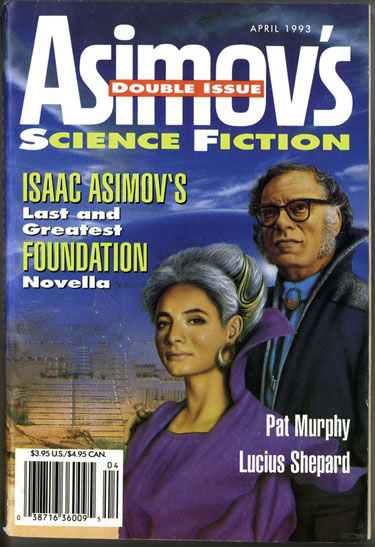
In this episode, we finally get to the chapter of Forward the Foundation featuring… well no, they all feature Hari but this one’s named after Dors. It was called “The Consort” when it ran in Asimov’s Science Fiction in April of 1993 and to be honest, Dors plays a larger role in this story than the so-called “featured” characters in the other eponymous chapters. If you hadn’t noticed the book has a bit of a pattern. In each section, Hari says farewell to his friends and loved ones as his life winds down in ten-year increments. In this story, Hari and we get to say goodbye to Dors, nicely bookending with Jon’s story.
Our guest this week is one of Joseph’s oldest friends, Rick Tetrault. Rick is the host of the Starbase 66 Podcast from the Infinite Potato Alliance and also qualifies as an “old friend” of Stars End. Rick gave us a great deal of sage advice when we were just figuring out how to do a podcast. You might recall that Starbase 66 was the site of our first collective guest appearance back in December. You’re more than invited to check that out here: Starbase 66: Foundationally Speaking.
But first, without further ado: Episode 11!
Featured Image: Interior artwork from Asimov’s Science Fiction Magazine, April 1993.
“We Must Keep the Podcast Stable If For No Other Reason Than That We’re Here”
Well, here we are again with another installment on Asimov’s swansong, Forward the Foundation.
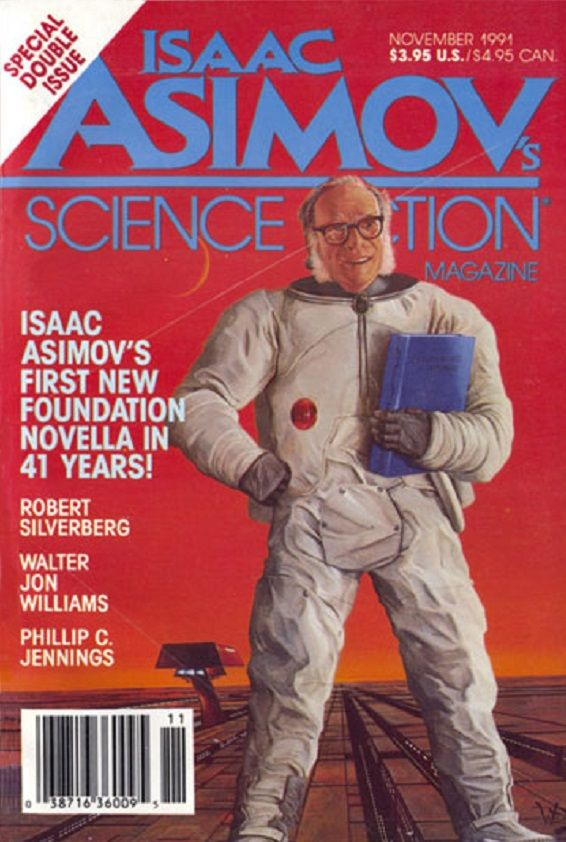
You might recall that Forward was written as a series of Novellas the first three of which appeared in Asimov’s Science Fiction Magazine. The installment we’re discussing this time is “Cleon I” which originally appeared in the magazine’s 15th-anniversary issue in April 1992 as “Cleon the Emperor.” Much like the previous story, it isn’t very much about the titular character but it’s a lot about Hari Seldon. This one is set during his tenure as Cleon’s First Minister.
But the cover, by Gary Friedman, is pretty great; it’s Asimov himself alongside a woman who is almost certainly Dors Venabali. I can’t say it’s Dors for sure, but I can state with absolute certainty that character is neither from Mycogen nor Dahl.
Inside the issue, there’s an extensive editorial about the Foundation series and its history and it answers, in part, one of the questions we posed on the podcast. We’d wondered why Asimov decided to write Forward as a series of novellas and evidently, the genesis of the idea came from Jennifer Brehl, who Asimov calls “my brilliant and lovely editor.” He continues.
Jennifer thought it might be a good idea if I wrote a Foundation book in which the characters were new from one section to another.
I thought the matter through and decided that I would write a Foundation book (called Forward the Foundation) in which Hari Seldon gradually grew older. I would tell it in five installments and in each installment, Hari was ten years older.
It turns bittersweet as we get some bits of the story we’ve heard before.
I began work on it but then toward the end of 1989 disaster struck. I came down with congestive heart failure produced by mitral valve insufficiency. I was very sick and I was hospitalized for months. Actually, I was convinced I was going to die — but I didn’t.
And a bit later…
But there’s a catch (there’s always a catch). I’m tired. I’m just plain tired. I sleep a great deal and I drag around even when I’m not asleep…
And the worst trouble is that I can’t write very much. This is especially true of the new Foundation book. I wrote the first installment (in fact, it was published last November in this magazine) and the second and third parts are finished as well. The fourth part is almost finished but it’s been weeks and weeks since I’ve been able to work on it. Nor do I know when I’ll be able to get to it. Every time I try, I find I am too tired to work at it.
Whether I will improve with time, I can’t say. Certainly, there seems no sign of it at the moment.
Believe me, I am sorry about this; more so than you can possibly be.
Coincidently, although the issue would have been printed weeks before, April 1992 is the very month that Asimov journeyed beyond this mortal coil.
“I Suspect You Will Find That No Podcast Is Ever Truly Crucial”
Have you been with us for a while? If you have you might remember some jokes back in the long, long ago about the longevity of our podcast. We were pretty stoked (is that what the kids say nowadays?) back in Season 1 Episode 8 when we surpassed the Manimal Threshold for example.
Well, on 26 April 2021 our first episode was squirted out into the aether so we have another milestone to celebrate; we’ve officially been a podcast for over a year.
Thirty-two episodes in and we’re starting to talk about our fifth book, Forward the Foundation by the Great and Glorious Az.
It’s a departure in that it started life as a series of novellas like the original trilogy; three of those appeared in Asimov’s Science Fiction Magazine starting in November 1991. The book and the stories within are somewhat bittersweet; we touch on that a bit in the podcast and we’ll get back to that here as soon as we’re able.
And we have a special guest in this episode, who you may know as @stratotron from that bluebird site! They are a perfect person to join us in a discussion of a chapter entitled “Eto Demerzel.” Join us and welcome the delightful Daneel Adrian Cayce to the conversation, Asimov Enthusiast, Trekkie, Twitterer, chiptune creator, and namesake of the quintessential character in the entire Asimov canon! It’s going to be good!
And thanks to everyone who’s stuck with us for an entire trip around the sun! Never fear, there’s no getting rid of us now!























 Stars End: A Foundation Podcast